

Sleep disturbance and C-reactive protein are linked, but the strongest human evidence runs from disturbed sleep toward higher inflammatory markers. In controlled studies, sleeping 6 hours instead of 8 hours for one week elevated IL-6 in both sexes and TNF-alpha in men; CRP findings are smaller and less consistent. Women often show stronger hs-CRP associations with short sleep or poor sleep quality than men’s, although patterns vary by cohort. CBT-I – cognitive behavioral therapy for insomnia – has randomized-trial evidence for reducing CRP levels in older adults with insomnia.
If your bloodwork came back showing elevated CRP and your doctor cannot fully explain it, your sleep may be a factor the lab requisition did not account for. CRP is a widely used inflammatory biomarker, and research now shows it is associated with disturbed sleep in population studies and can shift after severe sleep loss in some controlled studies.
This article covers how poor sleep can raise inflammatory markers, how inflammation may interact with sleep in return, the sex differences in the CRP-sleep relationship, and what lowers sleep-related inflammatory risk. It does not cover acute-phase CRP elevations from infection or injury. For the broader framework, see: Inflammatory Sleep Disruption.
How Quickly Does Poor Sleep Raise CRP?
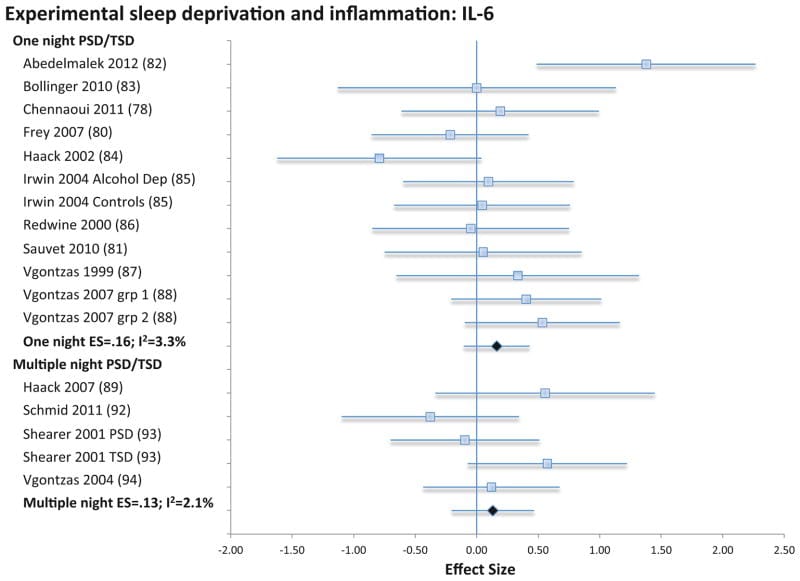
Severe sleep loss can raise inflammatory markers, but CRP responds less consistently than IL-6. Sleeping 6 hours instead of 8 hours for 7 nights elevated IL-6 in both men and women, while TNF-alpha increased in men. Extended total sleep deprivation and about 10 days of marked sleep restriction have raised hs-CRP in small laboratory studies.
The timing is relevant, but the CRP threshold is not fully settled. A 2016 meta-analysis of more than 70 studies found that sleep disturbance was associated with elevated CRP and IL-6. However, the same meta-analysis did not find a reliable pooled association between experimental sleep deprivation or sleep restriction and CRP, IL-6, or TNF-alpha.
The dose that mirrors everyday life: sleeping 6 hours instead of 8 hours across 7 nights raised IL-6 in both sexes and TNF-alpha in men. A separate partial-sleep-restriction study using 4 hours per night for 10 days found IL-6 elevation, while CRP showed a nonsignificant between-group trend. Another small laboratory study using 4.2 hours per night for 10 days reported hs-CRP elevation.
Caption: Forest plot of questionnaire-assessed sleep disturbance associated with CRP elevation. Studies assessing sleep disturbance by questionnaire show a positive association with CRP (effect size 0.20, 95% CI 0.07-0.33). Irwin, M. R., Olmstead, R., & Carroll, J. E. (2016). Biological Psychiatry, 80(1), 40-52.
Observational insomnia evidence points in the same direction, but the strength varies by study.
The same meta-analysis found that sleep disturbance was associated with elevated CRP, with an overall CRP effect size of 0.12 and an IL-6 effect size of 0.20. In young adults, insomnia symptoms were independently associated with elevated CRP after controlling for depression, anxiety, and neuroticism, although this was a small observational sample. In contrast, the large Norwegian HUNT study found only attenuated or inconsistent associations between insomnia symptoms and hs-CRP after multivariable adjustment.
Can Inflammation and Poor Sleep Reinforce Each Other?
Possibly, but the longitudinal evidence is stronger in the sleep-to-inflammation direction. In the CARDIA study, sleep disturbance predicted higher CRP and IL-6 at 5-year follow-up. Whether baseline CRP independently predicts worse future sleep is less clearly established.
In the CARDIA study, sleep disturbance was a significant predictor of CRP and IL-6 five years later, and the association held after controlling for baseline CRP levels. That finding supports sleep disturbance as a longitudinal predictor of inflammation. It does not, by itself, prove a bidirectional CRP-sleep loop. In people with inflammatory bowel disease, sleep disturbances were documented even when disease was inactive.
If your CRP is elevated and your sleep is poor, the two may share overlapping drivers, including adiposity, infection, autoimmune activity, sleep apnea, circadian disruption, stress physiology, or chronic insomnia.
Sleep remains a plausible contributor, but CRP is not specific enough to identify sleep as the cause by itself.
Are CRP Responses to Sleep Loss Different for Men and Women?
Women’s hs-CRP is often more sensitive to short sleep or poor sleep quality than men’s, but the pattern depends on age, cohort, and the way sleep is measured. In the Whitehall II study, women sleeping 5 hours or fewer had elevated hs-CRP after full adjustment; men did not. In young adults, the pattern differed by sleep-duration trajectory: persistent short sleep was associated with elevated hs-CRP in males, while persistent long sleep was associated with elevated hs-CRP in females.
The Whitehall II Study found that women sleeping 5 hours or fewer per night had elevated hs-CRP after controlling for BMI, physical activity, alcohol, smoking, and other covariates. Men sleeping 5 hours or fewer showed no hs-CRP association.
Whitehall II did not show significant sleep-duration variation in inflammatory markers among men.
In young adults from the Add Health cohort, persistent short sleep duration was associated with elevated hs-CRP in males, while persistent long sleep duration was associated with elevated hs-CRP in females. In a Korean population study, women showed hs-CRP associations with difficulty initiating sleep, poor sleep quality, and some maintaining-sleep categories. Men showed no significant sleep-quality association with hs-CRP; the main male association was excessive sleep duration of 10 hours or more.
These are population-level associations, and individual variation exists. A precise reading is that sex modifies the CRP-sleep association, and the direction depends on sleep duration, sleep quality, age, and population.
Does Improving Sleep Lower CRP?
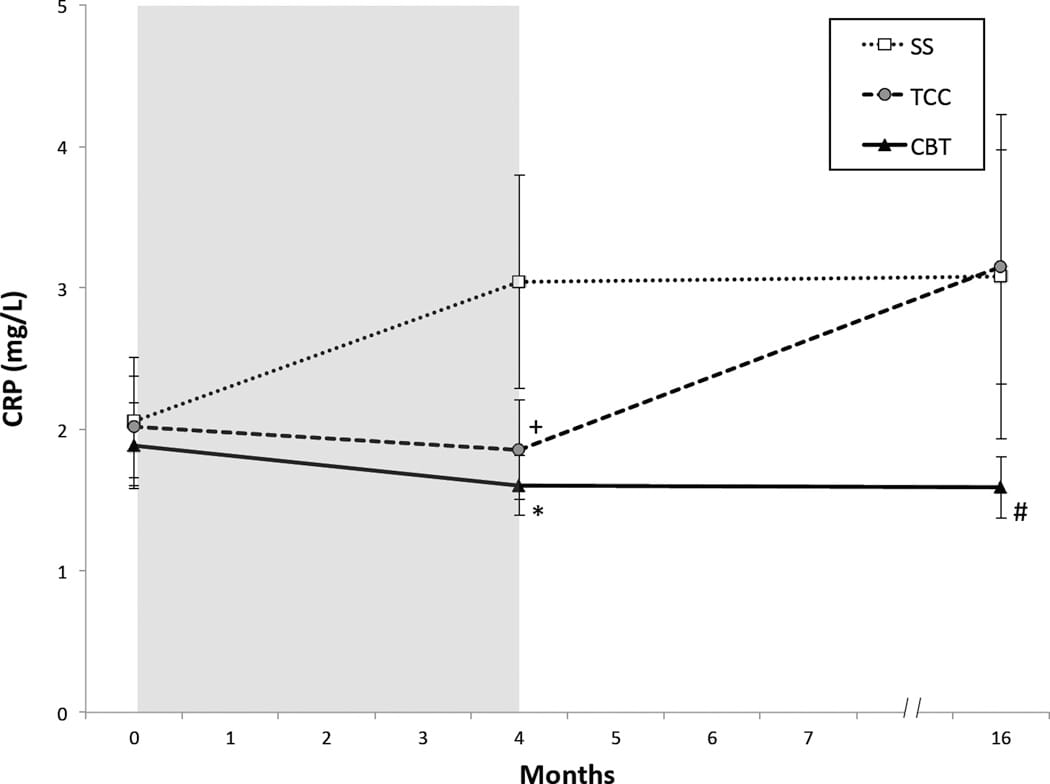
CBT-I has direct randomized-trial evidence for reducing CRP-related inflammatory risk. In a randomized controlled trial, CBT-I reduced CRP levels at months 4 and 16 compared with sleep education. Weekend catch-up sleep of 1-3 hours is associated with lower odds of being in the highest hs-CRP quartile, but the benefit appears strongest in people with consistent weekday-weekend bedtimes.
The data come from a randomized controlled trial of CBT-I in older adults with insomnia. Compared with a sleep education control, CBT-I reduced CRP levels at months 4 and 16. The 3.0 mg/L threshold is commonly used as the high-risk hs-CRP category.
Caption: Circulating CRP levels from baseline to month 16, by group. The CBT-I group shows CRP reduction while the sleep education control group shows progressive CRP elevation. Irwin, M. R. et al. (2015). Biological Psychiatry, 78(10), 721-729.
A systematic review of randomized controlled trials found that CBT-I was associated with improved CRP and glucose regulation across RCTs. However, many included trials had high risk of bias, so the direction of evidence is encouraging rather than definitive.
Weekend catch-up sleep tells a more conditional story. A cross-sectional study of >17,000 adults found moderate catch-up sleep, defined as 1 to less than 3 extra hours on weekends, was associated with 13% lower odds of being in the highest hs-CRP quartile. This pattern was strongest in people with consistent weekday-weekend bedtimes. Severe catch-up sleep, defined as 3 or more additional hours, did not show the same benefit. Because the study was cross-sectional, it cannot prove that catch-up sleep lowered CRP. It does suggest that sleep regularity may matter as much as total weekend recovery sleep.
Elevated CRP from poor sleep is one inflammatory factor, but it may compound with sleep apnea, circadian disruption, infection, autoimmune activity, metabolic disease, adiposity, or other inflammatory drivers. Identifying which causes are active helps prioritize where to start.
Find out which causes might be driving your 3am wakeups ->
Frequently Asked Questions
What Is the Difference Between CRP and hs-CRP?
Standard CRP and high-sensitivity CRP measure the same protein but with different assay precision. Standard CRP is generally used for larger inflammatory elevations, while hs-CRP is optimized for lower-grade inflammation and commonly measures concentrations in the low-grade range discussed in cardiovascular-risk research. Sleep-related CRP changes, when present, are usually small and are better captured with hs-CRP or similarly sensitive assays. Many sleep studies that examine low-grade inflammation use hs-CRP or CRP methods with adequate low-range sensitivity.
A common hs-CRP cardiovascular-risk framework classifies below 1.0 mg/L as low risk, 1.0-3.0 mg/L as average or moderate risk, and above 3.0 mg/L as high risk.
Is CRP Elevated With Sleep Apnea?
Yes. A meta-analysis found that people with obstructive sleep apnea have higher CRP or hs-CRP than controls. The mechanism is plausibly related to intermittent hypoxia: repeated oxygen drops during apneas can increase oxidative stress and inflammatory signaling.
Intermittent hypoxia and short sleep duration may act as independent inflammatory stressors. In adults with coronary artery disease, nocturnal intermittent hypoxia and short sleep duration were independently associated with elevated CRP.
What Does Elevated CRP Feel Like?
CRP itself does not produce a distinct felt state. Low-grade elevation in the 1.0-3.0 mg/L range is nonspecific and may reflect sleep disruption, adiposity, infection, autoimmune activity, periodontal disease, medication effects, or other inflammatory drivers. Fatigue or brain fog may come from poor sleep or the underlying condition, not from CRP itself.
This range is still health-relevant because it carries higher long-term cardiovascular risk in population studies. More on the fatigue-insomnia paradox: Inflammation: Exhausted But Can’t Sleep.
What CRP Level Should You Be Concerned About?
A common hs-CRP cardiovascular-risk framework classifies below 1.0 mg/L as low risk, 1.0-3.0 mg/L as average or moderate risk, and above 3.0 mg/L as high risk. Values above 10 mg/L sit outside the low-grade range discussed in sleep studies and are interpreted with other health information.
In context, sleep-related CRP shifts can occur within the low-grade range, so the absolute value matters less than persistence, health context, and other inflammatory causes. CBT-I data suggest that improving insomnia can reduce CRP levels.
If your hs-CRP is persistently above 1.0 mg/L and you have poor sleep, sleep quality is a plausible contributing factor. It should be considered alongside body composition, infection, autoimmune disease, sleep apnea, smoking, medications, oral health, and other causes.
Related Reading
- Inflammatory Sleep Disruption — the cause overview for cytokines, histamine, gut inflammation, neuroinflammation, and circadian immune timing
- Inflammaging and Sleep — how age-related inflammatory activity changes sleep architecture
- Why Do Men Sleep Worse After 50? — how aging, inflammation, and hormonal change can converge in men
- What Is Autoimmune Insomnia? — how autoimmune cytokine activity can disrupt sleep independently of pain
- Why Does Inflammation Make You Exhausted But Unable to Sleep? — how cytokine signaling can create fatigue without stable sleep
- Does an Anti-Inflammatory Diet Improve Sleep? — how dietary inflammatory load connects gut, immune, and sleep pathways
- NLRP3 Inflammasome and Sleep — how inflammasome signaling intersects with sleep regulation
- Prostaglandins and Sleep — how inflammatory lipid mediators can affect sleep pressure and continuity
References
1. Bakour, C., Schwartz, S., O’Rourke, K., Wang, W., Sappenfield, W., Couluris, M., & Chen, H. (2017). Sleep duration trajectories and systemic inflammation in young adults: Results from the National Longitudinal Study of Adolescent to Adult Health (Add Health). Sleep, 40(11), zsx156. https://pubmed.ncbi.nlm.nih.gov/29155987/
2. Bray, C., Bell, L. N., Liang, H., Haykal, R., Kaiksow, F., Mazza, J. J., & Yale, S. H. (2016). Erythrocyte sedimentation rate and C-reactive protein measurements and their relevance in clinical medicine. WMJ: Official Publication of the State Medical Society of Wisconsin, 115(6), 317-321. https://pubmed.ncbi.nlm.nih.gov/29094869/
3. Cho, H. J., Seeman, T. E., Kiefe, C. I., Lauderdale, D. S., & Irwin, M. R. (2015). Sleep disturbance and longitudinal risk of inflammation: Moderating influences of social integration and social isolation in the Coronary Artery Risk Development in Young Adults (CARDIA) study. Brain, Behavior, and Immunity, 46, 319-326. https://pubmed.ncbi.nlm.nih.gov/25733101/
4. Fukuoka, R., Kohno, T., Kohsaka, S., Yanagisawa, R., Kawakami, T., Hayashida, K., Kanazawa, H., Yuasa, S., Maekawa, Y., Sano, M., & Fukuda, K. (2017). Nocturnal intermittent hypoxia and short sleep duration are independently associated with elevated C-reactive protein levels in patients with coronary artery disease. Sleep Medicine, 29, 29-34. https://pubmed.ncbi.nlm.nih.gov/28153212/
5. Haack, M., Sanchez, E., & Mullington, J. M. (2007). Elevated inflammatory markers in response to prolonged sleep restriction are associated with increased pain experience in healthy volunteers. Sleep, 30(9), 1145-1152. https://pubmed.ncbi.nlm.nih.gov/17910386/
6. Irwin, M. R., Olmstead, R., Breen, E. C., Witarama, T., Carrillo, C., Sadeghi, N., Arevalo, J. M. G., Ma, J., Nicassio, P., Bootzin, R., & Cole, S. W. (2015). Cognitive behavioral therapy and tai chi reverse cellular and genomic markers of inflammation in late-life insomnia: A randomized controlled trial. Biological Psychiatry, 78(10), 721-729. https://pubmed.ncbi.nlm.nih.gov/25748580/
7. Irwin, M. R., Olmstead, R., & Carroll, J. E. (2016). Sleep disturbance, sleep duration, and inflammation: A systematic review and meta-analysis of cohort studies and experimental sleep deprivation. Biological Psychiatry, 80(1), 40-52. https://pubmed.ncbi.nlm.nih.gov/26140821/
8. Lee, H.-W., Yoon, H.-S., Yang, J. J., Song, M., Lee, J.-K., Lee, S.-A., Choi, J.-Y., & Kang, D. (2020). Association of sleep duration and quality with elevated hs-CRP among healthy Korean adults. PloS One, 15(8), e0238053. https://pubmed.ncbi.nlm.nih.gov/32841297/
9. Lee, Y. J., Lee, J. H., Shin, Y. H., Kim, J. K., Lee, H. R., & Lee, D. C. (2009). Gender difference and determinants of C-reactive protein level in Korean adults. Clinical Chemistry and Laboratory Medicine, 47(7), 863-869. https://pubmed.ncbi.nlm.nih.gov/19575548/
10. Li, K., Wei, P., Qin, Y., & Wei, Y. (2017). Is C-reactive protein a marker of obstructive sleep apnea?: A meta-analysis. Medicine, 96(19), e6850. https://pubmed.ncbi.nlm.nih.gov/28489776/
11. Laugsand, L. E., Vatten, L. J., Bjorngaard, J. H., Hveem, K., & Janszky, I. (2012). Insomnia and high-sensitivity C-reactive protein: The HUNT study, Norway. Psychosomatic Medicine, 74(5), 543-553. https://pubmed.ncbi.nlm.nih.gov/22685243/
12. Meier-Ewert, H. K., Ridker, P. M., Rifai, N., Regan, M. M., Price, N. J., Dinges, D. F., & Mullington, J. M. (2004). Effect of sleep loss on C-reactive protein, an inflammatory marker of cardiovascular risk. Journal of the American College of Cardiology, 43(4), 678-683. https://pubmed.ncbi.nlm.nih.gov/14975482/
13. Miller, M. A., Kandala, N. B., Kivimaki, M., Kumari, M., Brunner, E. J., Lowe, G. D., Marmot, M. G., & Cappuccio, F. P. (2009). Gender differences in cross-sectional relationships between sleep duration and markers of inflammation: Whitehall II study. Sleep, 32(7), 857-864. https://pubmed.ncbi.nlm.nih.gov/19639748/
14. Park, S., Kang, D. Y., Ahn, H., Kim, N., Yoon, J.-H., & Yang, B. R. (2022). Effect of weekend catch-up sleep on high-sensitivity C-reactive protein levels according to bedtime inconsistency: A population-based cross-sectional study. Scientific Reports, 12(1), 21619. https://pubmed.ncbi.nlm.nih.gov/36517526/
15. Ranjbaran, Z., Keefer, L., Farhadi, A., Stepanski, E., Sedghi, S., & Keshavarzian, A. (2007). Impact of sleep disturbances in inflammatory bowel disease. Journal of Gastroenterology and Hepatology, 22(11), 1748-1753. https://pubmed.ncbi.nlm.nih.gov/17914945/
16. Savin, K. L., Clark, T. L., Perez-Ramirez, P., Allen, T. S., Tristao Parra, M., & Gallo, L. C. (2023). The effect of cognitive behavioral therapy for insomnia (CBT-I) on cardiometabolic health biomarkers: A systematic review of randomized controlled trials. Behavioral Sleep Medicine, 21(6), 671-694. https://pubmed.ncbi.nlm.nih.gov/36476211/
17. Slavish, D. C., Graham-Engeland, J. E., Engeland, C. G., Taylor, D. J., & Buxton, O. M. (2018). Insomnia symptoms are associated with elevated C-reactive protein in young adults. Psychology & Health, 33(11), 1396-1415. https://pubmed.ncbi.nlm.nih.gov/30358412/
18. Vgontzas, A. N., Zoumakis, E., Bixler, E. O., Lin, H. M., Follett, H., Kales, A., & Chrousos, G. P. (2004). Adverse effects of modest sleep restriction on sleepiness, performance, and inflammatory cytokines. The Journal of Clinical Endocrinology and Metabolism, 89(5), 2119-2126. https://pubmed.ncbi.nlm.nih.gov/15126529/
Written by Kat Fu, M.S., M.S. ? Last reviewed: March 2, 2026 ? 18 references cited