

The common understanding of stress-related insomnia is that excess cortisol keeps the brain wired. The mechanism is less intuitive. Chronic stress changes how immune cells respond to cortisol at the receptor level, allowing inflammatory cytokine production to be less effectively restrained. That inflammatory output then is associated with measurable sleep disruption. And the fragmented sleep feeds right back into the same inflammatory pathway.
This article traces the full cycle – stress to inflammation, inflammation to sleep disruption, sleep disruption back to inflammation – with the human evidence behind each link. It does not cover the metabolic cortisol-blood-sugar pathway to 3am waking. For the broader overview of inflammatory sleep disruption, see the parent article: Inflammatory Sleep Disruption.
How Does Chronic Stress Cause Inflammation?
The mechanistic foundation comes from Cohen et al. (2012), who ran two linked studies. In the first (n=276), participants with long-duration stressful life events showed higher susceptibility to developing a confirmed cold after rhinovirus exposure. In the second (n=79), the mechanism was identified: peripheral blood mononuclear cells from chronically stressed participants showed blunted dexamethasone suppression of LPS-stimulated cytokine production (p<0.05). Dexamethasone is a synthetic glucocorticoid - a proxy for cortisol - so blunted suppression means the immune cells were less responsive to cortisol's anti-inflammatory instruction. Among infected subjects, greater glucocorticoid receptor resistance predicted higher local production of IL-1beta, TNF-alpha, and IL-6. The causal chain: prolonged stressors can produce glucocorticoid receptor resistance, which can amplify inflammatory output.
Miller, Cohen, and Ritchey (2002) documented this in caregivers. Parents caring for children with cancer showed flatter diurnal cortisol slopes – primarily reduced morning cortisol output – and diminished dexamethasone suppression of IL-6 production. A later genomic study from Miller et al. (2008) found similar cortisol secretion patterns between stressed caregivers and controls, supporting the point that stress-related inflammation is not simply a “too much cortisol” problem. Glucocorticoid receptor resistance is a receptor-level phenomenon: the cortisol is present, but the cells respond less strongly to it.
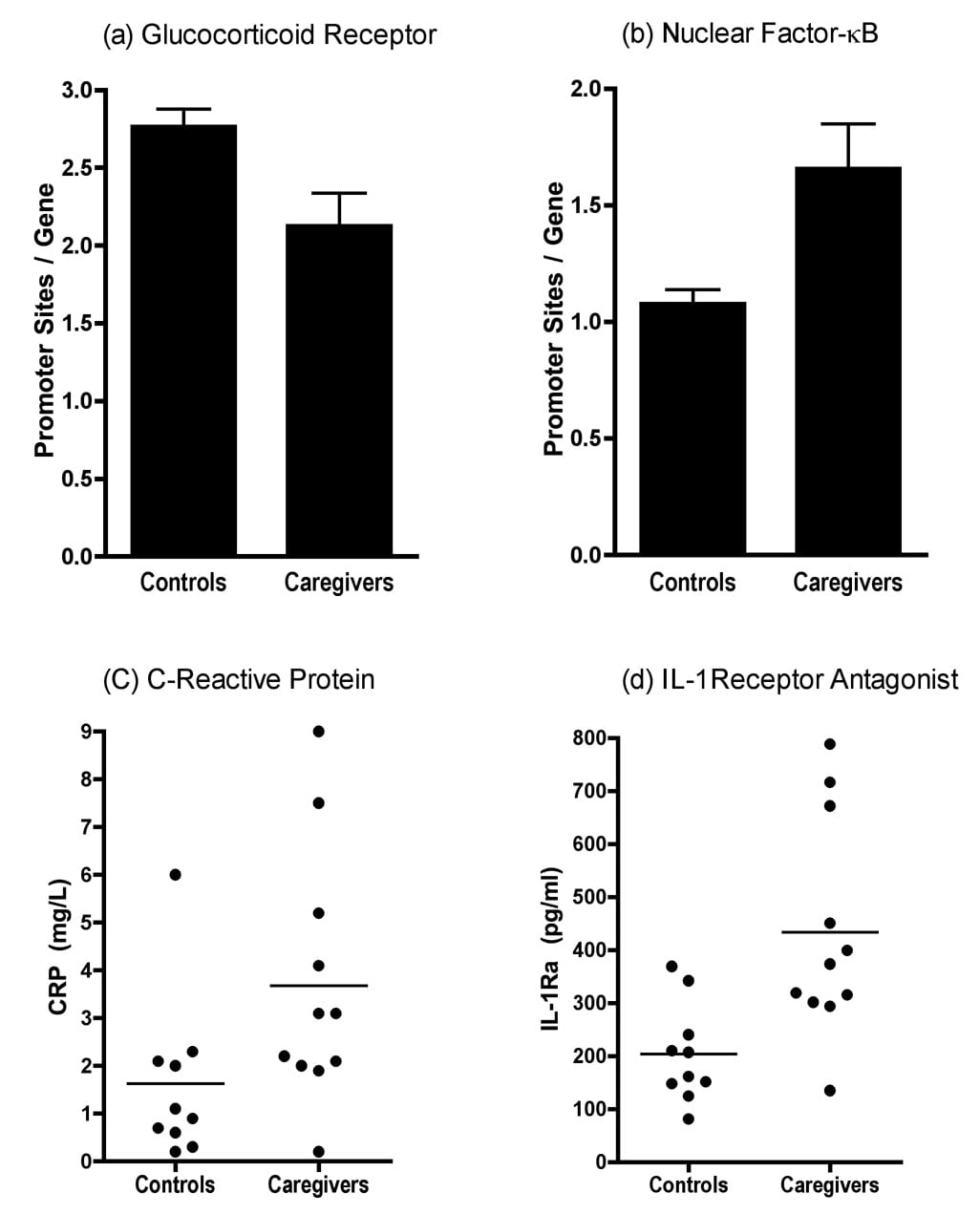
Miller et al. (2008) provided the genomic evidence. Monocytes from chronically stressed caregivers of brain-cancer patients showed reduced transcription of genes bearing glucocorticoid response elements (where cortisol exerts its anti-inflammatory effects) and increased transcription of NF-kappaB-responsive inflammatory pathways. Serum CRP and IL-1 receptor antagonist were elevated, consistent with the interpretation that the genomic change translated to measurable circulating inflammation. Despite similar plasma cortisol between groups, the stressed group’s immune cells showed reduced glucocorticoid-responsive transcription.
Figure: Genomic fingerprint of chronic stress. In TELiS bioinformatics analysis of response element prevalence in promoters of differentially expressed genes, (a) GR response elements are under-represented in genes up-regulated in stressed caregivers, whereas (b) transcripts bearing response elements for NF-kappaB are over-represented. In serum, caregivers display significantly higher concentrations of the inflammatory biomarkers (c) C-reactive protein and (d) interleukin-1 receptor antagonist. Miller, G. E., et al. (2008). A functional genomic fingerprint of chronic stress in humans: blunted glucocorticoid and increased NF-kappaB signaling. Biological Psychiatry, 64(4), 266-272.
The logical chain: stress does not equal “too much cortisol.” Chronic stress can blunt cortisol’s ability to suppress inflammation at the receptor level. The immune response becomes less effectively restrained by its primary anti-inflammatory regulator.
How Does Stress-Induced Inflammation Disrupt Sleep?
Vgontzas et al. (2002) conducted the defining cytokine-timing study. Comparing 11 chronic insomnia participants with 11 age- and BMI-matched controls, cosinor analysis showed the IL-6 secretion peak moved from 4am (controls) to 7pm (insomnia group), p<0.05. This is a marked cytokine timing shift. TNF-alpha rhythm was blunted nocturnally and fragmented into a 4-hour daytime pulse pattern. Both cytokine timing shifts were proposed to help explain daytime fatigue. In a related study, Vgontzas et al. (2001) found higher 24-hour ACTH and cortisol secretion in chronic insomnia, with the greatest elevations in the evening and first half of the night.
This cytokine timing shift offers one plausible route into inflammatory-neuroendocrine hyperarousal: inflammatory cytokines can activate HPA-axis signaling, and chronic insomnia studies show both cytokine timing changes and higher 24-hour ACTH/cortisol output. The evidence supports a linked pattern, not a single proven sequence in every person.
Passos et al. (2023) confirmed the cortisol-insomnia link in a PSG-verified (polysomnography – overnight sleep recording) chronic insomnia population (n=34). Insomnia Severity Index scores correlated with morning serum cortisol (r=0.37, p=0.03) and with anxiety and depression scores. N3 sleep – slow-wave deep sleep, the restorative stage – negatively correlated with tension-anxiety (r=-0.36, p=0.04). This pattern is consistent with a hyperarousal model in which deep sleep can erode while lighter stages are preserved. Sleep quantity may look adequate on a report. Sleep quality – the proportion of restorative deep sleep – erodes.
The distinction between this pathway and other inflammatory insomnia mechanisms matters. The cytokine timing shift described here is connected upstream to glucocorticoid receptor resistance from chronic psychological stress. Other inflammatory insomnia mechanisms – such as gut permeability-driven LPS translocation or histamine-mediated arousal – involve different upstream triggers producing inflammation through separate pathways. For an overview of how NF-kappaB and the circadian clock interact during the pre-dawn hours, see Why Inflammation Worsens at Night.
Why Does Poor Sleep Make Stress-Related Inflammation Worse?
Piber et al. (2023) dissociated sleep continuity from sleep duration as independent drivers of inflammatory activation. In a cohort of 262 older adults with diary sleep data available for n=82 and inflammatory signaling data available for n=132, greater wake time after sleep onset (WASO – the total minutes spent awake between initial sleep onset and final awakening) predicted higher NF-kappaB activation in peripheral blood monocytic cells (beta=0.42, p<0.01) after full covariate adjustment. Total sleep time showed no association with NF-kappaB or STAT protein activation. It is the continuity of sleep, not its duration, that was associated with inflammatory transcription factor activation.
Among female participants, elevated WASO also predicted higher STAT1, STAT3, and STAT5 activation (p<0.05 for STAT1 and STAT3; p<0.01 for STAT5) - transcription factors that amplify cytokine production cascades, feeding back into IL-6 and IL-1beta output. No comparable associations were found in male participants. This study identifies sleep maintenance disturbance as a sleep dimension associated with inflammatory signaling, separate from total sleep time, in older adults.
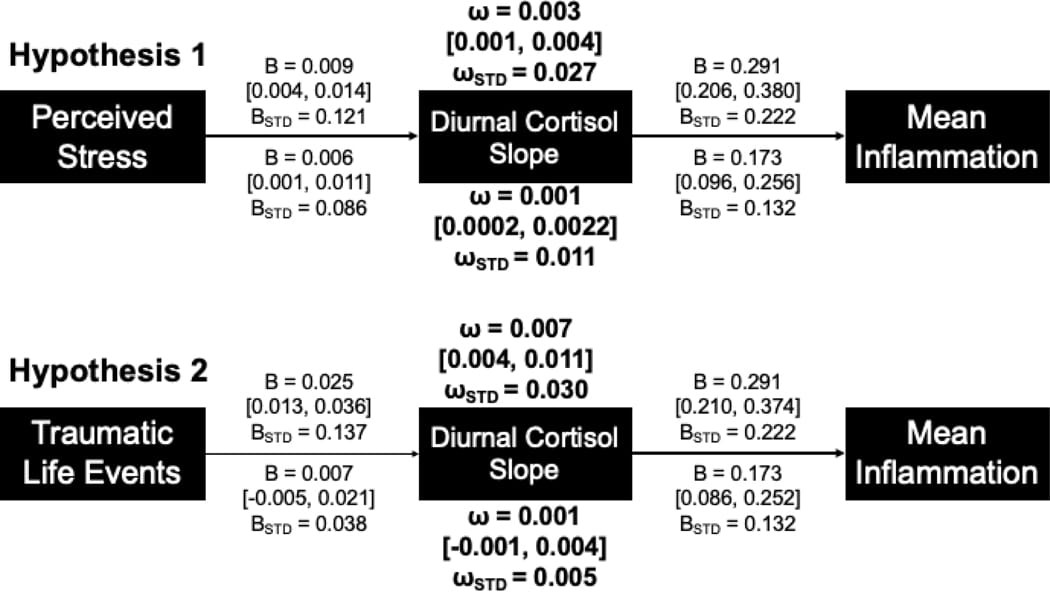
Knight et al. (2021) provided the population-scale evidence. Using structural equation modeling in 914 adults from the national MIDUS 2 cohort, they confirmed a statistically significant indirect pathway: perceived psychological stress was associated with flatter diurnal cortisol slope, and flatter slope was associated with higher IL-6, CRP, fibrinogen, E-Selectin, and ICAM-1. The pathway replicated across all five inflammatory markers. Cortisol was measured via ambulatory salivary sampling across multiple days – not a single-point laboratory draw – providing ecologically valid evidence for diurnal cortisol flattening under chronic stress.
Figure: Perceived stress, diurnal cortisol slope, and inflammation model. Representation of the primary models for hypotheses H1 and H2 with unstandardized and standardized coefficients (B, BSTD), indices of indirect pathways (omega, omegaSTD), and 95% confidence intervals. Values listed above each model are results from the analyses without covariates; values below each model are from the analyses with covariates. Secondary models were constructed similarly, but with mean inflammation replaced by separate paths for each inflammation biomarker. Knight, E. L., et al. (2021). Perceived stress is linked to heightened biomarkers of inflammation via diurnal cortisol in a national sample of adults. Brain, Behavior, and Immunity, 93, 206-213.
The self-reinforcing cycle in plain terms: stress can blunt cortisol’s anti-inflammatory regulation (glucocorticoid receptor resistance), escaped inflammation is associated with sleep disruption (cytokine timing shift), and fragmented sleep is associated with NF-kappaB activation. Each pass through the cycle may make the next pass more likely by reinforcing inflammatory and stress-system signaling. For a broader overview of how NF-kappaB activation from poor sleep amplifies inflammation, see The Bidirectional Inflammation-Insomnia Cycle.
Can Breaking the Stress-Inflammation Cycle Improve Sleep?
Breaking at the stress link. The Knight et al. (2021) structural equation model identified the flattened diurnal cortisol slope – blunted morning rise, maintained evening levels – as the cortisol pattern that mediates the connection between perceived stress and elevated inflammatory markers. Approaches that restore cortisol rhythm contrast (high morning, low evening) would be expected to target this mechanism. The measurable target is the diurnal cortisol slope itself, not overall cortisol reduction. This matters because total daily cortisol output may be normal even when the slope is flattened – as Miller et al. (2008) documented in chronically stressed caregivers.
Breaking at the inflammation link. The genomic fingerprint from Miller et al. (2008) identified NF-kappaB gene upregulation as the transcriptional driver of stress-related inflammation. Approaches that reduce NF-kappaB activity address the molecular mechanism. The Piber et al. (2023) finding that sleep fragmentation (not duration) is associated with NF-kappaB activation means that sleep continuity improvements are mechanistically precise – they target the inflammatory pathway rather than reducing inflammation through an indirect route.
Breaking at the sleep link. Sleep continuity improvement is a plausible target for reducing NF-kappaB activation (Piber et al., 2023). This means sleeping without frequent awakenings – not merely sleeping longer. The Vgontzas et al. (2002) cytokine timing data suggests that restoring consolidated nocturnal sleep may allow IL-6 to return to its normal nighttime pattern, removing the daytime fatigue driver while restoring the nighttime consolidation contribution.
Each entry point feeds back into the others. Restored cortisol rhythm may reduce inflammatory output, which may improve sleep continuity, which may further reduce NF-kappaB activation. The same self-reinforcing property that makes this cycle difficult to escape also means that interrupting one link may create benefits for the other two.
The question for someone caught in this cycle is which link offers the best starting point – the stress exposure, the inflammatory load, or the sleep fragmentation – and that depends on individual circumstances the article cannot determine.
Stress-driven inflammation is one path to sleep disruption, but it can compound with hormonal changes, metabolic patterns, circadian misalignment, or autonomic dysregulation. Identifying which causes are active helps direct the response.
Find out which causes might be driving your 3am wakeups ->
Frequently Asked Questions
Does Inflammation Elevate Cortisol?
This is the paradox Cohen et al. (2012) documented: stressed subjects had functional glucocorticoid signaling available, but their immune cells showed blunted response to it. The result can be cortisol activity and elevated inflammation at the same time – a combination that seems contradictory until glucocorticoid receptor resistance is understood. Cortisol is present and being produced, but the immune cells that should be responding to its anti-inflammatory action have downregulated their sensitivity.
Does Cortisol Reduce Inflammation or Cause It?
The Miller et al. (2008) genomic study showed this – stressed individuals had normal circulating cortisol but reduced glucocorticoid response element-driven gene transcription and increased NF-kappaB target gene expression. Cortisol’s relationship with inflammation is not simply dose-dependent.
What Is the Cortisol Awakening Response?
CAR and diurnal cortisol slope are related but distinct rhythm measures. Knight et al. (2021) linked flatter diurnal cortisol slope to elevated IL-6, CRP, and fibrinogen in a national sample. Vgontzas et al. (2001) separately found higher 24-hour ACTH and cortisol secretion in chronic insomnia, with the greatest elevations in the evening and first half of the night. Together, these findings suggest that stress-system timing, not just total cortisol, matters for inflammatory insomnia.
Does Magnesium Reduce Cortisol at Night?
Some studies show magnesium supplementation improves subjective sleep quality in selected populations, but the mechanism is not established well enough to claim that magnesium consistently works by suppressing cortisol. Anyone considering magnesium for sleep should understand this distinction: it may help some people, but it is not a proven direct way to interrupt the stress-inflammation cycle described in this article.
Related Reading
- Inflammatory Sleep Disruption — the cause overview for cytokines, histamine, gut inflammation, neuroinflammation, and circadian immune timing
- Why Does Histamine Wake You Up at 3am? — how brain histamine and mast-cell timing can drive early-morning waking
- Can Histamine Intolerance Cause Sleep Problems? — how DAO capacity and mast-cell activation can compound sleep disruption
- Why Is Inflammation Worse at Night? — how NF-kB and circadian immune timing shape pre-dawn inflammatory activity
- Can Inflammation Cause 3am Wakeups? — how inflammatory signaling can create early-morning wakeups
- Mast Cell Activation and Sleep — how mast-cell mediators can disrupt sleep and nighttime arousal
- Circadian Disruption and Inflammation — how circadian misalignment can amplify inflammatory sleep disruption
References
1. Cohen, S., Janicki-Deverts, D., Doyle, W. J., Miller, G. E., Frank, E., Rabin, B. S., & Turner, R. B. (2012). Chronic stress, glucocorticoid receptor resistance, inflammation, and disease risk. Proceedings of the National Academy of Sciences of the United States of America, 109(16), 5995-5999. https://pubmed.ncbi.nlm.nih.gov/22474371/
2. Knight, E. L., Jiang, Y., Rodriguez-Stanley, J., Almeida, D. M., Engeland, C. G., & Zilioli, S. (2021). Perceived stress is linked to heightened biomarkers of inflammation via diurnal cortisol in a national sample of adults. Brain, Behavior, and Immunity, 93, 206-213. https://pubmed.ncbi.nlm.nih.gov/33515741/
3. Miller, G. E., Cohen, S., & Ritchey, A. K. (2002). Chronic psychological stress and the regulation of pro-inflammatory cytokines: A glucocorticoid-resistance model. Health Psychology, 21(6), 531-541. https://pubmed.ncbi.nlm.nih.gov/12433005/
4. Miller, G. E., Chen, E., Sze, J., Marin, T., Arevalo, J. M. G., Doll, R., Ma, R., & Cole, S. W. (2008). A functional genomic fingerprint of chronic stress in humans: Blunted glucocorticoid and increased NF-kappaB signaling. Biological Psychiatry, 64(4), 266-272. https://pubmed.ncbi.nlm.nih.gov/18440494/
5. Passos, G. S., Youngstedt, S. D., Rozales, A. A. R. C., Ferreira, W. S., De-Assis, D. E., De-Assis, B. P., & Santana, M. G. (2023). Insomnia severity is associated with morning cortisol and psychological health. Sleep Science, 16(1), 92-96. https://pubmed.ncbi.nlm.nih.gov/37151768/
6. Piber, D., Olmstead, R., Cho, J. H., & Irwin, M. R. (2023). Disturbance of sleep maintenance, but not sleep duration, activates nuclear factor-kappaB and signal transducer and activator of transcription family proteins in older adults: Sex differences. Sleep, 46(10), zsad130. https://pubmed.ncbi.nlm.nih.gov/37140651/
7. Vgontzas, A. N., Zoumakis, M., Papanicolaou, D. A., Bixler, E. O., Prolo, P., Lin, H. M., Vela-Bueno, A., Kales, A., & Chrousos, G. P. (2002). Chronic insomnia is associated with a shift of interleukin-6 and tumor necrosis factor secretion from nighttime to daytime. Metabolism: Clinical and Experimental, 51(7), 887-892. https://pubmed.ncbi.nlm.nih.gov/12077736/
8. Vgontzas, A. N., Bixler, E. O., Lin, H. M., Prolo, P., Mastorakos, G., Vela-Bueno, A., Kales, A., & Chrousos, G. P. (2001). Chronic insomnia is associated with nyctohemeral activation of the hypothalamic-pituitary-adrenal axis: Clinical implications. The Journal of Clinical Endocrinology and Metabolism, 86(8), 3787-3794. https://pubmed.ncbi.nlm.nih.gov/11502812/
9. Turnbull, A. V., & Rivier, C. L. (1999). Regulation of the hypothalamic-pituitary-adrenal axis by cytokines: Actions and mechanisms of action. Physiological Reviews, 79(1), 1-71. https://pubmed.ncbi.nlm.nih.gov/9922367/
10. Clow, A., Thorn, L., Evans, P., & Hucklebridge, F. (2004). The awakening cortisol response: Methodological issues and significance. Stress, 7(1), 29-37. https://pubmed.ncbi.nlm.nih.gov/15204030/
11. Fries, E., Dettenborn, L., & Kirschbaum, C. (2009). The cortisol awakening response (CAR): Facts and future directions. International Journal of Psychophysiology, 72(1), 67-73. https://pubmed.ncbi.nlm.nih.gov/18854200/
12. Abbasi, B., Kimiagar, M., Sadeghniiat, K., Shirazi, M. M., Hedayati, M., & Rashidkhani, B. (2012). The effect of magnesium supplementation on primary insomnia in elderly: A double-blind placebo-controlled clinical trial. Journal of Research in Medical Sciences, 17(12), 1161-1169. https://pubmed.ncbi.nlm.nih.gov/23853635/
13. Rawji, A., Peltier, M. R., Mourtzanakis, K., Awan, S., Rana, J., Pothen, N. J., & Afzal, S. (2024). Examining the effects of supplemental magnesium on self-reported anxiety and sleep quality: A systematic review. Cureus, 16(4), e59317. https://pubmed.ncbi.nlm.nih.gov/38817505/
Written by Kat Fu, M.S., M.S. ? Last reviewed: February 24, 2026 ? 13 references cited