

Every wellness site has a version of “anti-inflammatory foods for better sleep.” The peer-reviewed literature does support a connection between dietary inflammation and sleep — but the findings are more specific, more limited, and more useful than a list of salmon and blueberries. There are now over a dozen studies examining links between the Dietary Inflammatory Index (DII) and individual sleep metrics, a half-million-participant meta-analysis on the Mediterranean diet and insomnia, and a controlled-trial meta-analysis on omega-3 and sleep outcomes. This article walks through the research by evidence type — population data, dietary pattern analyses, and supplement trials — and draws a line between what the data supports and where popular coverage overclaims. The pillar article covers the full inflammatory sleep disruption picture; this article focuses on the dietary evidence.
What Does the Research Say About Anti-Inflammatory Diets and Sleep?
The DII scores up to 45 dietary components — nutrients, flavonoids, spices, and other food constituents — on a scale from pro-inflammatory to anti-inflammatory, calculated from dietary assessment data with the E-DII variant adjusted per 1,000 kcal of energy intake. It was developed as a standardized research tool so that studies across different populations use the same metric for dietary inflammation (Farrell et al., 2024). Many studies that specifically examine dietary inflammatory potential and sleep use some version of the DII or its energy-adjusted variant (E-DII) to quantify the inflammatory potential of a person’s diet.
The largest US population study on this question is Kase et al. (2021), drawing on NHANES data from 2005-2016 across 30,121 adults aged 20 and older. Adults in the highest E-DII quintile — meaning the highest pro-inflammatory dietary pattern — had 40% greater odds of short sleep duration of six hours or less compared to the lowest quintile (OR=1.40, 95% CI: 1.21-1.61). Long sleep duration of nine hours or more was also elevated in higher E-DII quintiles (OR=1.23), creating a U-shaped relationship where both too-short and too-long sleep associate with inflammatory diets. Sleep disturbance risk rose in the highest quintile as well (OR=1.14, 95% CI: 1.02-1.27).
That study is cross-sectional, meaning it cannot establish that diet caused the sleep problems — the association could run in either direction. Jiang et al. (2025) added a Mendelian randomization component for individual DII-related nutrients. Using NHANES data from 2007-2018 (n=24,780) combined with two-sample Mendelian randomization — a method that uses genetic variants as proxies to reduce confounding and test causal direction — they found each one-unit DII increase was associated with 12.9% elevated sleep disorder risk (OR=1.129, 95% CI: 1.079-1.182). The Mendelian randomization findings are suggestive, but the authors state that the results should be interpreted with caution and that stronger evidence is still needed before making concrete dietary recommendations. At the nutrient level, their analysis identified genetically predicted selenium as protective against sleep apnea (OR=0.92, 95% CI: 0.86-0.98) and genetically predicted vitamin C and monounsaturated fatty acids as protective against sleep-wake disorders.
A limitation: the Kase NHANES analysis relied on a single 24-hour dietary recall per participant, which may not capture habitual eating patterns. The Mendelian randomization component partially compensates for the cross-sectional design, but the MR assumptions — that the genetic instruments are valid and do not affect sleep through other pathways — cannot be fully verified.
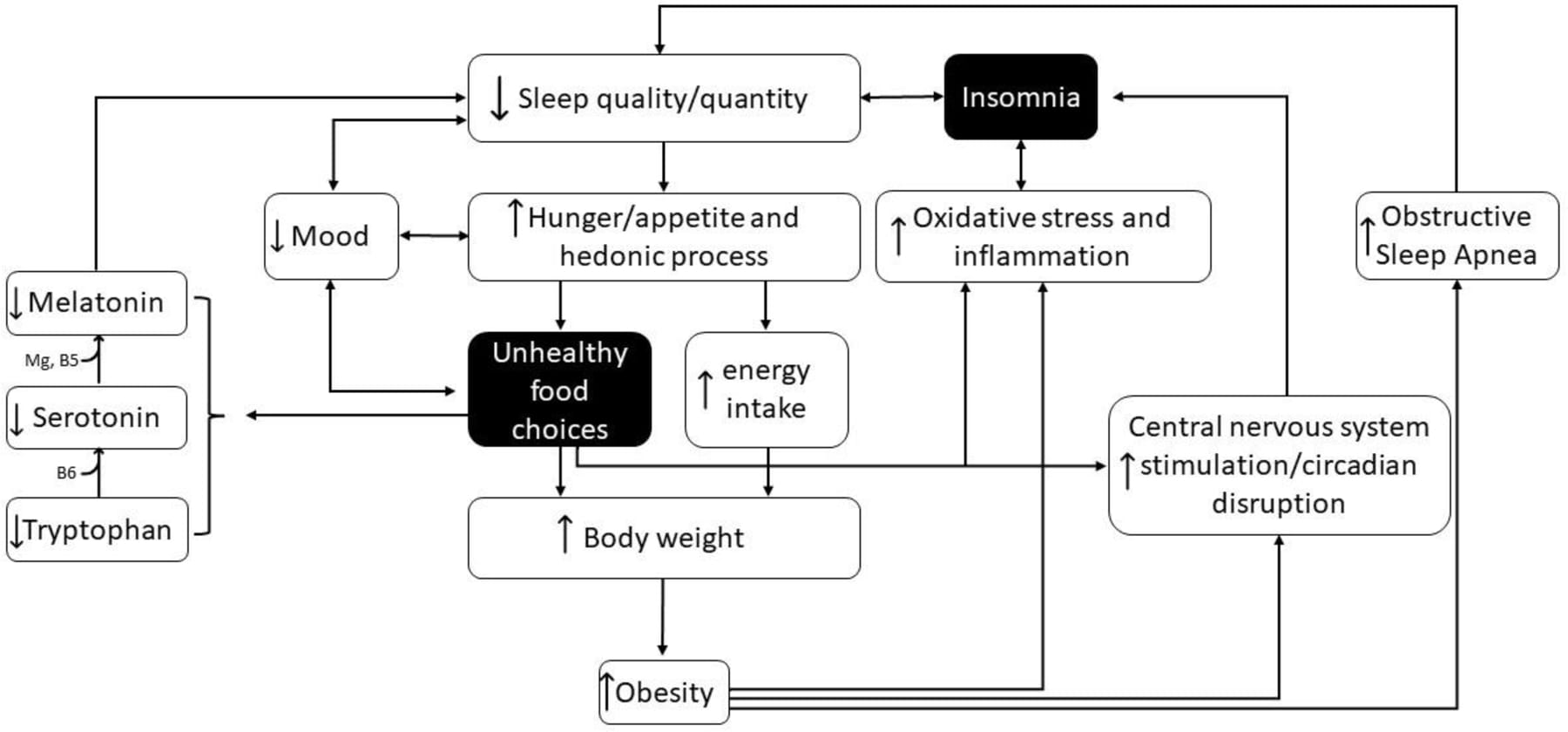
Does the Mediterranean Diet Improve Sleep?
Arab et al. (2024) conducted the largest meta-analysis to date on dietary patterns and insomnia, pooling 37 observational studies involving 591,223 participants across multiple countries and age groups. Mediterranean diet adherence was associated with 14% lower odds of insomnia symptoms (OR: 0.86; 95% CI: 0.79-0.93; p<0.001). High overall diet quality -- measured by indices that overlap with but extend beyond Mediterranean diet scoring -- showed an even larger 34% lower odds (OR: 0.66; 95% CI: 0.48-0.90; p=0.010). This study was co-authored by Frank Scheer, a circadian researcher at Harvard, and insomnia was assessed using validated instruments including the Insomnia Severity Index and the Athens Insomnia Scale, which reduces measurement bias.
Godos et al. (2024) published a broad review focused on the Mediterranean diet and sleep, synthesizing 23 reports across European, North American, and Middle Eastern populations. Higher adherence was associated with lower likelihood of poor sleep quality, inadequate sleep duration, excessive daytime sleepiness, and insomnia across the majority of included studies. Studies conducted outside the traditional Mediterranean region showed similar associations, suggesting the finding is not limited to Southern European cohorts.
Here is where the evidence becomes more nuanced than popular coverage suggests. The Godos review included observational studies, not diet-assignment trials, so it cannot establish that assigning people to a Mediterranean diet improves sleep. The observational data is consistent and comes from large samples, but direct trial evidence for Mediterranean diet and sleep outcomes remains thinner than the observational evidence.
There is also a bidirectional complication. Diet and sleep may influence each other, which means the observational association between Mediterranean diet adherence and better sleep partially reflects reverse causation: people who sleep well may eat better because they sleep well, rather than sleeping well because they eat better. Observational designs cannot fully untangle this.
The practical takeaway: the Mediterranean diet is a reasonable dietary approach supported by large observational data. But “proven to fix your sleep” overstates what the current evidence base shows. The gap between observational and trial-level evidence matters when interpreting diet-and-sleep claims.
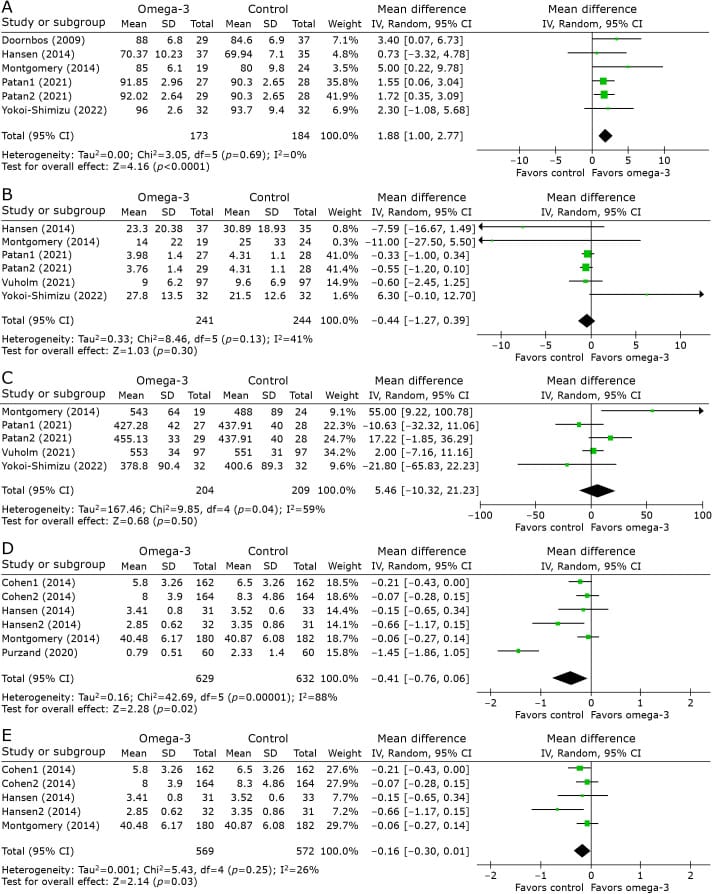
Do Omega-3 Fatty Acids Improve Sleep?
Shimizu et al. (2024) conducted a meta-analysis that included randomized controlled trials and other trials with control groups — 8 controlled trials comparing omega-3 long-chain polyunsaturated fatty acid supplementation against control conditions. This controlled-trial design gives the omega-3 evidence more weight than observational nutrient associations, while still leaving room for uncertainty about dose, formulation, and population.
The primary finding: sleep efficiency was higher in omega-3 groups compared to control groups — a consistent result across the included trials. Sleep latency (time to fall asleep) and total sleep duration did not differ between groups at the pooled level. In this meta-analysis, omega-3 changed a sleep-continuity metric, not total sleep time.
DHA and EPA may not have identical effects, but the current meta-analysis does not establish which fatty acid contributes more to the sleep-efficiency finding. Shimizu et al. discuss omega-3 effects on membrane phospholipids, melatonin production, and autonomic balance as possible mechanisms.
Dose matters. Subjectively assessed sleep quality showed improvement overall, though initial statistical heterogeneity was high. When the analysis was stratified by supplementation dose, heterogeneity dropped and the improvement became consistent, suggesting that dose may explain some of the variation in subjective sleep findings.
Effect sizes are modest. The pooled sleep-efficiency difference was about 1.9 percentage points (MD=1.88; 95% CI: 1.00-2.77), so the finding is measurable but small. The value of this evidence is the controlled-trial design, not a large effect size.
What Does Anti-Inflammatory Eating Improve About Sleep — and What Doesn’t It Change?
Farrell et al. (2024) published a DII-sleep review, authored by a team that included James R. Hébert, one of the DII developers. Across all 12 included studies — eight cross-sectional studies and four cohort or post-hoc analyses of completed diet trials — more anti-inflammatory diets were associated with better sleep in at least one domain. The metrics that recurred across studies were sleep efficiency and WASO. The metric that did not consistently associate with DII across studies: total sleep duration.
This distinction matters. Anti-inflammatory eating is associated with sleeping more efficiently — less time awake during the sleep period, fewer disruptions, higher percentage of time in bed spent asleep. It is not consistently associated with sleeping longer. Popular articles claiming that anti-inflammatory diets help you “sleep longer” or “get more hours” are not supported by the current evidence base.
A key prospective study supporting this pattern is Farrell et al. (2023), a prospective longitudinal cohort that tracked 427 adults across four timepoints over three years. Sleep was measured with actigraphy (objective measurement via wearable sensor), and DII was calculated from three unannounced 24-hour dietary recalls at each wave — stronger methodology than the single-recall approach used in NHANES. For each one-unit increase in DII (more pro-inflammatory), WASO increased by approximately one minute (beta=0.80, p=0.02). Longitudinally, every one-unit increase in DII change predicted a WASO increase (beta=1.00, p=0.01) and a sleep efficiency decrease (beta=-0.16, p<0.05).
Farrell et al. (2023) also found that pro-inflammatory dietary changes predicted later bedtime and later waketime — a circadian timing effect. The diet-sleep connection may extend beyond inflammation into circadian regulation, though the current evidence cannot determine whether this runs through inflammatory pathways, circadian mechanisms, or both.
Race modified these associations in the Farrell et al. cohort. African American participants showed stronger bedtime-delay effects from pro-inflammatory diets than European American participants, indicating the diet-sleep relationship is not uniform across populations.
Studies using rigorous measurement — multiple dietary recalls combined with actigraphy — showed stronger and more consistent results than those relying on single dietary recalls or subjective sleep questionnaires alone. Measurement quality matters. Measurement quality may explain some of the inconsistency across studies.
Diet-related inflammation is one contributor to sleep disruption, but it may sit alongside hormonal changes, metabolic patterns, circadian timing, or autonomic dysregulation. Multiple causes might be active at once — dietary change alone might not be enough if other drivers are present.
Find out which causes may be contributing to your 3 AM wakeups
Find out which causes might be driving your 3am wakeups ->
Frequently Asked Questions
Can an Anti-Inflammatory Diet Improve Sleep After 50?
The DII-sleep associations in NHANES data include adults aged 20 and older. Kase et al. (2021) adjusted for age in its models. For midlife and older adults, the practical message is narrower: an anti-inflammatory dietary pattern may be relevant to sleep continuity, but the current sleep-specific evidence does not show that age alone makes the effect larger.
Does a High Glycemic Diet Worsen Sleep?
This finding points in the same direction as the Mediterranean diet analysis: dietary patterns with a higher inflammatory or glycemic burden tend to associate with worse sleep outcomes. The 16% increase in insomnia risk from high glycemic index diets (Arab et al., 2024) represents a population-level association. It is not only that anti-inflammatory eating patterns associate with better sleep — pro-inflammatory eating patterns associate with worse sleep. The two directions of evidence point in the same direction.
How Long Does It Take for Dietary Changes to Affect Sleep?
The Farrell et al. (2023) prospective cohort measured DII and sleep at baseline, one year, two years, and three years — the changes in WASO and sleep efficiency associated with DII changes emerged across these intervals. Shorter-term data from supplement trials (including the omega-3 controlled trials in Shimizu et al., 2024) measured outcomes over weeks to months, generally 12 weeks or longer. There is no study showing that adopting an anti-inflammatory diet produces measurable sleep changes within days. The current evidence supports setting expectations in weeks to months, with the strongest DII data coming from sustained dietary patterns measured over years.
Related Reading
- Inflammatory Sleep Disruption — the cause overview for cytokines, histamine, gut inflammation, neuroinflammation, and circadian immune timing
- CRP and Sleep Quality — how inflammatory markers relate to sleep continuity and restriction
- Inflammaging and Sleep — how age-related inflammatory activity changes sleep architecture
- Why Do Men Sleep Worse After 50? — how aging, inflammation, and hormonal change can converge in men
- What Is Autoimmune Insomnia? — how autoimmune cytokine activity can disrupt sleep independently of pain
- Why Does Inflammation Make You Exhausted But Unable to Sleep? — how cytokine signaling can create fatigue without stable sleep
- NLRP3 Inflammasome and Sleep — how inflammasome signaling intersects with sleep regulation
- Prostaglandins and Sleep — how inflammatory lipid mediators can affect sleep pressure and continuity
References
1. Arab, A., Karimi, E., Garaulet, M., & Scheer, F. A. J. L. (2024). Dietary patterns and insomnia symptoms: A systematic review and meta-analysis. Sleep Medicine Reviews, 75, 101936. https://pubmed.ncbi.nlm.nih.gov/38714136/
2. Farrell, E. T., Wirth, M. D., McLain, A. C., Hurley, T. G., Shook, R. P., Hand, G. A., Hébert, J. R., & Blair, S. N. (2023). Associations between the Dietary Inflammatory Index and sleep metrics in the Energy Balance Study (EBS). Nutrients, 15(2), 419. https://pubmed.ncbi.nlm.nih.gov/36678290/
3. Farrell, E. T., Hébert, J. R., Heflin, K., Davis, J. E., Turner-McGrievy, G. M., & Wirth, M. D. (2024). Dietary inflammatory index (DII) and sleep quality, duration, and timing: A systematic review. Sleep Medicine Reviews, 77, 101964. https://pubmed.ncbi.nlm.nih.gov/38833836/
4. Godos, J., Ferri, R., Lanza, G., Caraci, F., Vistorte, A. O. R., Yelamos Torres, V., Grosso, G., & Castellano, S. (2024). Mediterranean diet and sleep features: A systematic review of current evidence. Nutrients, 16(2), 282. https://pubmed.ncbi.nlm.nih.gov/38257175/
5. Jiang, J., Huang, S., Yao, W., Yuan, Y., Huang, T., & Xia, Z. (2025). Exploring the link between dietary inflammatory index and sleep disorders: Insights from NHANES and Mendelian randomization approach. Medicine, 104(27), e43170. https://pubmed.ncbi.nlm.nih.gov/40629578/
6. Kase, B. E., Liu, J., Wirth, M. D., Shivappa, N., & Hebert, J. R. (2021). Associations between dietary inflammatory index and sleep problems among adults in the United States, NHANES 2005-2016. Sleep Health, 7(2), 273-280. https://pubmed.ncbi.nlm.nih.gov/33071202/
7. Shimizu, K., Kuramochi, Y., & Hayamizu, K. (2024). Effect of omega-3 fatty acids on sleep: A systematic review and meta-analysis of randomized controlled trials. Journal of Clinical Biochemistry and Nutrition, 75(3), 204-212. https://pubmed.ncbi.nlm.nih.gov/39583980/
Written by Kat Fu, M.S., M.S. ? Last reviewed: February 27, 2026 ? 7 references cited