

You are so tired your body aches, but the moment you lie down your brain refuses to switch off. This can happen across chronic health conditions and acute illness alike, and it can have a neurochemical explanation. Anxiety and stress can coexist with this pattern, but inflammatory signaling can also create a direct sleep-wake mismatch. Two prostaglandins – PGD2 and PGE2 – can pull the brain in opposite directions at the same time. Inflammatory cytokines (immune-messaging proteins including TNF-alpha and IL-1beta) can reshape when and how the brain receives sleep and wake inputs. This article covers the prostaglandin paradox, the cytokine contribution, and the feedback loop that can make the pattern self-reinforcing. For the broader inflammatory sleep picture, see Inflammatory Sleep Disruption.
Why Does Inflammation Cause Fatigue?
During inflammatory states, PGD2 is produced in the leptomeninges (the inner protective membranes around the brain), choroid plexus (the tissue that produces cerebrospinal fluid), and oligodendrocytes by an enzyme called lipocalin-type PGD synthase. From there, PGD2 is released into the cerebrospinal fluid, where it circulates through the ventricular and subarachnoid spaces. When PGD2 reaches the basal forebrain, it binds DP1 receptors and triggers local release of adenosine – a paracrine molecule that accumulates during wakefulness and drives sleep pressure. This adenosine activates A2A receptors on VLPO (ventrolateral preoptic area) sleep neurons, which then send inhibitory GABAergic projections to the tuberomammillary nucleus, suppressing its histamine-driven arousal output (Urade & Hayaishi, 2011). Blocking any step in this cascade – with PGD synthase inhibitors, DP1 antagonists, or caffeine (an adenosine A2A receptor antagonist) – reduces both NREM and REM sleep, which supports the pathway’s role in maintaining physiological sleep.
The subjective experience is deep, pervasive tiredness. But PGD2 is only half the story.
Inflammatory cytokines – TNF-alpha and IL-1beta – can contribute to fatigue through sickness behavior, a conserved neuroimmune response linked with immune recovery, thermoregulation, and energy conservation (Zhang et al., 2025). In people with chronic insomnia, cytokine timing can change across the 24-hour day. Vgontzas et al. (2002) measured this displacement in 11 chronic insomniacs versus 11 healthy controls: IL-6 shifted from a nighttime peak around 4 AM to an evening peak around 7 PM, while TNF-alpha lost its normal circadian rhythm and showed a daytime 4-hour rhythm. The authors proposed that this pattern may help explain daytime fatigue and difficulty falling asleep. TNF-alpha, which normally promotes NREM sleep at night, may contribute to sleepiness when its timing is displaced. The result can be a timing mismatch: fatigue inputs arrive during the day, and arousal inputs block sleep at night.
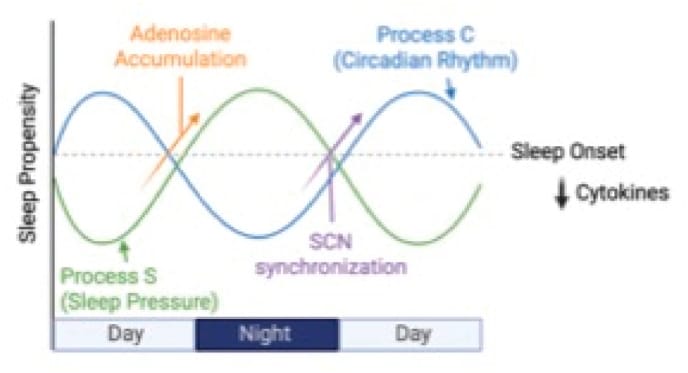
Figure: Two-Process Model of Sleep Regulation. The homeostatic process (Process S) reflects sleep pressure that accumulates with wakefulness and dissipates with sleep, partly mediated by adenosine. The circadian process (Process C), governed by SCN synchronization, entrains internal rhythms to the light-dark cycle. The interaction of these two processes determines sleep onset, depth, and duration. Cytokines can adjust the sleep onset threshold further. Zhang, N., et al. (2025). IL-1b and TNF-a-driven sleep alterations: Neuroimmune mechanisms and behavioral implications. Brain, Behavior, & Immunity – Health, 50, 101139.
Why Does Inflammation Also Prevent Sleep?
While PGD2 pushes the brain toward sleep, PGE2 does the opposite. Huang et al. (2003) perfused PGE2 into the tuberomammillary nucleus of rats at doses of 100, 200, and 400 pmol/min for two hours. The result was a dose-dependent increase in histamine release in both the medial preoptic area and the frontal cortex, accompanied by increased wakefulness and suppression of both NREM and REM sleep. Of the four PGE2 receptor subtypes (EP1 through EP4), only the EP4 agonist replicated this wake-promoting effect, and EP4 mRNA was identified in histaminergic neurons of the tuberomammillary nucleus.
The anatomical separation matters. PGE2’s wake-promoting action occurs in the posterior hypothalamus (the tuberomammillary nucleus), while its fever-inducing action occurs in the anterior preoptic area. Arousal and fever are mechanistically separable consequences of the same inflammatory mediator – a person can experience PGE2-driven wakefulness independent of fever.
This is what makes the paradox neurochemically precise: PGE2 activates the same histaminergic neurons that PGD2 works to suppress through the VLPO inhibition cascade. During inflammation, prostaglandin production can increase from the same arachidonic acid precursor. The model is that sleep-promoting and wake-promoting prostaglandin pathways can be activated in parallel.
TNF-alpha and IL-1beta add a second dimension to sleep-wake disruption. Zhang et al. (2025) described IL-1beta and TNF-alpha as cytokines that can alter sleep-wake circuits through serotonergic, noradrenergic, dopaminergic, and homeostatic sleep pathways. The effect is fragmented sleep architecture: the brain accumulates NREM pressure but cannot consolidate it into sustained sleep episodes. Vgontzas et al. (2002) found that IL-6 timing shifted from its usual nighttime peak into the evening in chronic insomnia, while TNF-alpha lost its normal circadian rhythm.
What Creates the “Exhausted But Unable to Sleep” State?
Both prostaglandins are synthesized from the same arachidonic acid pool. During inflammation, COX enzymes (cyclooxygenase-1 and cyclooxygenase-2) convert arachidonic acid into PGH2, which can then be converted into prostanoids including PGD2 and PGE2. In this model, sleep-promoting and wake-promoting prostaglandin pathways can rise in parallel, creating simultaneous sleep pressure and arousal (Urade & Hayaishi, 2011).
The human evidence for this paradox comes from Raison et al. (2010), who studied 31 participants – 19 receiving chronic interferon-alpha therapy (which induces sustained inflammatory cytokine activation including TNF-alpha, IL-1, IL-6, and soluble receptors) and 12 controls. Polysomnography showed that those receiving interferon-alpha developed increased wake after sleep onset (WASO), decreased Stage 3/4 slow-wave sleep, reduced sleep efficiency, and extended REM latency. Their sleep was objectively less continuous and less deep. At the same time, fatigue scores rose during the interferon-alpha course – these participants reported more fatigue. Yet when given standardized daytime nap opportunities, the interferon-alpha group showed reduced propensity to fall asleep compared to controls. They reported more fatigue while showing reduced daytime sleep propensity. This is the measurable version of the paradox: fatigue increasing while sleep propensity decreases.
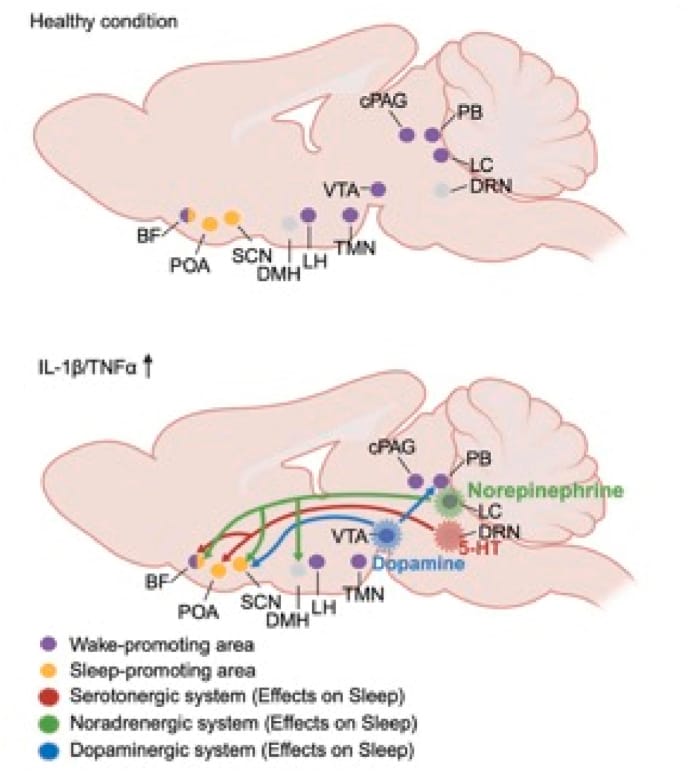
Figure: Neurocircuitry underlying sleep regulation in healthy and immune activated conditions. The diagram highlights the interplay between immune activation and central neuromodulatory pathways in sleep regulation. Sagittal schematic of a mouse brain illustrating key brain regions and neurotransmitter pathways involved in sleep-wake regulation. In the healthy condition (top panel), wake-promoting nuclei (purple dots), including the locus coeruleus (LC), ventral tegmental area (VTA), tuberomammillary nucleus (TMN), parabrachial nucleus (PB), and others, maintain arousal. Sleep-promoting regions (yellow dots), such as the preoptic area (POA) and suprachiasmatic nucleus (SCN), balance this activity to regulate sleep initiation. In the immune activated condition (bottom panel), pro-inflammatory cytokines IL-1b and TNFa are elevated, leading to altered activity in neurotransmitter systems. This includes increased engagement of the serotonergic system (red projections from DRN), noradrenergic system (green projections from LC), and dopaminergic system (blue projections from VTA). Arrows indicate projections targeting both sleep- and wake-promoting areas, suggesting immune-mediated modulation of these circuits during sleep disturbance. Zhang, N., et al. (2025). IL-1b and TNF-a-driven sleep alterations: Neuroimmune mechanisms and behavioral implications. Brain, Behavior, & Immunity – Health, 50, 101139.
The exhausted-but-unable-to-sleep pattern is not limited to psychology. During infection, inflammatory cytokines can alter sleep architecture as part of a conserved neuroimmune adaptation that supports immune recovery, thermoregulation, and energy conservation (Zhang et al., 2025). When inflammatory signaling persists, sleep-wake disruption can persist too.
The feedback loop makes it worse. Haack et al. (2009) measured urinary PGE2 metabolite levels in 15 participants undergoing 88 hours of total sleep deprivation, compared to 9 controls. By the third sleep-deprivation day, PGE2 metabolite rose by approximately 30%. Sleep loss can raise PGE2 metabolite, and PGE2 can promote wakefulness through histaminergic signaling. That creates a plausible feedback loop: sleep loss can increase a wake-promoting prostaglandin, making the next sleep period harder to consolidate.
Does Sleep Loss Make Inflammation-Induced Fatigue Worse?
Zhang et al. (2023) conducted a review and Mendelian randomization meta-analysis – a method that uses genetic variants as instruments to establish causal direction – across 44 publications and 51,879 participants. Chronic insomnia participants showed elevated serum CRP (C-reactive protein), IL-1beta, IL-6, and TNF-alpha compared to healthy controls. The Mendelian randomization analysis found that genetically elevated CRP and IL-6 were associated with causal effects on sleep-duration phenotypes. This supports a causal role for selected inflammatory proteins in sleep-duration traits.
The relationship between inflammatory markers and sleep follows a U-shaped curve: both short and long sleep associate with elevated inflammation, but through different cytokine profiles. Daytime sleepiness alone did not show the same inflammatory differentiation, which keeps the insomnia and daytime-sleepiness findings separate. In Zhang et al. (2023), IL-1beta was one of several inflammatory markers elevated in insomnia compared with controls.
Meanwhile, sleep loss can raise PGE2 metabolite, and chronic insomnia is associated with altered IL-6 and TNF-alpha timing (Haack et al., 2009; Vgontzas et al., 2002). Inflammation and sleep loss can reinforce each other: inflammatory signaling can fragment sleep, and sustained sleep loss can add wake-promoting inflammatory pressure. Addressing inflammatory contributors can be part of changing that loop.
Many people have more than one cause contributing to their sleep disruption. The exhausted-but-unable-to-sleep pattern might be driven by inflammatory prostaglandins, but it might also be shaped by metabolic, hormonal, or autonomic contributors running in parallel. Identifying which causes might be active in your case is a useful next step.
Find out which causes might be driving your 3am wakeups ->
Frequently Asked Questions
Does Ibuprofen Affect Sleep Through Prostaglandins?
Ibuprofen and other non-selective NSAIDs block both COX-1 and COX-2, reducing the synthesis of prostaglandins, including sleep-promoting PGD2 and wake-promoting PGE2. The practical takeaway is more limited: NSAIDs affect prostaglandin synthesis, and prostaglandins participate in sleep-wake regulation. The net sleep effect can vary because pain, inflammation, and prostaglandin pathways interact.
Why Do Non-Steroidal Anti-Inflammatory Drugs Affect Sleep Quality?
Taking ibuprofen before bed can change both pain signaling and prostaglandin signaling. PGD2 supports adenosine-dependent sleep pressure, while PGE2 can promote wakefulness through histaminergic neurons. Because NSAIDs affect prostaglandin production upstream, their sleep effects can vary by context.
Why Do You Feel Exhausted But Cannot Sleep When You Are Sick?
During acute infection, TNF-alpha, IL-1beta, and IL-6 can rise and alter sleep-wake circuits. The sickness behavior program – fatigue, muscle ache, withdrawal from activity, reduced appetite – is an evolutionarily conserved response that supports immune recovery, thermoregulation, and energy conservation (Zhang et al., 2025). At the same time, PGE2 activates histaminergic arousal neurons, which can maintain wakefulness even when cytokine signaling is increasing sleep pressure. The subjective experience – feeling physically exhausted but lying awake for hours – is the acute, self-limiting version of the same PGD2/PGE2 paradox that can persist when inflammatory signaling remains elevated.
Related Reading
- Inflammatory Sleep Disruption — the cause overview for cytokines, histamine, gut inflammation, neuroinflammation, and circadian immune timing
- CRP and Sleep Quality — how inflammatory markers relate to sleep continuity and restriction
- Inflammaging and Sleep — how age-related inflammatory activity changes sleep architecture
- Why Do Men Sleep Worse After 50? — how aging, inflammation, and hormonal change can converge in men
- What Is Autoimmune Insomnia? — how autoimmune cytokine activity can disrupt sleep independently of pain
- Does an Anti-Inflammatory Diet Improve Sleep? — how dietary inflammatory load connects gut, immune, and sleep pathways
- NLRP3 Inflammasome and Sleep — how inflammasome signaling intersects with sleep regulation
- Prostaglandins and Sleep — how inflammatory lipid mediators can affect sleep pressure and continuity
References
1. Haack, M., Lee, E., Cohen, D. A., & Mullington, J. M. (2009). Activation of the prostaglandin system in response to sleep loss in healthy humans: Potential mediator of increased spontaneous pain. Pain, 145(1-2), 136-141. https://pubmed.ncbi.nlm.nih.gov/19560866/
2. Huang, Z.-L., Sato, Y., Mochizuki, T., Okada, T., Qu, W.-M., Yamatodani, A., Urade, Y., & Hayaishi, O. (2003). Prostaglandin E2 activates the histaminergic system via the EP4 receptor to induce wakefulness in rats. Journal of Neuroscience, 23(14), 5975-5983. https://pubmed.ncbi.nlm.nih.gov/12853415/
3. Raison, C. L., Rye, D. B., Woolwine, B. J., Vogt, G. J., Bautista, B. M., Spivey, J. R., & Miller, A. H. (2010). Chronic interferon-alpha administration disrupts sleep continuity and depth in patients with hepatitis C: Association with fatigue, motor slowing, and increased evening cortisol. Biological Psychiatry, 68(10), 942-949. https://pubmed.ncbi.nlm.nih.gov/20537611/
4. Urade, Y., & Hayaishi, O. (2011). Prostaglandin D2 and sleep/wake regulation. Sleep Medicine Reviews, 15(6), 411-418. https://pubmed.ncbi.nlm.nih.gov/22024172/
5. Vgontzas, A. N., Zoumakis, M., Papanicolaou, D. A., Bixler, E. O., Prolo, P., Lin, H.-M., Vela-Bueno, A., Kales, A., & Chrousos, G. P. (2002). Chronic insomnia is associated with a shift of interleukin-6 and tumor necrosis factor secretion from nighttime to daytime. Metabolism: Clinical and Experimental, 51(7), 887-892. https://pubmed.ncbi.nlm.nih.gov/12077736/
6. Zhang, Y., Zhao, W., Liu, K., Chen, Z., Fei, Q., Ahmad, N., & Yi, M. (2023). The causal associations of altered inflammatory proteins with sleep duration, insomnia and daytime sleepiness. Sleep, 46(10), zsad207. https://pubmed.ncbi.nlm.nih.gov/37535878/
7. Zhang, N., Park, K., Chung, S., & Yim, Y. S. (2025). IL-1b and TNF-a-driven sleep alterations: Neuroimmune mechanisms and behavioral implications. Brain, Behavior, & Immunity – Health, 50, 101139. https://pubmed.ncbi.nlm.nih.gov/41323350/
Written by Kat Fu, M.S., M.S. ? Last reviewed: February 23, 2026 ? 7 references cited