

People with autoimmune conditions describe a frustration that follows a recognizable pattern: “I can’t heal unless I sleep, but I can’t sleep because I haven’t healed yet.” They have tried sleep hygiene, melatonin, magnesium, and sometimes CBT-I – and hit a wall. The assumption is usually that pain or medication is causing the insomnia. The research points to a different contributor: inflammatory cytokines can act on sleep-regulatory circuits in the brain, and rheumatoid arthritis sleep data show sleep-inflammation relationships that are not fully explained by pain alone.
This article covers the cytokine-mediated mechanism behind autoimmune insomnia, the evidence that IL-6 receptor blockade improved sleep before measurable disease-activity improvement in one small rheumatoid arthritis pilot trial, and which autoimmune conditions carry the highest insomnia risk. For the broader overview of how inflammation fragments sleep, see the parent article: Inflammatory Sleep Disruption.
How Do Autoimmune Diseases Cause Insomnia?
The assumption that autoimmune insomnia is caused by pain makes intuitive sense – inflamed joints hurt, and pain disrupts sleep. But the polysomnography data tells a different story. The cytokines elevated in autoimmune disease can alter sleep-regulatory circuits, and rheumatoid arthritis sleep recordings show cytokine-sleep relationships that are not fully accounted for by pain.
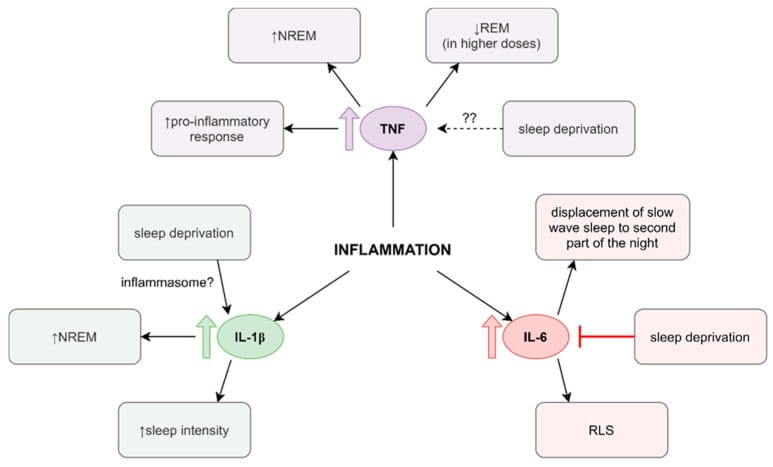
TNF-alpha, IL-6, and IL-1beta are among the cytokines most relevant to this mechanism. At the chronic low-grade concentrations present in rheumatoid arthritis, lupus, and multiple sclerosis, these molecules may contribute to fragmented, non-restorative sleep, while acute immune activation can produce a different pattern: more consolidated NREM sleep during short-term illness (Zhang et al., 2025). During a short-term illness, the same cytokines promote deep NREM sleep to support immune recovery. But in chronic autoimmune disease, where cytokine elevation is sustained for months or years, this adaptive mechanism may become disruptive.
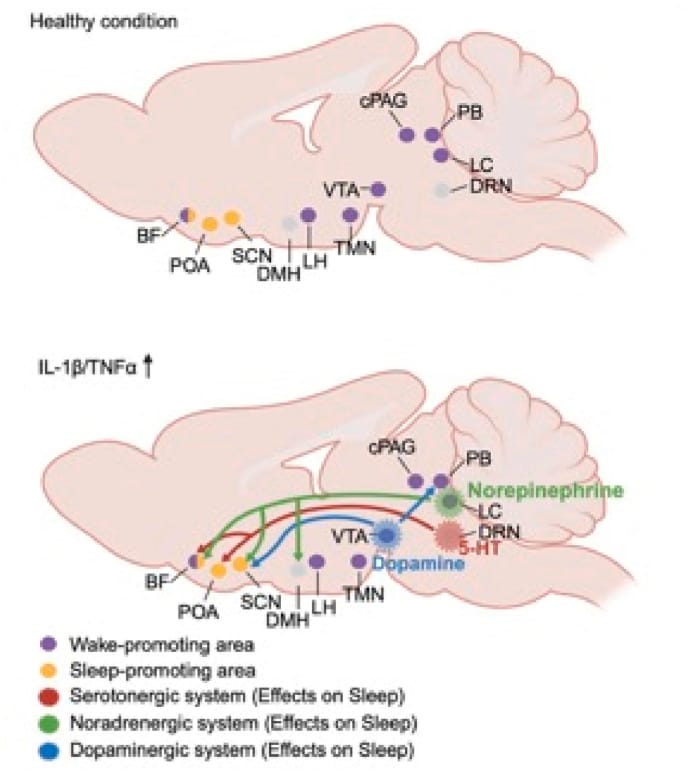
The neuroscience maps to each cytokine individually. IL-1beta suppresses serotonergic neuronal firing in the dorsal raphe nucleus (a brainstem region that regulates sleep-wake transitions) while enhancing serotonin release in sleep-promoting hypothalamic regions – a push-pull disruption that destabilizes sleep architecture from two directions. TNF-alpha modulates noradrenergic and dopaminergic arousal circuits, increasing NREM depth at moderate concentrations but increasing fragmentation at higher or sustained inflammatory exposure (Zhang et al., 2025).
One of the strongest human datasets for this mechanism comes from a polysomnography study by Bjurström et al. (2017). They studied 72 participants – 24 with rheumatoid arthritis and 48 matched controls – using overnight sleep recordings combined with monocytic cytokine assays taken in the evening and morning. The results were directional and cytokine-dependent:
- RA participants showed lower sleep efficiency than controls (83.8% vs. 88.1%).
- Evening TNF production correlated with sleep maintenance that night – the cytokine measured before bed predicted how well sleep held together overnight.
- Evening IL-6 predicted increased slow-wave sleep (the deepest stage of NREM), which in turn counteracted morning inflammatory upswings.
- The cytokine-sleep relationships were reciprocal – IL-6 and TNF operated through distinct temporal windows and produced opposing downstream effects.
The Bjurström findings support the hypothesis of a cytokine-specific feedback loop between sleep maintenance, slow-wave sleep, and cellular inflammation in rheumatoid arthritis. Evening cytokine concentrations predicted that night’s sleep structure in ways that pain scores did not match.
The evolutionary context explains why this happens. These cytokine-sleep interactions are an adaptive host-defense response – during acute infection, IL-1beta and TNF-alpha promote deep NREM sleep to support immune recovery. In chronic autoimmune disease, where cytokine elevation is sustained rather than temporary, this adaptive mechanism may remain active or dysregulated. The brain keeps receiving pro-inflammatory input that would normally drive deep sleep, but the chronic nature of the exposure can contribute to fragmentation rather than consolidation (Zhang et al., 2025).
Can Blocking Inflammatory Cytokines Improve Autoimmune Insomnia?
This is the section that moves the autoimmune insomnia argument from correlation toward mechanism. If blocking a single cytokine receptor improves sleep before overall disease activity improves, that suggests the cytokine pathway may be contributing to sleep disturbance separately from the broader inflammatory disease score.
Fragiadaki et al. (2012) studied 15 people with rheumatoid arthritis and confirmed sleep disturbances. Each received six monthly infusions of tocilizumab at 8 mg/kg – tocilizumab is an IL-6 receptor antagonist, meaning it blocks IL-6 from binding to its receptor. The sleep results arrived early:
- Sleep quality improved and daytime sleepiness decreased at the first-month assessment – before measurable reductions in disease activity (DAS-28 scores) occurred.
- Sleep improvements did not correlate with changes in DAS-28 scores, arguing against overall disease-activity change as the sole explanation.
- Sleep improvements did correlate with improvements in functional disability (HAQ scores), suggesting IL-6 may be linked to sleep and function through pathways not fully reflected by joint-focused disease activity.
The mechanistic explanation is direct: IL-6-mediated interactions have been associated with sleep disturbances, and Fragiadaki et al. tested whether IL-6 receptor inhibition changed sleep in rheumatoid arthritis. When tocilizumab blocks IL-6 receptor binding, it may reduce one sleep-relevant inflammatory pathway. The sleep improvement appearing before disease improvement argues against overall disease-activity reduction as the sole reason sleep improved.
This finding is not isolated. Ditmer et al. (2021) documented a broader pattern: anti-cytokine biologics (anti-TNF, anti-IL-6) improve sleep quality in rheumatoid arthritis and inflammatory bowel disease beyond what pain reduction or disease activity improvement explains. The sleep benefit may involve cytokine effects on sleep-regulatory pathways, not only the indirect effect of feeling better as inflammation decreases.
The implication is direct. In this small RA trial, sleep improved early after IL-6 receptor blockade, before measurable disease-activity reduction. That supports the idea that immune signaling can contribute to sleep disruption through pathways that are not fully explained by pain, disability, or psychological distress.
Which Autoimmune Conditions Carry the Highest Insomnia Risk?
The general population insomnia rate falls between 10.5% and 22.6%. In the cited rheumatoid arthritis, lupus, and multiple sclerosis data, the rate is two to seven times higher – and the excess risk cannot be reduced to one explanation across all three conditions.
Rheumatoid arthritis carries an insomnia prevalence of 25.6% to 70.9% (Ditmer et al., 2021). The range reflects different measurement methods and populations, but the lower bound alone exceeds the general population ceiling. George et al. (2025) provided recent epidemiological evidence: in a population-based study of 1,826 participants (913 with RA, 913 matched comparators), RA participants had a 34% increased hazard of developing any sleep disorder (HR 1.34; 95% CI 1.11-1.61). The risk of insomnia was also elevated 34% (HR 1.34; 95% CI 1.03-1.73). Within the RA group, obesity, dyslipidemia, cardiovascular disease, depression, anxiety, and more recent calendar year of RA incidence were associated with higher risk of any sleep disorder.
Lupus (erythematosus) shows an insomnia prevalence of 33.3% to 71.1% (Ditmer et al., 2021). Faraguna et al. (2024) provided objective data using actigraphy in 73 participants (40 with SLE, 33 healthy controls). The findings revealed a counterintuitive pattern: SLE participants had higher total sleep time (7.55 vs. 6.60 hours) but lower sleep efficiency and more wake after sleep onset. Glucocorticoid dose independently correlated with sleep maintenance impairment, while perceived psychological stress was associated with a separate short-sleep phenotype. This means at least two associated sleep patterns appeared in this SLE cohort: one linked with glucocorticoid dose and sleep maintenance, and one linked with perceived stress and shorter sleep duration.
Multiple sclerosis has a sleep disorder prevalence of approximately 60% – a rate two to five times higher than the general population (Sakkas et al., 2019). The mechanism in MS includes a factor not present in RA or lupus: lesion load can contribute to disrupted sleep patterns, alongside circadian rhythm disorders, medication effects, and elevated pro-inflammatory cytokines. A 2025 controlled polysomnography study in de novo relapsing-remitting MS found reduced sleep efficiency, reduced REM sleep percentage, increased wakefulness after sleep onset, and increased cyclic alternating pattern markers of sleep fragmentation; CSF IL-1beta and IL-15 were associated with specific cyclic alternating pattern measures (Romigi et al., 2025).
The cross-disease pattern is consistent: across rheumatoid arthritis, lupus, and multiple sclerosis, insomnia prevalence exceeds the general population by two to seven times. The mechanism is not explained by pain, medication, or psychological factors alone. Across these conditions, sleep disruption can involve inflammatory signaling, disease activity, medication effects, lesion-related disruption, psychological stress, and circadian rhythm changes in different proportions.
Why Don’t Standard Sleep Approaches Work Well for Autoimmune Insomnia?
If you have an autoimmune condition and have worked through the standard sleep recommendations without lasting improvement, the research explains why.
CBT-I is the gold standard for primary insomnia. It works by restructuring sleep behavior (sleep restriction, stimulus control) and reducing conditioned hyperarousal – the learned association between bed and wakefulness. In autoimmune insomnia, hyperarousal may include inflammatory arousal in addition to conditioned arousal, with cytokines influencing sleep-regulatory circuits. The behavioral approach addresses a different part of the problem. CBT-I may still provide partial benefit by improving the behavioral component of sleep, but it does not directly target the immune driver. In a randomized trial of group-based CBT-I in rheumatoid arthritis, CBT-I improved patient-reported insomnia and RA-related outcomes at week 26, but it did not significantly improve polysomnography-measured sleep efficiency at the primary endpoint (Latocha et al., 2023).
Melatonin addresses circadian timing – it helps the brain recognize when it is time to initiate sleep. Magnesium is usually framed as relaxation support. Neither directly addresses TNF-alpha, IL-6, or IL-1beta acting on sleep-regulatory circuits at the neurological level. These approaches may help sleep timing, sleep habits, or arousal, while leaving immune-related contributors partly unaddressed.
Ditmer et al. (2021) describes CBT-I as the preferred treatment for insomnia and also reviews evidence that monoclonal antibodies and other immune-modulating therapies can affect sleep in chronic inflammatory diseases. The sleep disturbances in these conditions can be mechanistically distinct from insomnia in the general population. The review authors discuss immune-targeted therapies as relevant to sleep outcomes because pro-inflammatory cytokines can influence sleep structure.
The direction the research points toward is addressing the inflammatory driver as part of the sleep conversation. Sleep outcomes belong in autoimmune-care conversations, especially when sleep worsens during inflammatory activity or medication changes. The Fragiadaki tocilizumab data shows that biologics and disease-modifying therapies may have sleep benefits beyond their primary indication – meaning the medication managing the autoimmune condition might also be the more effective sleep approach. Discussing sleep outcomes when evaluating or adjusting autoimmune therapy is a step that the research supports.
Autoimmune inflammation might be one contributor to sleep disruption, but it rarely acts alone. Metabolic changes, hormonal fluctuations, circadian misalignment, and autonomic dysregulation might all be active at the same time, each amplifying the others. Identifying which causes might be driving your pattern is a useful next step before deciding where to focus.
Find out which causes might be driving your 3am wakeups ->
Frequently Asked Questions
Can an Overactive Immune Response Cause Sleep Problems?
Bjurström et al. (2017) demonstrated this with polysomnography in 72 participants: the cytokine concentrations measured in the evening predicted sleep structure that night with a directionality that pain scores did not match. Evening TNF production correlated with sleep maintenance, and evening IL-6 predicted slow-wave sleep depth. The immune-sleep relationship can unfold on a time scale of hours – not the weeks or months that characterize disease flares.
Does Addressing Insomnia Lower Inflammation?
This does not mean behavioral sleep approaches are irrelevant in autoimmune conditions. They may still improve the behavioral and conditioned components of insomnia. But the research suggests that the immune-to-sleep direction deserves attention: IL-6 receptor blockade improved sleep before disease activity improved in a small RA pilot trial (Fragiadaki et al., 2012), while group-based CBT-I in RA improved patient-reported sleep outcomes without significantly improving objective sleep efficiency at the primary endpoint (Latocha et al., 2023).
Can Cytokines Cause Insomnia?
The Zhang et al. (2025) review maps the molecular detail of IL-1beta and TNF-alpha pathways. At acute concentrations (during a short-term illness), these cytokines promote consolidated deep sleep. At higher or sustained inflammatory exposure, the same immune-to-sleep signaling may contribute to fragmentation rather than consolidation.
Related Reading
- Inflammatory Sleep Disruption — the cause overview for cytokines, histamine, gut inflammation, neuroinflammation, and circadian immune timing
- CRP and Sleep Quality — how inflammatory markers relate to sleep continuity and restriction
- Inflammaging and Sleep — how age-related inflammatory activity changes sleep architecture
- Why Do Men Sleep Worse After 50? — how aging, inflammation, and hormonal change can converge in men
- Why Does Inflammation Make You Exhausted But Unable to Sleep? — how cytokine signaling can create fatigue without stable sleep
- Does an Anti-Inflammatory Diet Improve Sleep? — how dietary inflammatory load connects gut, immune, and sleep pathways
- NLRP3 Inflammasome and Sleep — how inflammasome signaling intersects with sleep regulation
- Prostaglandins and Sleep — how inflammatory lipid mediators can affect sleep pressure and continuity
References
1. Bjurström, M. F., Olmstead, R., & Irwin, M. R. (2017). Reciprocal relationship between sleep macrostructure and evening and morning cellular inflammation in rheumatoid arthritis. Psychosomatic Medicine, 79(1), 24-33. https://pubmed.ncbi.nlm.nih.gov/27428854/
2. Ditmer, M., Gabryelska, A., Turkiewicz, S., Białasiewicz, P., Małecka-Wojciesko, E., & Sochal, M. (2021). Sleep problems in chronic inflammatory diseases: Prevalence, treatment, and new perspectives: A narrative review. Journal of Clinical Medicine, 11(1), 67. https://pubmed.ncbi.nlm.nih.gov/35011807/
3. Faraguna, U., Porciani, C., Colitta, A., Bruno, S., Frumento, P., Stagnaro, C., Tani, C., Vagelli, R., & Mosca, M. (2024). Actigraphic and self-reported characterization of sleep in systemic lupus erythematosus patients. Rheumatology (Oxford, England), 63(4), 1076-1083. https://pubmed.ncbi.nlm.nih.gov/37432350/
4. Fragiadaki, K., Tektonidou, M. G., Konsta, M., Chrousos, G. P., & Sfikakis, P. P. (2012). Sleep disturbances and interleukin 6 receptor inhibition in rheumatoid arthritis. The Journal of Rheumatology, 39(1), 60-62. https://pubmed.ncbi.nlm.nih.gov/22133618/
5. George, R. J., Kumar, R., Achenbach, S. J., Lovering, E., Lennon, R. J., Davis, J. M., Carvalho, D. Z., Crowson, C. S., & Myasoedova, E. (2025). Sleep disorders in rheumatoid arthritis: Incidence, risk factors and association with dementia. Seminars in Arthritis and Rheumatism, 73, 152722. https://pubmed.ncbi.nlm.nih.gov/40245587/
6. Latocha, K. M., Løppenthin, K. B., Østergaard, M., Jennum, P. J., Hetland, M. L., Røgind, H., Lundbak, T., Midtgaard, J., Christensen, R., & Esbensen, B. A. (2023). The effect of group-based cognitive behavioural therapy for insomnia in patients with rheumatoid arthritis: A randomized controlled trial. Rheumatology (Oxford, England), 62(3), 1097-1107. https://pubmed.ncbi.nlm.nih.gov/35951745/
7. Romigi, A., Stampanoni Bassi, M., Caccamo, M., Gilio, L., Ceriello, F., Finardi, A., Vitrani, G., Rosenzweig, I., Furlan, R., Buttari, F., & Centonze, D. (2025). Sleep macrostructure, cyclic alternating pattern and CSF cytokines in de novo relapsing-remitting multiple sclerosis: A controlled polysomnographic study. Journal of Sleep Research, e70248. https://pubmed.ncbi.nlm.nih.gov/41342280/
8. Sakkas, G. K., Giannaki, C. D., Karatzaferi, C., & Manconi, M. (2019). Sleep abnormalities in multiple sclerosis. Current Treatment Options in Neurology, 21(1), 4. https://pubmed.ncbi.nlm.nih.gov/30701337/
9. Zhang, N., Park, K., Chung, S., & Yim, Y. S. (2025). IL-1b and TNF-a-driven sleep alterations: Neuroimmune mechanisms and behavioral implications. Brain, Behavior, & Immunity – Health, 50, 101139. https://pubmed.ncbi.nlm.nih.gov/41323350/
Written by Kat Fu, M.S., M.S. ? Last reviewed: February 21, 2026 ? 9 references cited