

People commonly search for explanations for waking at 3am. The prevailing explanations cover cortisol spikes, blood sugar crashes, and anxiety. The inflammatory mechanism — documented in published research describing overnight immune and glucocorticoid timing — is discussed less often.
This article does three things. First, it explains what the immune apparatus is doing during the pre-dawn sleep-maintenance window. Second, it maps four inflammatory pathways — each covered individually in the Inflammatory Sleep Disruption pillar — to the 3am phenomenon. Third, it provides a practical framework for distinguishing inflammatory 3am waking from metabolic, hormonal, and circadian causes.
This is a synthesis. Each pathway described below has a dedicated Tier 1 article with full mechanistic detail. This article connects them to one experience: waking up at 3am and not being able to fall back asleep.
What Happens in Your Immune Apparatus at 3am?
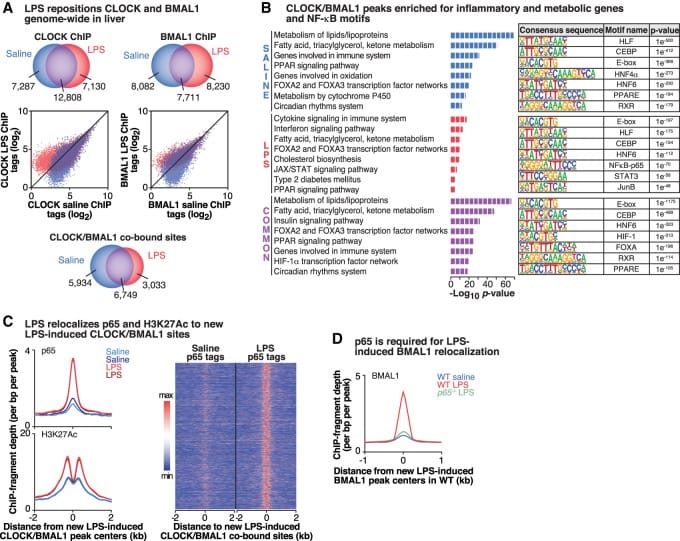
The circadian immune rhythm is governed in part by the interaction between NF-κB and the core clock protein BMAL1. Hong et al. (2018) demonstrated in mouse and cell models that NF-κB can participate in maintaining molecular and behavioral circadian rhythms. When NF-κB is activated in those models, it causes CLOCK/BMAL1 protein complexes to relocate across the genome to NF-κB-bound sites, redirecting the clock’s machinery toward inflammatory gene transcription. NF-κB activation also suppresses Period, Cryptochrome, and Rev-erb genes — the repressors that normally form the clock’s negative feedback loop. This creates a self-reinforcing cycle: chronic inflammation can disrupt the circadian timing that would normally contain it.
Figure: Activation of NF-κB transcription repositions CLOCK/BMAL1 binding genome-wide. Hong, H.K., et al. (2018). Requirement for NF-κB in maintenance of molecular and behavioral circadian rhythms in mice. Genes & Development, 32(21-22), 1367-1379.
When BMAL1 is suppressed by NF-κB, downstream consequences follow. Tang et al. (2022) showed that BMAL1 suppresses IL-6 production in airway epithelial cells through a transcription factor called FOXA2. When BMAL1 is depleted, IL-6 increases and loses its normal circadian oscillation. In their cohort of asthmatic individuals, those with nocturnal flares had serum IL-6 of 7.45 ± 6.57 pg/mL compared to 2.81 ± 1.49 pg/mL in those without nighttime episodes — a 2.6-fold difference. A plausible bridge is that NF-κB can interfere with BMAL1 timing, while lower BMAL1 can reduce FOXA2-mediated restraint on IL-6 in airway epithelial cells.
Cortisol’s suppressive role at this time point involves a molecular intermediary. Cortisol induces GILZ (glucocorticoid-induced leucine zipper), a protein that prevents the NF-κB subunit p65 from entering the cell nucleus and activating inflammatory genes. When glucocorticoid signaling is lower, GILZ-mediated restraint on p65 may be reduced (Srinivasan & Walker, 2022). At the same time, the CLOCK protein acetylates glucocorticoid receptors, reducing their anti-inflammatory efficacy. Low cortisol plus impaired receptor sensitivity creates a double vulnerability at the pre-dawn trough.
The first rigorous human documentation of this circadian inflammatory pattern came from Arvidson et al. (1994), who measured serum IL-6 at three-hour intervals from 7:30 to 22:30 in 48 individuals with rheumatic diseases and 10 healthy controls. IL-6 was undetectable in healthy controls but elevated in RA participants, peaking in the morning hours. The temporal pattern might correspond to the circadian rhythm of rheumatic symptoms, including morning stiffness. More recent evidence adds sleep-loss context: Lee and Park (2024) summarized evidence that three nights of inadequate sleep caused IL-6 mRNA to increase three-fold and TNF-α mRNA to increase two-fold in healthy subjects.
Which Inflammatory Pathways Can Wake You Up at 3am?
Histamine and mast cells — nighttime histamine signaling. Brain-resident mast cells can release histamine, and histamine released from these cells is wake-promoting in mouse models (Chikahisa et al., 2013). Neuronal histamine synthesis and release also follow a circadian pattern, with higher levels during the active/wake period (Thakkar, 2011). Histaminergic neurons in the tuberomammillary nucleus (TMN) fire during wakefulness and are silenced during sleep — they are a central wake-promoting pathway (Thakkar, 2011). When mast cell activation is elevated, histamine-mediated arousal may make sleep maintenance harder. This is why H1 antihistamines can induce drowsiness — they reduce histamine signaling in a pathway that supports wakefulness. The full mechanism is covered in Histamine and 3am Waking and Histamine Intolerance and Sleep.
Gut lipopolysaccharides — inflammatory signaling from the gut. When intestinal barrier integrity is compromised, bacterial lipopolysaccharides (LPS) can enter the bloodstream and activate TLR4/NF-κB transcription. In a mouse LPS model, the vagus nerve relayed gut-derived inflammatory input to the brainstem, and vagotomy abolished the sleep-deprivation-amplified cytokine response (Zhang et al., 2021). Because LPS-triggered inflammation can add to overnight inflammatory signaling, this pathway may contribute to sleep fragmentation in susceptible people. For the full gut-sleep mechanism, see Leaky Gut and Insomnia.
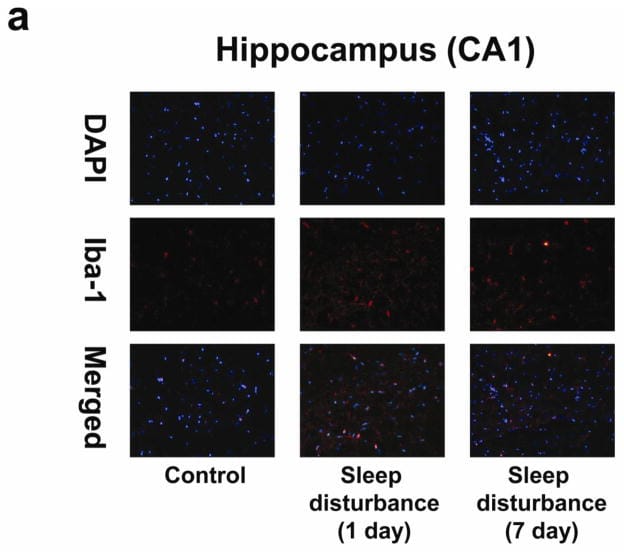
Neuroinflammation — microglial activation and sleep disturbance. Sleep deprivation activates microglia — the brain’s resident immune cells — in the mouse hippocampus (CA1 and CA3 regions), with increased hippocampal IL-6 (Zhu et al., 2012). In a separate rat and cell study focused on the primary somatosensory cortex, sleep deprivation triggered microglial mitochondrial DNA release and NF-κB activation (Hu et al., 2024). This pathway may explain why inflammatory 3am waking feels like the brain switching on — not the body. The full neuroinflammation-sleep connection is in Brain Fog and Poor Sleep: Neuroinflammation.
Figure: Sleep disturbance induces microglia activation in the mouse hippocampus. Twenty-four hours of sleep disturbance increased Iba-1 positive cells in mouse hippocampus CA1 and CA3 one and seven days after sleep disturbance. Zhu, B., et al. (2012). Sleep disturbance induces neuroinflammation and impairment of learning and memory. Neurobiology of Disease, 48(3), 348-355.
Pro-inflammatory cytokines — IL-6 and TNF-α timing. In chronic insomnia, the normal circadian pattern of IL-6 secretion shifts from a 4am peak to a 7pm peak (Vgontzas et al., 2002). TNF-α loses its normal circadian pattern and shows a 4-hour rhythm (Vgontzas et al., 2002). This circadian misalignment may help explain why sleep can feel fragmented even when fatigue is high. The result is the “wired but tired” phenotype — exhaustion that cannot translate into sustained sleep. The full bidirectional mechanism is in Chronic Inflammation and Insomnia.
How Do You Know If Inflammation Is the Reason You Wake Up at 3am?
Inflammatory 3am waking often feels like the brain switched on. You wake alert, mind activated, sometimes with joint stiffness or sinus pressure. Falling back asleep can take 30-90+ minutes. Daytime fatigue may worsen as the day progresses rather than improving. This pattern may occur in people with chronic inflammatory conditions, histamine sensitivity, gut permeability issues, or persistent brain fog.
Metabolic 3am waking (blood sugar crash) feels like the body is requesting fuel. Hunger, shakiness, heart racing. Eating something may ease it within 15-20 minutes.
Hormonal 3am waking (cortisol spike or night sweats) feels like heat, sweating, and arousal arrive together. Hot, sweaty, heart pounding. This pattern can occur during perimenopause and andropause.
Circadian 3am waking (advanced sleep phase) feels like morning arrived early. Awake, calm, not distressed but unable to fall back asleep. This pattern can occur after 50 and in early-rise chronotypes.
The meta-analytic evidence supports the inflammatory angle as measurable. Irwin et al. (2016) reviewed 72 studies (n > 50,000 participants) and found that chronic sleep disturbance is associated with elevated CRP and IL-6. High-sensitivity CRP (hs-CRP) is a commonly available blood test that tracks systemic inflammation. Dressle et al. (2022) added that people with chronic insomnia show moderately elevated cortisol (standardized mean difference = 0.50) consistent with a 24-hour hyperarousal state — a finding that overlaps with but is distinct from the inflammatory pattern.
The inflammatory pattern may be worth considering when 3am waking co-occurs with a chronic inflammatory condition, histamine sensitivity, gut issues, or persistent brain fog — and when the standard explanations (blood sugar, anxiety, cortisol) have been addressed without resolution.
This is not a way to identify a cause. It is a framework for asking better questions.
Inflammation is one of several causes that can drive 3am waking. Metabolic blood sugar patterns, hormonal changes, autonomic nervous imbalances, and circadian timing disruption can all produce middle-of-the-night arousal. The inflammatory pathway is the one that can be easier to overlook.
Find out which causes might be driving your 3am wakeups ->
Frequently Asked Questions
Can Inflammation Cause Insomnia?
The relationship is bidirectional. Inflammation can contribute to insomnia by activating arousal pathways and fragmenting sleep architecture. Insomnia can increase inflammatory signaling by elevating NF-κB, which drives cytokine transcription that compounds the original sleep disruption. Once the loop is established, each direction can reinforce the other. The full mechanism — including the NF-κB/cytokine cascade and the evidence for reversibility — is covered in Chronic Inflammation and Insomnia.
Does Inflammation Make You Tired But Unable to Sleep?
The prostaglandin balance may also contribute. In an LPS mouse model, LPS-induced NREM sleep was partly dependent on prostaglandins and mainly mediated by other pro-inflammatory substances (Oishi et al., 2015). The exhaustion-without-sleep phenotype is covered in more depth in Why Does Inflammation Make You Exhausted But Unable to Sleep?
Does Reducing Inflammation Improve Sleep?
On the behavioral side, CBT-I (a non-pharmacological insomnia approach) reduced CRP and reversed NF-κB activation at 4-month and 16-month follow-ups in a randomized controlled trial of 123 older adults (Irwin et al., 2015). The evidence supports the narrower point that some inflammation-related sleep pathways appear modifiable, but the approach depends on which pathway is dominant. Direction, not prescription — the pathway matters.
What Inflammatory Markers Are Associated with Poor Sleep?
These lab values track with physical consequences.
IL-6 was documented in a circadian pattern in RA participants by Arvidson et al. (1994). Its effect size of 0.42 after multi-night partial sleep restriction reflects a moderate but consistent elevation (Ballesio et al., 2026).
TNF-α loses its normal circadian pattern in chronic insomnia and shows a 4-hour rhythm; TNF-α mRNA increases two-fold after three nights of inadequate sleep (Vgontzas et al., 2002; Lee & Park, 2024).
CRP shows the largest effect size (0.76) after multi-night partial sleep restriction in Ballesio et al. (2026). High-sensitivity CRP (hs-CRP) is a commonly available blood test for tracking this marker.
Additionally, 10 nights of 4-hour sleep restriction produced IL-6 elevations that correlated with increased pain sensitivity (r = 0.67, p < 0.01) (Haack et al., 2007) — demonstrating that these markers track with physical consequences, not just laboratory measurements.
Related Reading
- Inflammatory Sleep Disruption — the cause overview for cytokines, histamine, gut inflammation, neuroinflammation, and circadian immune timing
- Why Does Histamine Wake You Up at 3am? — how brain histamine and mast-cell timing can drive early-morning waking
- Can Histamine Intolerance Cause Sleep Problems? — how DAO capacity and mast-cell activation can compound sleep disruption
- Why Is Inflammation Worse at Night? — how NF-kB and circadian immune timing shape pre-dawn inflammatory activity
- Can Chronic Stress Cause Insomnia Through Inflammation? — how stress load, inflammatory signaling, and hyperarousal reinforce each other
- Mast Cell Activation and Sleep — how mast-cell mediators can disrupt sleep and nighttime arousal
- Circadian Disruption and Inflammation — how circadian misalignment can amplify inflammatory sleep disruption
References
1. Arvidson, N. G., Gudbjörnsson, B., Elfman, L., Rydén, A. C., Tötterman, T. H., & Hällgren, R. (1994). Circadian rhythm of serum interleukin-6 in rheumatoid arthritis. Annals of the Rheumatic Diseases, 53(8), 521-524. https://pubmed.ncbi.nlm.nih.gov/7944637/
2. Ballesio, A., Fiori, V., & Lombardo, C. (2026). Effects of experimental sleep deprivation on peripheral inflammation: An updated meta-analysis of human studies. Journal of Sleep Research, 35(1), e70099. https://pubmed.ncbi.nlm.nih.gov/40474574/
3. Chikahisa, S., Kodama, T., Soya, A., Sagawa, Y., Ishimaru, Y., Séi, H., & Nishino, S. (2013). Histamine from brain resident MAST cells promotes wakefulness and modulates behavioral states. PLOS ONE, 8(10), e78434. https://pubmed.ncbi.nlm.nih.gov/24205232/
4. Dressle, R. J., Feige, B., Spiegelhalder, K., Schmucker, C., Benz, F., Mey, N. C., & Riemann, D. (2022). HPA axis activity in patients with chronic insomnia: A systematic review and meta-analysis of case-control studies. Sleep Medicine Reviews, 62, 101588. https://pubmed.ncbi.nlm.nih.gov/35091194/
5. Fragiadaki, K., Tektonidou, M. G., Konsta, M., Chrousos, G. P., & Sfikakis, P. P. (2012). Sleep disturbances and interleukin 6 receptor inhibition in rheumatoid arthritis. The Journal of Rheumatology, 39(1), 60-62. https://pubmed.ncbi.nlm.nih.gov/22133618/
6. Haack, M., Sanchez, E., & Mullington, J. M. (2007). Elevated inflammatory markers in response to prolonged sleep restriction are associated with increased pain experience in healthy volunteers. Sleep, 30(9), 1145-1152. https://pubmed.ncbi.nlm.nih.gov/17910386/
7. Hong, H. K., Maury, E., Ramsey, K. M., Perelis, M., Marcheva, B., Omura, C., Kobayashi, Y., Guttridge, D. C., Barish, G. D., & Bass, J. (2018). Requirement for NF-κB in maintenance of molecular and behavioral circadian rhythms in mice. Genes & Development, 32(21-22), 1367-1379. https://pubmed.ncbi.nlm.nih.gov/30366905/
8. Hu, Y., Wang, Y., Wang, Y., Zhang, Y., Wang, Z., Xu, X., Zhang, T., Zhang, T., Zhang, S., Hu, R., Shi, L., Wang, X., Li, J., Shen, H., Liu, J., Noda, M., Peng, Y., & Long, J. (2024). Sleep deprivation triggers mitochondrial DNA release in microglia to induce neural inflammation: Preventative effect of hydroxytyrosol butyrate. Antioxidants, 13(7), 833. https://pubmed.ncbi.nlm.nih.gov/39061901/
9. Irwin, M. R., Wang, M., Ribeiro, D., Cho, H. J., Olmstead, R., Breen, E. C., Martinez-Maza, O., & Cole, S. (2008). Sleep loss activates cellular inflammatory signaling. Biological Psychiatry, 64(6), 538-540. https://pubmed.ncbi.nlm.nih.gov/18561896/
10. Irwin, M. R., Olmstead, R., & Carroll, J. E. (2016). Sleep disturbance, sleep duration, and inflammation: A systematic review and meta-analysis of cohort studies and experimental sleep deprivation. Biological Psychiatry, 80(1), 40-52. https://pubmed.ncbi.nlm.nih.gov/26140821/
11. Irwin, M. R., Olmstead, R., Breen, E. C., Witarama, T., Carrillo, C., Sadeghi, N., Arevalo, J. M., Ma, J., Nicassio, P., Bootzin, R., & Cole, S. (2015). Cognitive behavioral therapy and tai chi reverse cellular and genomic markers of inflammation in late-life insomnia: A randomized controlled trial. Biological Psychiatry, 78(10), 721-729. https://pubmed.ncbi.nlm.nih.gov/25748580/
12. Lee, Y., & Park, K. I. (2024). The relationship between sleep and innate immunity. Encephalitis, 4(4), 69-75. https://pubmed.ncbi.nlm.nih.gov/38769055/
13. Oishi, Y., Yoshida, K., Scammell, T. E., Urade, Y., Lazarus, M., & Saper, C. B. (2015). The roles of prostaglandin E2 and D2 in lipopolysaccharide-mediated changes in sleep. Brain, Behavior, and Immunity, 47, 172-177. https://pubmed.ncbi.nlm.nih.gov/25532785/
14. Srinivasan, M., & Walker, C. (2022). Circadian clock, glucocorticoids and NF-κB signaling in neuroinflammation- implicating glucocorticoid induced leucine zipper as a molecular link. ASN Neuro, 14, 17590914221120190. https://pubmed.ncbi.nlm.nih.gov/36317290/
15. Tang, L., Liu, L., Sun, X., Hu, P., Zhang, H., Wang, B., Zhang, X., Jiang, J., Zhao, X., & Shi, X. (2022). BMAL1/FOXA2-induced rhythmic fluctuations in IL-6 contribute to nocturnal asthma attacks. Frontiers in Immunology, 13, 947067. https://pubmed.ncbi.nlm.nih.gov/36505412/
16. Thakkar, M. M. (2011). Histamine in the regulation of wakefulness. Sleep Medicine Reviews, 15(1), 65-74. https://pubmed.ncbi.nlm.nih.gov/20851648/
17. Vgontzas, A. N., Zoumakis, M., Papanicolaou, D. A., Bixler, E. O., Prolo, P., Lin, H. M., Vela-Bueno, A., Kales, A., & Chrousos, G. P. (2002). Chronic insomnia is associated with a shift of interleukin-6 and tumor necrosis factor secretion from nighttime to daytime. Metabolism: Clinical and Experimental, 51(7), 887-892. https://pubmed.ncbi.nlm.nih.gov/12077736/
18. Zhang, Y., Xie, B., Chen, X., Zhang, J., & Yuan, S. (2021). A key role of gut microbiota-vagus nerve/spleen axis in sleep deprivation-mediated aggravation of systemic inflammation after LPS administration. Life Sciences, 265, 118736. https://pubmed.ncbi.nlm.nih.gov/33176177/
19. Zhu, B., Dong, Y., Xu, Z., Gompf, H. S., Ward, S. A., Xue, Z., Miao, C., Zhang, Y., Chamberlin, N. L., & Xie, Z. (2012). Sleep disturbance induces neuroinflammation and impairment of learning and memory. Neurobiology of Disease, 48(3), 348-355. https://pubmed.ncbi.nlm.nih.gov/22776332/
Written by Kat Fu, M.S., M.S. ? Last reviewed: February 22, 2026 ? 19 references cited