

People who sleep poorly tend to focus on the fatigue. The less visible consequence can be measurable inflammation — increases in C-reactive protein (CRP), interleukin-6 (IL-6), and tumor necrosis factor alpha (TNF-alpha) that can rise after acute or repeated sleep and circadian disruption. Over time, this elevation matters for cardiovascular risk, immune defense, and brain health.
This article covers the evidence that disrupted circadian rhythms can activate inflammation — the causal direction from bad sleep timing to inflammatory activation. A related article in this series — Why Is Inflammation Worse at Night? — covers the opposite direction: why existing inflammation flares after dark. That article assumes inflammation is already present and explains its nocturnal amplification. This one asks what happens when healthy adults experience circadian misalignment.
Both articles involve the same NF-kB/BMAL1 molecular pathway. The difference is the starting point. Here, the starting point is a healthy baseline — and the question is whether clock disruption alone is enough to generate new inflammation.
The parent pillar — Inflammatory Sleep Disruption — maps the inflammatory causes and how they interact.
How Does a Disrupted Body Clock Activate Inflammatory Pathways?
The body’s circadian clock runs through a transcription factor pair: CLOCK and BMAL1. These proteins bind DNA at E-box sequences to drive rhythmic gene expression across nearly every tissue. But CLOCK has a second function that is less well known: it directly upregulates NF-kB-mediated inflammatory transcription by increasing phosphorylation and acetylation of p65, the active subunit of NF-kB (Spengler et al., 2012).
The important detail: CLOCK drives NF-kB independently of BMAL1. Under normal conditions, BMAL1 counterbalances this pro-inflammatory push. When BMAL1 signaling is reduced or mistimed, the balance can tilt toward NF-kB-mediated inflammatory transcription.
This is a two-way relationship. NF-kB’s RelB subunit physically interacts with BMAL1 to repress circadian clock output (Bellet et al., 2012). The result is a feed-forward pattern: inflammatory signaling can interfere with clock output, and weaker clock output may reduce anti-inflammatory restraint. Even modest initial NF-kB activation may make inflammatory signaling easier to sustain.
Downstream, the consequences are measurable. In macrophages — immune cells responsible for inflammatory responses — BMAL1 deficiency disrupts NRF2-mediated antioxidant defense. Without NRF2’s protective activity, reactive oxygen species (ROS) accumulate and drive production of IL-1beta, a pro-inflammatory cytokine (Early et al., 2018).
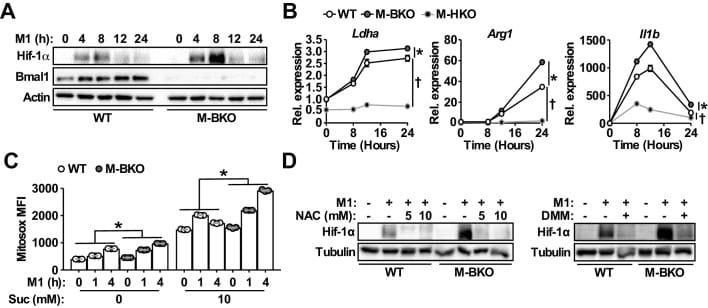
A second pathway adds to this inflammatory pattern. In mouse macrophage data, when myeloid immune cells lose BMAL1, succinate dehydrogenase-driven mitochondrial ROS production increases, stabilizing HIF-1alpha — a transcription factor that reprograms cellular metabolism toward inflammatory output (Alexander et al., 2020). Under inflammatory stimulation, macrophages shift from oxidative phosphorylation toward glycolysis, a metabolic pattern associated with heightened inflammatory activation.
The core takeaway: the circadian clock acts as an active suppressor of inflammatory pathways. When clock signaling is impaired, that anti-inflammatory restraint can weaken.
What Inflammatory Markers Increase With Rotating Schedules and Social Jet Lag?
The molecular mechanism predicts that people with disrupted circadian rhythms should show elevated inflammatory markers. The population and laboratory data support this.
In a 2022 study of 2,329 electronics manufacturing workers, shift workers had slightly higher mean hs-CRP than daytime workers, but the mean difference was not statistically significant (0.61 versus 0.57 mg/L; p = 0.210). The stronger finding was categorical: shift workers had higher odds of hs-CRP above 3 mg/L (adjusted OR 1.80, 95% CI 1.16-2.80) and higher odds of elevated leukocyte count (adjusted OR 2.27, 95% CI 1.37-3.74) (Woo et al., 2022).
But rotating schedules involve more than clock disruption — they come with stress, diet changes, and reduced sleep. Morris et al. (2016) tested circadian misalignment in healthy adults under controlled laboratory conditions and found increases in 24-hour IL-6, CRP, resistin, and TNF-alpha. Morris et al. (2017) extended the finding to chronic shift workers in a controlled crossover design: circadian misalignment increased 24-hour hs-CRP by 11% and also increased blood pressure.
The relevance extends beyond rotating schedules. In the Cleveland Family Study, greater social jetlag was associated with higher IL-1, and later weekday and weekend sleep timing was associated with higher IL-6, after adjustment for obstructive sleep apnea severity (Girtman et al., 2022).
You do not need to work night schedules for this to apply. Inconsistent weekend sleep timing has been associated with inflammatory markers in population data, though the magnitude and marker pattern differ by study population.
Can Disrupted Sleep Reprogram Your Immune Cells?
The acute inflammatory markers covered above — CRP, IL-6, TNF-alpha — rise and fall. They can respond to sleep restoration. But a 2022 study from the Icahn School of Medicine at Mount Sinai uncovered a different category of consequence.
McAlpine et al. (2022) subjected mice to chronic sleep fragmentation and then examined their hematopoietic stem and progenitor cells (HSPCs) — the upstream precursors to blood and immune cells. Sleep fragmentation altered the HSPC epigenome, changing which genes were accessible for transcription. The cells became biased toward producing myeloid cells: monocytes and neutrophils, the myeloid arm of the immune response.
The finding that distinguishes this from the acute marker data: some immune-cell effects persisted after recovery sleep in mice. Mice that had been sleep-fragmented and then allowed recovery still showed evidence that sleep fragmentation had changed hematopoietic behavior. The molecular imprint of insufficient sleep remained detectable in cells that give rise to blood and immune cells.
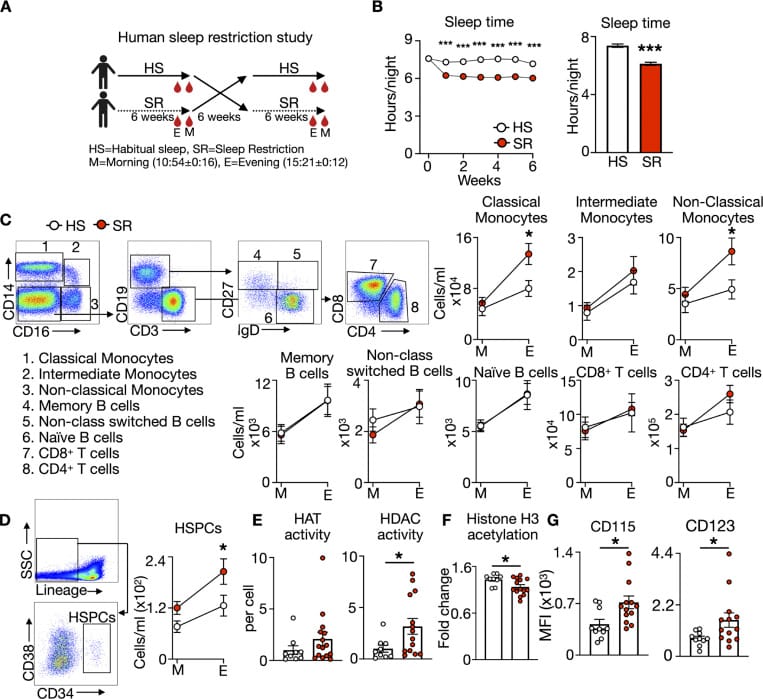
The human component of the same study showed the same direction: sleep restriction in 14 human participants increased circulating monocytes and altered HSPC epigenetic markers, including increased HDAC activity and reduced histone acetylation — changes associated with myeloid-skewed differentiation.
Short-term inflammatory changes can improve when sleep timing and continuity improve. Longer-duration fragmentation may carry more durable immune-cell effects, especially in the animal data.
How Many Nights of Bad Sleep Does It Take to Raise Inflammatory Markers?
A meta-analysis by Irwin et al. (2016) synthesized the experimental evidence on sleep loss and inflammation. Total sleep deprivation — staying awake for a full night — elevated inflammatory markers within a single night. Partial sleep deprivation, typically restricting sleep to 4-5 hours per night, showed more variable effects across studies.
Vgontzas et al. (2004) tested a scenario that matches a common pattern: sleeping 2 hours less than habitual for 7 nights. IL-6 increased in both men and women. TNF-alpha increased in men but not women. This mirrors the weeknight sleep debt that accumulates when bedtime moves later but the alarm stays fixed.
Haack et al. (2007) found that 10 days at 4 hours per night produced a non-significant CRP trend (p = 0.11) and statistically elevated IL-6. The threshold for measurable inflammatory change depends on the degree of restriction, the number of nights, and which inflammatory marker is measured.
The counterpart: inflammatory elevation from short-term sleep disruption can improve.
In a randomized controlled trial, Irwin et al. (2015) showed that cognitive behavioral therapy for insomnia (CBT-I) reduced CRP levels at months 4 and 16 compared with sleep seminar control.
Weekend catch-up sleep also appears to help — but with a caveat. Park et al. (2022) analyzed data from 17,665 participants and found that 1-3 hours of weekend catch-up sleep was associated with 13% lower odds of being in the highest hs-CRP group. However, this association was observed only in people with consistent weekday bedtimes. The total hours of catch-up mattered less than whether the underlying schedule was regular in that analysis.
A few nights of moderate restriction can be enough to change inflammatory markers in some studies. Sleep restoration and more regular timing can reduce inflammatory burden in some settings. Timing regularity appears to matter alongside total duration.
Circadian-driven inflammation is one contributor to disrupted sleep, but it might be compounding with histamine sensitivity, gut permeability, neuroinflammation, or metabolic changes. Each pathway has different markers and different points to address. Identifying which causes might be active in your pattern helps prioritize where to start.
Find out which causes might be driving your 3am wakeups ->
Additional Questions
Does Circadian Disruption Weaken Vaccine Responses?
Prather et al. (2012) found that participants with shorter sleep in the days surrounding hepatitis B vaccination mounted a lower antibody response. In the full text, each additional hour of actigraphy-measured sleep was associated with a 56% higher secondary antibody response.
Guan et al. (2026) reported in a mouse model that chronic sleep fragmentation before and during influenza vaccination reduced neutralizing antibody titers, altered B-cell maturation programs, and lowered protection against lethal challenge.
Sleep timing and continuity around vaccination may affect adaptive immune responses. In the mouse data, chronic sleep fragmentation altered B-cell maturation and germinal-center programs, which are part of antibody formation.
Does Circadian Disruption Affect Gut Health?
Gao et al. (2021) found that 72 hours of acute sleep deprivation disrupted gut microbial metabolites, reduced short-chain fatty acids including butyrate, increased intestinal inflammation, and impaired gut barrier integrity in mice. The findings fit a broader circadian-clock/gut-microbiota link: when sleep and circadian timing are disrupted, microbial oscillations and host inflammatory pathways can change in parallel.
Bishehsari et al. (2020) reviewed evidence that circadian disruption can alter gut microbiota communities and perturb host metabolism, energy homeostasis, and inflammatory pathways.
For more on the gut-sleep connection, see Leaky Gut and Insomnia and Gut Bacteria and Insomnia.
Is the Inflammatory Effect of Sleep Disruption Different for Men and Women?
Vgontzas et al. (2004) found that 7 nights of moderate sleep restriction raised IL-6 in both men and women, but TNF-alpha elevation was male-predominant.
The sex-dependent pattern in that study means the same sleep disruption produced different inflammatory profiles depending on biological sex. The exact mechanism is not fully characterized. For age-related changes in men, see Why Do Men Sleep Worse After 50?
Can a More Regular Sleep Schedule Reduce Inflammation?
The Irwin et al. (2015) CBT-I trial is one of the stronger human data points for improvement: a behavioral approach for insomnia reduced CRP at 4 and 16 months compared with a sleep seminar control. The Park et al. (2022) catch-up sleep analysis adds a caveat — additional weekend sleep was associated with lower odds of high hs-CRP only when weekday bedtimes were regular. In irregular schedulers, the same association was not observed.
The caveat from the McAlpine et al. (2022) HSPC epigenetic data: chronic, long-duration sleep fragmentation may carry more durable immune-cell consequences in animal data. Short-term disruption appears more responsive. The human threshold for durable HSPC changes is not yet established.
Consistency of timing may matter alongside total hours. The catch-up sleep data and the CBT-I data both point to the same conclusion: regular sleep timing can be part of reducing inflammatory burden.
Related Reading
- Inflammatory Sleep Disruption — the cause overview for cytokines, histamine, gut inflammation, neuroinflammation, and circadian immune timing
- Why Does Histamine Wake You Up at 3am? — how brain histamine and mast-cell timing can drive early-morning waking
- Can Histamine Intolerance Cause Sleep Problems? — how DAO capacity and mast-cell activation can compound sleep disruption
- Why Is Inflammation Worse at Night? — how NF-kB and circadian immune timing shape pre-dawn inflammatory activity
- Can Inflammation Cause 3am Wakeups? — how inflammatory signaling can create early-morning wakeups
- Can Chronic Stress Cause Insomnia Through Inflammation? — how stress load, inflammatory signaling, and hyperarousal reinforce each other
- Mast Cell Activation and Sleep — how mast-cell mediators can disrupt sleep and nighttime arousal
References
1. Alexander, R. K., Liou, Y.-H., Knudsen, N. H., Starost, K. A., Xu, C., Hyde, A. L., Liu, S., Jacobi, D., Liao, N.-S., & Lee, C.-H. (2020). Bmal1 integrates mitochondrial metabolism and macrophage activation. eLife, 9, e54090. https://pubmed.ncbi.nlm.nih.gov/32396064/
2. Bellet, M. M., Zocchi, L., & Sassone-Corsi, P. (2012). The RelB subunit of NFκB acts as a negative regulator of circadian gene expression. Cell Cycle, 11(17), 3304-3311. https://pubmed.ncbi.nlm.nih.gov/22894897/
3. Bishehsari, F., Voigt, R. M., & Keshavarzian, A. (2020). Circadian rhythms and the gut microbiota: from the metabolic syndrome to cancer. Nature Reviews Endocrinology, 16(12), 731-739. https://pubmed.ncbi.nlm.nih.gov/33106657/
4. Early, J. O., Menon, D., Wyse, C. A., Cervantes-Silva, M. P., Zaslona, Z., Carroll, R. G., Palsson-McDermott, E. M., Angiari, S., Ryan, D. G., Corcoran, S. E., Timmons, G., Geiger, S. S., Fitzpatrick, D. J., O’Connell, D., Xavier, R. J., Hokamp, K., O’Neill, L. A. J., & Curtis, A. M. (2018). Circadian clock protein BMAL1 regulates IL-1β in macrophages via NRF2. Proceedings of the National Academy of Sciences of the United States of America, 115(36), E8460-E8468. https://pubmed.ncbi.nlm.nih.gov/30127006/
5. Gao, T., Wang, Z., Dong, Y., Cao, J., & Chen, Y. (2021). Melatonin-Mediated Colonic Microbiota Metabolite Butyrate Prevents Acute Sleep Deprivation-Induced Colitis in Mice. International Journal of Molecular Sciences, 22(21), 11894. https://pubmed.ncbi.nlm.nih.gov/34769321/
6. Girtman, K. L., Baylin, A., O’Brien, L. M., & Jansen, E. C. (2022). Later sleep timing and social jetlag are related to increased inflammation in a population with a high proportion of OSA: findings from the Cleveland Family Study. Journal of Clinical Sleep Medicine, 18(9), 2179-2187. https://pubmed.ncbi.nlm.nih.gov/35686375/
7. Guan, M., Gu, W., Gileles-Hillel, A., Khalyfa, A., Balamalaliyage, P., Tunterak, W., Li, M., Huang, Y., Wen, Y., Driver, J., Gozal, D., & Wan, X. F. (2026). Poor sleep impairs immune responses and influenza vaccine protection. Nature Communications. https://pubmed.ncbi.nlm.nih.gov/42014403/
8. Haack, M., Sanchez, E., & Mullington, J. M. (2007). Elevated inflammatory markers in response to prolonged sleep restriction are associated with increased pain experience in healthy volunteers. Sleep, 30(9), 1145-1152. https://pubmed.ncbi.nlm.nih.gov/17910386/
9. Irwin, M. R., Olmstead, R., Breen, E. C., Witarama, T., Carrillo, C., Sadeghi, N., Arevalo, J. M. G., Ma, J., Nicassio, P., Bootzin, R., & Cole, S. (2015). Cognitive behavioral therapy and tai chi reverse cellular and genomic markers of inflammation in late-life insomnia: a randomized controlled trial. Biological Psychiatry, 78(10), 721-729. https://pubmed.ncbi.nlm.nih.gov/25748580/
10. Irwin, M. R., Olmstead, R., & Carroll, J. E. (2016). Sleep disturbance, sleep duration, and inflammation: A systematic review and meta-analysis of cohort studies and experimental sleep deprivation. Biological Psychiatry, 80(1), 40-52. https://pubmed.ncbi.nlm.nih.gov/26140821/
11. McAlpine, C. S., Kiss, M. G., Zuraikat, F. M., Cheek, D., Schiroli, G., Amatullah, H., Huynh, P., Bhatti, M. Z., Wong, L. P., Yates, A. G., Poller, W. C., Mindur, J. E., Chan, C. T., Janssen, H., Downey, J., Singh, S., Sadreyev, R. I., Nahrendorf, M., Jeffrey, K. L., … Swirski, F. K. (2022). Sleep exerts lasting effects on hematopoietic stem cell function and diversity. The Journal of Experimental Medicine, 219(11), e20220081. https://pubmed.ncbi.nlm.nih.gov/36129517/
12. Morris, C. J., Purvis, T. E., Hu, K., & Scheer, F. A. J. L. (2016). Circadian misalignment increases cardiovascular disease risk factors in humans. Proceedings of the National Academy of Sciences of the United States of America, 113(10), E1402-E1411. https://pubmed.ncbi.nlm.nih.gov/26858430/
13. Morris, C. J., Purvis, T. E., Mistretta, J., Hu, K., & Scheer, F. A. J. L. (2017). Circadian Misalignment Increases C-Reactive Protein and Blood Pressure in Chronic Shift Workers. Journal of Biological Rhythms, 32(2), 154-164. https://pubmed.ncbi.nlm.nih.gov/28347188/
14. Park, S., Kang, D. Y., Ahn, H., Kim, N., Yoon, J.-H., & Yang, B. R. (2022). Effect of weekend catch-up sleep on high-sensitivity C-reactive protein levels according to bedtime inconsistency: a population-based cross-sectional study. Scientific Reports, 12(1), 21619. https://pubmed.ncbi.nlm.nih.gov/36517526/
15. Prather, A. A., Hall, M., Fury, J. M., Ross, D. C., Muldoon, M. F., Cohen, S., & Marsland, A. L. (2012). Sleep and antibody response to hepatitis B vaccination. Sleep, 35(8), 1063-1069. https://pubmed.ncbi.nlm.nih.gov/22851802/
16. Spengler, M. L., Kuropatwinski, K. K., Comas, M., Gasparian, A. V., Fedtsova, N., Gleiberman, A. S., Gitlin, I. I., Artemicheva, N. M., Deluca, K. A., Gudkov, A. V., & Antoch, M. P. (2012). Core circadian protein CLOCK is a positive regulator of NF-κB-mediated transcription. Proceedings of the National Academy of Sciences of the United States of America, 109(37), E2457-E2465. https://pubmed.ncbi.nlm.nih.gov/22895791/
17. Vgontzas, A. N., Zoumakis, E., Bixler, E. O., Lin, H.-M., Follett, H., Kales, A., & Chrousos, G. P. (2004). Adverse effects of modest sleep restriction on sleepiness, performance, and inflammatory cytokines. The Journal of Clinical Endocrinology & Metabolism, 89(5), 2119-2126. https://pubmed.ncbi.nlm.nih.gov/15126529/
18. Woo, S.-J., Chae, C.-H., & Lim, J.-W. (2022). Association between shift work and inflammatory markers in workers at an electronics manufacturing company. Annals of Occupational and Environmental Medicine, 34, e35. https://pubmed.ncbi.nlm.nih.gov/36544883/
Written by Kat Fu, M.S., M.S. ? Last reviewed: June 25, 2026 ? 18 references cited