

Yes – and histamine intolerance can contribute to sleep problems, especially sleep maintenance insomnia. Histamine intolerance occurs when the body cannot break down histamine efficiently, usually due to low diamine oxidase (DAO) enzyme activity. In a prospective prevalence study of 167 adults with insomnia-related symptoms, 82.6% carried AOC1 variants associated with DAO deficiency. Histamine is a wake-promoting neurotransmitter in the brain’s tuberomammillary nucleus, and mast cell mediators may add another arousal pathway when histamine-related inflammation is active.
When the body cannot break down histamine efficiently, histamine-related arousal pathways may stay more active during the sleep period – and standard sleep supplements that interact with mast cell pathways may be insufficient when histamine load or mast cell activation is part of the sleep problem. Addressing histamine clearance may improve sleep quality, daytime energy, and cognitive function over time when histamine burden is one of the active contributors. This article covers how diamine oxidase enzyme deficiency connects to insomnia, why common sleep remedies may be incomplete when histamine is elevated, what the research shows about histamine-targeted approaches, and how mast cell activation extends that disruption. Histamine-driven sleep disruption is one of several inflammatory mechanisms – for the broader picture, see Inflammatory Sleep Disruption.
What Is Histamine Intolerance and How Does It Affect Sleep
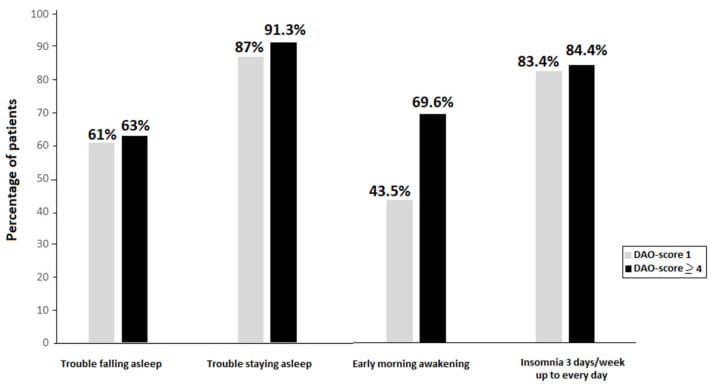
Histamine intolerance is not an allergy – it is a reduced capacity to break down histamine, typically from low diamine oxidase (DAO) enzyme activity. When histamine accumulates faster than the body can break it down, histamine-related arousal pathways may remain active during the sleep period. In a prospective prevalence study of 167 adults with insomnia-related symptoms, 82.6% carried genetic variants associated with DAO deficiency, and 88% reported difficulty staying asleep as their primary complaint (Lopez Garcia et al., 2024).
Histamine is one of the brain’s primary wake-promoting neurotransmitters. Histaminergic neurons in the tuberomammillary nucleus (TMN) – a small cluster in the posterior hypothalamus – fire during wakefulness and stop firing during sleep (Thakkar, 2011). When histamine-related signaling remains elevated, that wakefulness drive may make sleep more fragmented.
The enzyme responsible for breaking down histamine in the gut and bloodstream is diamine oxidase (DAO). Genetic variants in the AOC1 gene – the gene encoding DAO – reduce the body’s capacity to degrade histamine from food and from endogenous mast cell release. In a 2024 prospective prevalence study of 167 adults presenting with insomnia-related symptoms, 82.6% carried AOC1 variants associated with DAO deficiency. Among those with higher genetic burden (four or more single nucleotide polymorphisms), rates of sleep maintenance problems and early morning awakening were elevated compared to those with fewer variants (Lopez Garcia et al., 2024).
The insomnia pattern in histamine intolerance tends to look different from stress-related or circadian-related sleep problems. The predominant complaint in Lopez Garcia’s cohort was difficulty staying asleep (88%), followed by difficulty falling asleep (60.5%). That maintenance-dominant pattern – falling asleep at a reasonable time but waking repeatedly or too early – is consistent with histamine-related arousal contributing to wakefulness during the second half of the night.
Beyond sleep, histamine intolerance produces a constellation of overlapping presentations. In a study of 77 individuals with histamine intolerance, Tamasi and Kalabay (2025) documented respiratory issues in 95%, bloating in 94%, headache in 91%, fatigue in 83%, and postprandial drowsiness in 81%. The drowsiness-fatigue combination is often misattributed to poor sleep alone, when histamine excess may be contributing to both daytime fatigue and nighttime waking.
One reason histamine intolerance goes unrecognized for so long: the presentations vary from episode to episode in the same person after similar exposures, making it difficult to identify a pattern.
What Is the Diamine Oxidase Enzyme and How Does It Affect Sleep
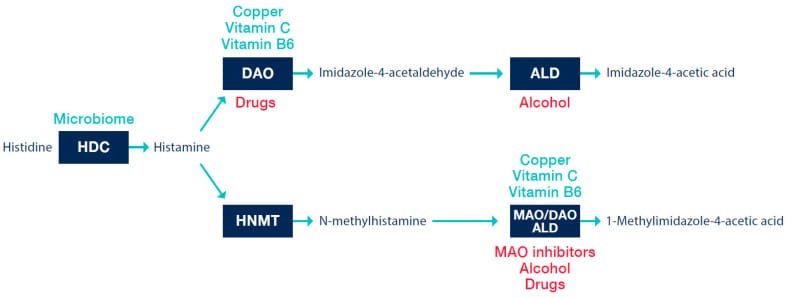
Diamine oxidase (DAO) is the primary enzyme responsible for breaking down histamine in the gut and bloodstream. When DAO activity is low – from genetic variants, gut inflammation, or certain medications – histamine from food and mast cell release accumulates instead of being cleared. A 2026 randomized controlled trial found that DAO supplementation improved sleep quality measures, and participants using melatonin had greater insomnia severity improvement with DAO than with placebo (Ferrer-Garcia et al., 2026).
DAO is produced in the intestinal mucosa. Its primary job is to degrade histamine before it enters the bloodstream. When DAO activity is sufficient, dietary histamine – from aged cheeses, fermented foods, cured meats, alcohol – gets broken down in the gut. When DAO activity is low, that histamine passes into circulation and adds to whatever histamine the body is already producing through mast cell activity.
Several factors reduce DAO activity beyond genetics. Gut inflammation can damage the intestinal cells that produce DAO. Alcohol inhibits DAO directly. Certain medications – including some NSAIDs and antiarrhythmics – also reduce DAO function (Hrubisko et al., 2021).
When a genetic predisposition toward low DAO combines with any of these factors, nighttime histamine burden may remain elevated during the hours when wakefulness-promoting histamine signaling should be lower.
The connection between DAO support and sleep improvement has recent evidence. In a 2026 randomized, double-blind, placebo-controlled trial, 101 adults with insomnia and confirmed AOC1 gene variants received either DAO supplementation or placebo for 28 days. The DAO group showed improvements in Pittsburgh Sleep Quality Index scores – including sleep efficiency and reduced sleep medication use – compared to placebo. Among participants who were also taking melatonin, insomnia severity improvements were greater in the DAO group at both day 7 and day 28 (Ferrer-Garcia et al., 2026).
The DAO-plus-melatonin finding matters. For people whose insomnia involves histamine accumulation, melatonin alone may be insufficient because it does not address the histamine excess. Adding DAO enzyme support may reduce one wake-promoting input while melatonin supports circadian-driven sleep onset. Without addressing the histamine burden first, melatonin is working against a wakefulness drive it was not designed to override.
The mechanistic link is biologically plausible but should be stated carefully: histamine promotes wakefulness through H1 receptor activation in the TMN, while DAO primarily reduces peripheral histamine burden. Histaminergic neurons fire exclusively during wakefulness and cease firing during NREM and REM sleep (Thakkar, 2011). Reducing circulating histamine – whether through DAO supplementation, dietary histamine reduction, or both – may reduce one contributor to nighttime arousal in people whose sleep disruption is histamine-related.
Can Mast Cell Activation Syndrome Cause Insomnia
Yes. In a study comparing 553 individuals with MCAS to 558 controls, those with MCAS had elevated rates of severe chronic insomnia across both sexes. MCAS involves pathological mast cell degranulation that releases not only histamine but serotonin, cytokines, and prostaglandins – creating compounding sleep disruption that extends beyond what antihistamines alone can address (Weinstock et al., 2025).
Mast cell activation syndrome (MCAS) is a condition in which mast cells degranulate inappropriately – releasing inflammatory mediators without a true allergic trigger. Where histamine intolerance involves impaired breakdown of histamine, MCAS involves excessive production and release of histamine alongside many other mediators.
MCAS carries a heavy sleep burden. Weinstock et al. (2025) surveyed 553 individuals with MCAS and 558 controls and found that insomnia was among the neuropsychiatric conditions elevated in MCAS across both sexes. Women with MCAS reported higher rates in 18 of 19 neurologic categories and all 14 psychiatric categories; men reported higher rates in 17 of 19 neurologic categories and 8 of 14 psychiatric categories. When those with MCAS rated the effectiveness of various approaches for their neuropsychiatric presentations, antihistamines received a rating of 6.3 out of 10 – outperforming benzodiazepines at 5.6 out of 10. That finding is relevant, but it should be read as patient-reported neuropsychiatric relief overall rather than an insomnia-specific drug comparison.
MCAS also creates sleep disruption through pathways beyond histamine alone. Weinstock et al. (2020) found that 40.8% of individuals with MCAS had restless legs syndrome, compared to 12.9% of spouse controls. In women with MCAS, there was an odds ratio of 6.7 compared with the general U.S. female population. Restless legs syndrome disrupts sleep onset and sleep maintenance independently – meaning people with MCAS can face both histamine-driven early awakening and movement-related sleep fragmentation at the same time.
The compounding nature of MCAS is what distinguishes it from isolated histamine intolerance. When mast cells degranulate, they release histamine, but also prostaglandins, serotonin, cytokines (including TNF-alpha and IL-6), and tryptase. These mediators can influence arousal, pain, inflammation, autonomic tone, and movement-related sleep disruption through different pathways. This is why people with MCAS often describe their insomnia as resistant to every approach they have tried: each remedy addresses one pathway while several others remain active.
Why Do Standard Sleep Remedies Make Histamine Intolerance Worse
Many standard sleep supplements do not address histamine clearance or mast cell mediator release. Melatonin interacts with mast cell pathways and may reduce some inflammatory signaling, but the available evidence does not show that melatonin alone resolves histamine-related insomnia. Fermented supplements and some probiotic formulations may also add histamine or histamine-producing organisms in sensitive individuals.
Melatonin is typically the first supplement people reach for when sleep is disrupted. And at a molecular level, melatonin does interact with mast cells beneficially: it suppresses NF-kB activation, which in turn reduces mast cell degranulation and histamine release. Melatonin also binds to MT1 and MT2 receptors and can down-regulate mast cell proliferation (Pham et al., 2021).
In a person with normal mast cell function, this pathway works – melatonin rises in the evening, mast cell activity decreases, histamine levels fall, and the TMN wakefulness neurons cease firing. When mast cell activation is pathologically elevated – as in MCAS or severe histamine intolerance – melatonin’s inhibitory effects may be insufficient on their own. Taking more melatonin does not directly address impaired histamine clearance (Pham et al., 2021).
Mast cells also follow circadian activation patterns. Clock genes – Clock, Bmal1, Per1/2, Cry1/2 – regulate mast cell quantity and degranulation timing. The IgE/Fc-epsilon-RI and IL-33/ST2 mast cell activation pathways both show time-of-day variation (Pham et al., 2021). This circadian regulation of mast cells may help explain why some histamine-related waking clusters in the early morning hours – between roughly 2 and 4 AM – when the circadian mast cell activation peak coincides with the lowest point of cortisol’s anti-inflammatory influence.
Other sleep-adjacent supplements can also be a poor fit for some people with histamine intolerance. Fermented supplements, including some probiotic formulations, can contain histamine or histamine-producing bacteria. For someone with impaired histamine clearance, histamine-containing products can add to an already elevated histamine load.
This creates a recognizable pattern: cycling through supplement after supplement, finding that each new remedy either does nothing or makes sleep worse. The supplements are not ineffective in general – they are being added on top of an unaddressed histamine burden. Addressing histamine clearance first – through DAO support, dietary histamine reduction, or targeted antihistamine use – changes the equation. Once the histamine load is managed, supplements like melatonin can function as intended.
Histamine-driven waking might be compounding with other causes – autonomic dysregulation, metabolic disruption, hormonal shifts, or circadian misalignment might all be active at the same time. Identifying which causes might be involved is a useful next step before adding or changing anything.
Find out which causes might be driving your 3am wakeups ->
Frequently Asked Questions
What Are the Presentations of Histamine Intolerance at Night
Nighttime histamine intolerance presentations include waking between 2 and 4 AM, nasal congestion, itching without visible rash, racing heart, anxiety upon waking, flushing, and urgency to urinate. These differ from cortisol-driven waking, which tends to involve hunger and a sense of wired alertness.
The 2-to-4 AM waking window is a commonly reported pattern in histamine-related sleep disruption. This timing corresponds to the circadian peak in mast cell activation and the nadir of cortisol’s anti-inflammatory capacity. People often describe the waking as abrupt – not a gradual return to consciousness but a sudden alertness, sometimes accompanied by a racing heart or a feeling of anxiety that has no obvious emotional cause.
Nasal congestion that appears at night or upon waking is another common indicator. Histamine causes vasodilation and increased mucous production in the nasal passages. Flushing – warmth or redness in the face, ears, or chest – can accompany the waking episode. Some people report urgency to urinate, which may relate to histamine effects on bladder tissue and smooth muscle contraction.
Cortisol-driven early waking tends to involve a wired, alert feeling paired with hunger – the body mobilizing glucose. Histamine-related waking tends to involve more inflammatory-type presentations: congestion, itching, flushing, heart rate changes. Both can produce anxiety, but the physical accompaniments differ.
Is Waking Up Itchy at Night a Sign of Histamine Intolerance
Nocturnal itching without an obvious dermatological cause can be consistent with histamine intolerance, especially when it appears alongside other histamine-related presentations. The circadian histamine peak coincides with peak itch intensity, and the itching in histamine intolerance typically occurs without a visible rash – distinguishing it from eczema or contact dermatitis.
Histamine is one of the primary mediators of itch sensation. When circulating histamine levels rise – as they do during the nighttime mast cell activation peak – itch perception increases even in the absence of a local skin condition. This is why people with histamine intolerance may experience itching that moves around the body, appears and disappears unpredictably, and leaves no visible mark.
The absence of a visible rash is a distinguishing feature. Eczema and contact dermatitis produce visible inflammation at the itch site. In histamine intolerance, itch may be driven by circulating histamine acting on nerve endings rather than by a local inflammatory process in the skin. When nocturnal itching appears alongside other histamine intolerance indicators – waking between 2 and 4 AM, nasal congestion, flushing, digestive issues after high-histamine meals – the combination points toward histamine as a common contributor.
Does a Low-Histamine Diet Improve Sleep
Reducing dietary histamine can improve sleep in people whose total histamine burden is partially driven by food sources. A low-histamine diet lowers the amount of histamine the body must degrade overnight. The effect depends on whether dietary histamine is the dominant source or whether endogenous mast cell production is the primary contributor.
The reasoning is direct: the body has a finite capacity to break down histamine. If dietary histamine from aged cheese, wine, fermented foods, smoked fish, and cured meats is consuming a large portion of that capacity, reducing those foods lowers the total histamine the body must process – including overnight, when histamine elevation disrupts sleep.
Hrubisko et al. (2021) identified a low-histamine diet as one of the evidence-supported management approaches for histamine intolerance. In practice, many people report that eliminating high-histamine foods – particularly at dinner – leads to fewer nighttime awakenings and reduced congestion upon waking.
The limitation is that dietary histamine is only one input. In people with MCAS or high endogenous mast cell activity, the body produces enough histamine internally that dietary restriction alone may not reduce the total burden enough to resolve sleep disruption. A low-histamine diet tends to work better when combined with DAO support and, where appropriate, antihistamine use – addressing both the external and internal histamine sources.
Why Do Antihistamines Make You Sleepy
First-generation antihistamines cross the blood-brain barrier and block H1 receptors in the tuberomammillary nucleus – the brain region where histamine drives wakefulness. Blocking H1 receptors in the TMN directly reduces the wakefulness drive, which is the same mechanism that makes drowsiness a side effect of older allergy medications.
Histaminergic neurons in the tuberomammillary nucleus fire during wakefulness. Their primary receptor target for maintaining wakefulness is the H1 receptor. When a first-generation antihistamine like diphenhydramine crosses into the brain and blocks H1 receptors, it removes the histamine-driven wakefulness input – and the result can be drowsiness (Thakkar, 2011).
This is also why antihistamines may be more relevant than broad sedatives for people whose sleep disruption is strongly histamine-related. A benzodiazepine or an orexin antagonist works by suppressing brain activity broadly – but it does not address the histamine excess that is driving the wakefulness in the first place. An antihistamine targets the overactive wake-promoting pathway directly. Weinstock et al. (2025) found that individuals with MCAS rated antihistamines 6.3/10 for neuropsychiatric relief compared to benzodiazepines at 5.6/10 – consistent with the idea that histamine pathways matter in MCAS-related neuropsychiatric presentations.
Second-generation antihistamines (cetirizine, loratadine) are designed for lower brain penetration than first-generation antihistamines, which is why they tend to relieve allergy presentations with less drowsiness.
Related Reading
- Inflammatory Sleep Disruption — the cause overview for cytokines, histamine, gut inflammation, neuroinflammation, and circadian immune timing
- Why Does Histamine Wake You Up at 3am? — how brain histamine and mast-cell timing can drive early-morning waking
- Why Is Inflammation Worse at Night? — how NF-kB and circadian immune timing shape pre-dawn inflammatory activity
- Can Inflammation Cause 3am Wakeups? — how inflammatory signaling can create early-morning wakeups
- Can Chronic Stress Cause Insomnia Through Inflammation? — how stress load, inflammatory signaling, and hyperarousal reinforce each other
- Mast Cell Activation and Sleep — how mast-cell mediators can disrupt sleep and nighttime arousal
- Circadian Disruption and Inflammation — how circadian misalignment can amplify inflammatory sleep disruption
References
1. Lopez Garcia, R., Ferrer-Garcia, J., Sansalvador, A., & Quera-Salva, M.-A. (2024). Prevalence of diamine oxidase enzyme (DAO) deficiency in subjects with insomnia-related symptoms. Journal of Clinical Medicine, 13(16), 4583. https://pubmed.ncbi.nlm.nih.gov/39200725/
2. Ferrer-Garcia, J., Navarro, M. D., Abadias, M., Lopez-Garcia, R., Sansalvador, A., Gris, G., & Uscamaita, K. (2026). Effect of diamine oxidase (DAO) enzyme dietary supplementation in subjects with insomnia symptoms and single nucleotide polymorphisms of the AOC1 gene: A randomized double-blind placebo-controlled study. Sleep Medicine: X, 11, 100167. https://pubmed.ncbi.nlm.nih.gov/41437955/
3. Hrubisko, M., Danis, R., Huorka, M., & Wawruch, M. (2021). Histamine intolerance-the more we know the less we know. A review. Nutrients, 13(7), 2228. https://pubmed.ncbi.nlm.nih.gov/34209583/
4. Patel, T., Ishiuji, Y., & Yosipovitch, G. (2007). Nocturnal itch: Why do we itch at night? Acta Dermato-Venereologica, 87(4), 295-298. https://pubmed.ncbi.nlm.nih.gov/17598030/
5. Pham, L., Baiocchi, L., Kennedy, L., Sato, K., Meadows, V., Meng, F., Huang, C.-K., Kundu, D., Zhou, T., Chen, L., Alpini, G., & Francis, H. (2021). The interplay between mast cells, pineal gland, and circadian rhythm: Links between histamine, melatonin, and inflammatory mediators. Journal of Pineal Research, 70(2), e12699. https://pubmed.ncbi.nlm.nih.gov/33020940/
6. Stromberga, Z., Chess-Williams, R., & Moro, C. (2019). Histamine modulation of urinary bladder urothelium, lamina propria and detrusor contractile activity via H1 and H2 receptors. Scientific Reports, 9(1), 3899. https://pubmed.ncbi.nlm.nih.gov/30846750/
7. Tamasi, J., & Kalabay, L. (2025). Spectrum, time course, stages, and a proposal for the diagnosis of histamine intolerance in general practice: A nonrandomized, quasi-experimental study. Journal of Clinical Medicine, 14(2), 311. https://pubmed.ncbi.nlm.nih.gov/39860319/
8. Thakkar, M. M. (2011). Histamine in the regulation of wakefulness. Sleep Medicine Reviews, 15(1), 65-74. https://pubmed.ncbi.nlm.nih.gov/20851648/
9. Uesawa, Y., Hishinuma, S., & Shoji, M. (2014). Molecular determinants responsible for sedative and non-sedative properties of histamine H1-receptor antagonists. Journal of Pharmacological Sciences, 124(2), 160-168. https://pubmed.ncbi.nlm.nih.gov/24476926/
10. Weinstock, L. B., Afrin, L. B., Reiersen, A. M., Brook, J., Blitshteyn, S., Ehrlich, G., Schofield, J. R., Kinsella, L., Kaufman, D., Dempsey, T., & Molderings, G. J. (2025). Prevalence and treatment response of neuropsychiatric disorders in mast cell activation syndrome. Brain, Behavior, & Immunity – Health, 48, 101048. https://pubmed.ncbi.nlm.nih.gov/40686928/
11. Weinstock, L. B., Walters, A. S., Brook, J. B., Kaleem, Z., Afrin, L. B., & Molderings, G. J. (2020). Restless legs syndrome is associated with mast cell activation syndrome. Journal of Clinical Sleep Medicine, 16(3), 401-408. https://pubmed.ncbi.nlm.nih.gov/31994488/
Written by Kat Fu, M.S., M.S. ? Last reviewed: January 20, 2026 ? 11 references cited