

The connection between gut bacteria and sleep has moved past the general-wellness stage. Named organisms with measured metabolic outputs now have published trial data tying them to sleep quality in controlled human studies.
The gut microbiome produces neurotransmitters and metabolites that can signal through gut-brain pathways and may influence sleep architecture — the structural pattern of sleep stages across the night. This article covers which bacterial genera appear in insomnia research, the three metabolic pathways they use to influence sleep (GABA production, butyrate and circadian clock regulation, and the tryptophan-to-serotonin-to-melatonin chain), controlled trial evidence for probiotic strains, and the bidirectional loop where poor sleep can alter the microbiome in return.
This is distinct from how gut barrier breakdown reaches the brain, which covers intestinal permeability and LPS translocation. This article focuses on which organisms and pathways have evidence so far.
Which Gut Bacteria Are Linked to Insomnia?
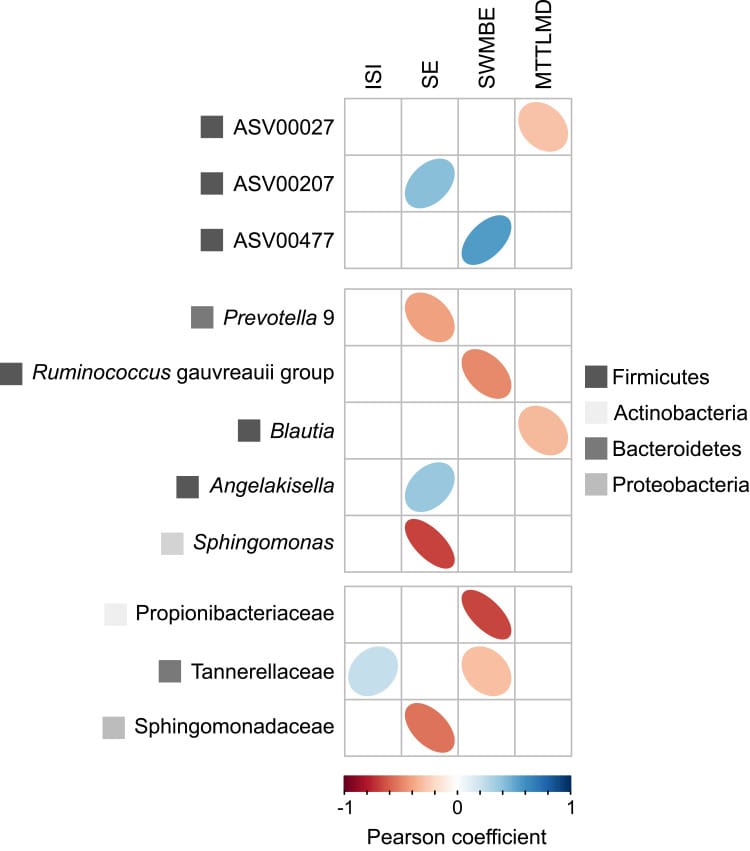
Both Lachnoclostridium and Blautia are short-chain fatty acid producers, which could connect them to the butyrate-sleep mechanism covered in the next section. Haimov et al. (2022) used two weeks of actigraphy alongside fecal microbiota sequencing in community-dwelling older adults, and found that sleep quality and cognitive performance together explained 7.5-7.9% of variance in gut microbiota composition. In a complex biological ecosystem, that is a measurable association, and it held using objective sleep measurement rather than questionnaires alone.
On the other side of the ledger, Proteobacteria is often treated as a marker of gut dysbiosis (microbial imbalance), and some probiotic sleep trials track whether interventions reduce it. Common butyrate-producing bacteria in the human colon include Faecalibacterium prausnitzii, Roseburia intestinalis, and Eubacterium hallii, but the strongest insomnia-specific evidence here is still correlational rather than proof that those species are depleted in every insomnia pattern.
A 2025 randomized controlled trial provides intervention evidence that a probiotic can change both sleep scores and microbiome composition. When Liu et al. (2025) supplemented Bifidobacterium animalis BLa80 in healthy adults with poor sleep scores, the strain reduced Proteobacteria while increasing Bacteroidetes, Fusicatenibacter, and Parabacteroides — moving the microbiome composition toward a less Proteobacteria-heavy profile while sleep quality improved.
Figure: Pearson correlations between bacterial taxa and insomnia and cognitive measurements. Pearson correlations between ASVs or taxonomic groups most associated with the canonical correspondence axis (three top ASVs/taxa for each of the four CCAs) and insomnia and cognitive measurements. ASVs/taxa for which P-values <0.05 are presented for ASV and family levels of classification; taxa for which FDR adjusted P-value <0.1 are presented for the genus level of classification. Haimov, I., Magzal, F., Tamir, S., Lalzar, M., Asraf, K., Milman, U., Agmon, M., & Shochat, T. (2022). Variation in gut microbiota composition is associated with sleep quality and cognitive performance in older adults with insomnia. Nature and Science of Sleep, 14, 1753-1767.
For the gut-cholesterol side: If your interest in gut health includes LDL-C, ApoB, or high cholesterol despite healthy diet and exercise, The Gut-LDL-C Blueprint walks through the gut-liver side of cholesterol in a self-paced format.
How Do Gut Bacteria Affect Sleep?
Pathway 1: GABA (Gamma-Aminobutyric Acid) Production
Certain bacterial strains synthesize GABA (gamma-aminobutyric acid) — the primary inhibitory neurotransmitter responsible for sleep onset and maintenance. A 2025 randomized controlled trial confirmed that Bifidobacterium animalis BLa80 has measurable GABA production capacity via HPLC analysis (high-performance liquid chromatography, a method for identifying and quantifying compounds in solution), and supplementation improved PSQI (Pittsburgh Sleep Quality Index) scores compared to placebo; ISI (Insomnia Severity Index) scores were numerically lower but did not reach statistical significance (Liu et al., 2025). GABA produced in the gut may signal to the brain through the vagus nerve — the primary neural connection between the gut and the brainstem — and other gut-brain pathways.
Pathway 2: Butyrate and the Circadian Clock
Butyrate — the short-chain fatty acid produced by Faecalibacterium, Roseburia, and Eubacterium — increased non-REM sleep by roughly 50% when administered orally in mice and 70% via intraportal injection (into the vein connecting the gut to the liver). The sleep-promoting effect did not occur with subcutaneous or intraperitoneal delivery, establishing that butyrate acts via a hepatoportal sensory mechanism in this animal model — meaning the gut-to-liver vein is the detection route, not general blood circulation (Szentirmai et al., 2019). Gut-produced butyrate has a plausible anatomical route to this receptor.
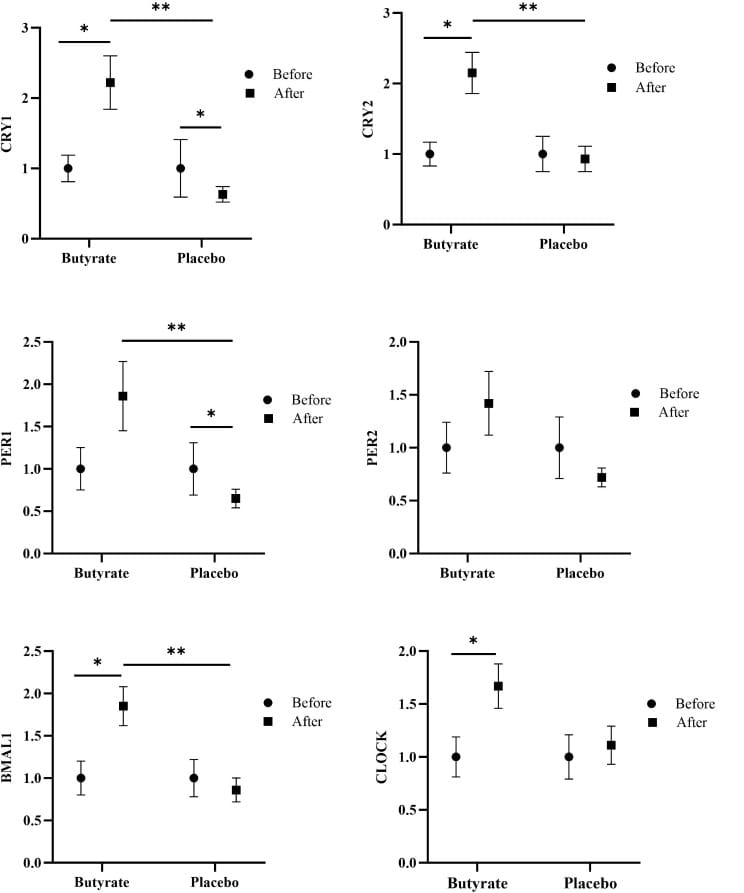
In humans, a 2024 randomized controlled trial found that butyrate supplementation (600 mg/day sodium butyrate for 12 weeks) upregulated circadian clock genes — CRY1, CRY2, PER1, and BMAL1 (all p <= 0.005) -- while improving PSQI scores by nearly 3 points while the placebo group worsened. The placebo group's sleep worsened during the same period (PSQI change: -2.94 butyrate vs. +1.16 placebo, p < 0.001). This human trial connected butyrate supplementation to circadian clock gene expression and sleep quality in people with active ulcerative colitis (Firoozi et al., 2024).
Figure: Effect of butyrate supplementation on circadian clock gene expression. The effect of intervention on circadian clock genes expression. The data were reported as mean (s.e.m) fold change (2^-DDCt) relative to baseline. P-values were obtained from the multiple linear regression test, which was adjusted for baseline PSQI, age and sex for comparisons between group analysis (** P-value <= 0.007) and one sample t test for comparisons within group analysis ( P-value <= 0.007). P-value <= 0.007 was used to determine statistical significance using the Bonferroni correction method. Firoozi, D., Masoumi, S. J., Mohammad-Kazem Hosseini Asl, S., Labbe, A., Razeghian-Jahromi, I., Fararouei, M., Lankarani, K. B., & Dara, M. (2024). Effects of short-chain fatty acid-butyrate supplementation on expression of circadian-clock genes, sleep quality, and inflammation in patients with active ulcerative colitis: A double-blind randomized controlled trial. Lipids in Health and Disease, 23*(1), 216.
Pathway 3: Tryptophan to Serotonin to Melatonin
Approximately 90% of the body’s serotonin is produced in the gut. Gut bacteria help regulate tryptophan metabolism and host serotonin biosynthesis, and serotonin serves as the biochemical precursor for melatonin synthesis in the pineal gland. This pathway is indirect — bacteria are best understood here as upstream regulators of tryptophan and serotonin availability rather than direct producers of the melatonin that controls human sleep timing. When the microbiome is depleted, tryptophan metabolism can divert toward the kynurenine pathway (an inflammatory metabolic route) instead of the serotonin pathway, reducing the substrate available for melatonin production.
Do Probiotics Help with Sleep?
Lee et al. (2021), n = 122 completers of 156 enrolled: Lactobacillus reuteri NK33 (2.0 x 10^9 CFU) combined with Bifidobacterium adolescentis NK98 (0.5 x 10^9 CFU) for 8 weeks. ISI scores dropped in the probiotic group versus placebo (p = 0.006). The rate of meaningful improvement: 28.6% in the probiotic group versus 11.9% in the placebo group (p = 0.022). IL-6 (interleukin-6, a pro-inflammatory cytokine) also decreased in the probiotic group (p = 0.041), consistent with a possible connection between the sleep benefit and reduced inflammation. The gut microbiome changed in composition: Bifidobacteriaceae increased, while Enterobacteriaceae and Proteobacteria showed nonsignificant downward trends and the Proteobacteria/Actinobacteria ratio decreased significantly.
Patterson et al. (2024), n = 89: Bifidobacterium longum 1714 for 8 weeks in adults with impaired sleep quality. The PSQI sleep quality component improved at week 4 (p < 0.05), with reduced daytime dysfunction. An honest limitation: actigraphy (objective sleep tracking) did not show differences between groups. The benefit was subjective -- participants reported better sleep, but the wrist-worn device did not detect changes in sleep duration or timing. Subjective improvement without objective confirmation leaves room for placebo effects.
Liu et al. (2025), n = 101 completers of 106 enrolled: Bifidobacterium animalis BLa80 at 10 billion CFU for 8 weeks. PSQI improved versus placebo (p = 0.005); ISI was numerically lower but did not reach statistical significance (p = 0.211). The microbiome moved toward a less Proteobacteria-heavy profile (reduced Proteobacteria, increased Bacteroidetes). GABA production was confirmed in vitro via HPLC, providing a mechanistic explanation for the sleep benefit.
Ahmad et al. (2025), n = 99: Lactobacillus rhamnosus GG (10 billion CFU) combined with Bifidobacterium longum (5 billion CFU) for 12 weeks. Sleep efficiency improved from 78.5% to 86.2% (p < 0.001) -- a 7.7 percentage point gain that is sizable for a sleep-efficiency outcome. REM sleep latency (the time from sleep onset to the first REM period) decreased by 26 minutes (p < 0.001). Fecal butyrate increased from 12.3 to 16.5 micrograms/mL (p < 0.001), confirming the short-chain fatty acid mechanism in living subjects rather than in a laboratory dish. Microbial diversity also increased: the Shannon index (a measure of community richness and evenness) rose from 3.8 to 4.2 (p = 0.002).
Does Sleep Deprivation Harm Gut Bacteria?
Sleep deprivation does not just result from a disrupted microbiome — it can alter the microbiome in return. A 2026 systematic review found that sleep deprivation reduced alpha diversity and shifted gut taxonomy overall, although human studies were still limited by small sample sizes. This supports a loop model, but the exact organisms and metabolites involved are not yet settled in humans.
Two of the probiotic trials provide indirect evidence for improving sleep while microbiome markers shift in a favorable direction. In the Ahmad et al. (2025) trial, when probiotics increased microbial diversity (Shannon index rose from 3.8 to 4.2, p = 0.002) and butyrate levels climbed, sleep efficiency improved by 7.7 percentage points in the same participants. The Liu et al. (2025) trial showed a parallel pattern: supplementing BLa80 reduced Proteobacteria while improving PSQI sleep-quality scores. Both trials suggest that restoring the microbiome may be one way to support better sleep quality.
Lee et al. (2021) adds another dimension: in the probiotic group, IL-6 decreased alongside a significant Proteobacteria/Actinobacteria ratio reduction and nonsignificant downward trends in Enterobacteriaceae and Proteobacteria. The inflammatory and dysbiotic components moved together. This supports a model where the cycle may run partly through inflammation as the intermediary — disrupted microbiome composition drives up inflammatory markers, and those inflammatory markers fragment sleep.
Gut-driven inflammation is one contributor to sleep disruption, but it can compound with hormonal changes, metabolic patterns, circadian timing problems, or autonomic dysregulation. Identifying which causes are active helps direct the response.
Find out which causes might be driving your 3am wakeups ->
Frequently Asked Questions
Which Gut Bacteria Improve Sleep Duration?
Patterson et al. (2024) found no actigraphy-measured duration change despite subjective sleep quality improvement. Ahmad et al. (2025) improved sleep efficiency (more time asleep within the sleep window) and reduced REM latency, but the gains were architectural — meaning the structure of sleep improved within the existing time frame, not the total hours. Sleep quality scores (PSQI, ISI) and efficiency metrics respond to probiotic supplementation; raw duration has not been reliably shown to change in published trials.
Does the Microbiome Produce Melatonin?
Approximately 90% of the body’s serotonin is produced in the gut. The microbiome regulates the raw material supply for melatonin, but the evidence for human sleep is strongest for upstream tryptophan-serotonin regulation rather than direct bacterial production of sleep-timing melatonin. When the microbiome is disrupted, tryptophan metabolism can divert toward the kynurenine pathway (an inflammatory route) instead of the serotonin pathway, reducing the substrate available for melatonin. The microbiome’s contribution to melatonin is therefore upstream and indirect: it controls how much tryptophan goes toward serotonin rather than toward inflammatory metabolites.
What Is the Connection Between Irritable Bowel Syndrome and Insomnia?
Firoozi et al. (2024) studied butyrate supplementation in people with ulcerative colitis (a related inflammatory gut condition, but not the same condition as IBS) and found that sleep quality improved alongside circadian clock gene upregulation and reduced inflammatory markers (fecal calprotectin decreased by 134 units in the butyrate group while increasing by 52 in the placebo group). The gut-brain axis can connect intestinal inflammation to brain arousal through both vagal nerve transmission and circulating cytokine release. The relationship is bidirectional: poor sleep worsens gastrointestinal inflammation, and gastrointestinal inflammation fragments sleep.
Related Reading
- Inflammatory Sleep Disruption — the cause overview for cytokines, histamine, gut inflammation, neuroinflammation, and circadian immune timing
- How Does Leaky Gut Affect Sleep? — how gut permeability and LPS signaling can contribute to sleep fragmentation
- Does Poor Sleep Cause Brain Inflammation? — how neuroinflammation and sleep loss can reinforce each other
- How Does the Glymphatic System Work During Sleep? — how brain waste clearance depends on sleep depth and continuity
- What Is the Connection Between Chronic Inflammation and Insomnia? — how cytokines, sleep loss, and arousal can form a repeating loop
References
1. Ahmad, S. R., AlShahrani, A. M., & Kumari, A. (2025). Effects of probiotic supplementation on depressive symptoms, sleep quality, and modulation of gut microbiota and inflammatory biomarkers: A randomized controlled trial. Brain Sciences, 15(7), 761. https://pubmed.ncbi.nlm.nih.gov/40722352/
2. Firoozi, D., Masoumi, S. J., Mohammad-Kazem Hosseini Asl, S., Labbe, A., Razeghian-Jahromi, I., Fararouei, M., Lankarani, K. B., & Dara, M. (2024). Effects of short-chain fatty acid-butyrate supplementation on expression of circadian-clock genes, sleep quality, and inflammation in patients with active ulcerative colitis: A double-blind randomized controlled trial. Lipids in Health and Disease, 23(1), 216. https://pubmed.ncbi.nlm.nih.gov/39003477/
3. Haimov, I., Magzal, F., Tamir, S., Lalzar, M., Asraf, K., Milman, U., Agmon, M., & Shochat, T. (2022). Variation in gut microbiota composition is associated with sleep quality and cognitive performance in older adults with insomnia. Nature and Science of Sleep, 14, 1753-1767. https://pubmed.ncbi.nlm.nih.gov/36225322/
4. Lee, H. J., Hong, J. K., Kim, J.-K., Kim, D.-H., Jang, S. W., Han, S.-W., & Yoon, I.-Y. (2021). Effects of probiotic NVP-1704 on mental health and sleep in healthy adults: An 8-week randomized, double-blind, placebo-controlled trial. Nutrients, 13(8), 2660. https://pubmed.ncbi.nlm.nih.gov/34444820/
5. Liu, Y., Chen, Y., Zhang, Q., Zhang, Y., & Xu, F. (2025). A double blinded randomized placebo trial of Bifidobacterium animalis subsp. lactis BLa80 on sleep quality and gut microbiota in healthy adults. Scientific Reports, 15(1), 11095. https://pubmed.ncbi.nlm.nih.gov/40169760/
6. Patterson, E., Tan, H. T. T., Groeger, D., Andrews, M., Buckley, M., Murphy, E. F., & Groeger, J. A. (2024). Bifidobacterium longum 1714 improves sleep quality and aspects of well-being in healthy adults: A randomized, double-blind, placebo-controlled clinical trial. Scientific Reports, 14(1), 3725. https://pubmed.ncbi.nlm.nih.gov/38355674/
7. Rivière, A., Selak, M., Lantin, D., Leroy, F., & De Vuyst, L. (2016). Bifidobacteria and butyrate-producing colon bacteria: Importance and strategies for their stimulation in the human gut. Frontiers in Microbiology, 7, 979. https://pubmed.ncbi.nlm.nih.gov/27446020/
8. Roth, W., Zadeh, K., Vekariya, R., Ge, Y., & Mohamadzadeh, M. (2021). Tryptophan metabolism and gut-brain homeostasis. International Journal of Molecular Sciences, 22(6), 2973. https://pubmed.ncbi.nlm.nih.gov/33804088/
9. Shin, N. R., Whon, T. W., & Bae, J. W. (2015). Proteobacteria: Microbial signature of dysbiosis in gut microbiota. Trends in Biotechnology, 33(9), 496-503. https://pubmed.ncbi.nlm.nih.gov/26210164/
10. Supasitdikul, T., Mazariegos, J. R. R., Nhat, N. N., Tung, Y. T., Yang, D. F., Lee, L. J., Gunawan, S. P., & Chen, Y. C. (2026). Sleep deprivation alters gut microbiome diversity and taxonomy: A systematic review and meta-analysis of human and rodent studies. Journal of Sleep Research, 35(2), e70125. https://pubmed.ncbi.nlm.nih.gov/40562421/
11. Szentirmai, E., Millican, N. S., Massie, A. R., & Kapas, L. (2019). Butyrate, a metabolite of intestinal bacteria, enhances sleep. Scientific Reports, 9(1), 7035. https://pubmed.ncbi.nlm.nih.gov/31065013/
12. Wang, B., Duan, R., & Duan, L. (2018). Prevalence of sleep disorder in irritable bowel syndrome: A systematic review with meta-analysis. Saudi Journal of Gastroenterology, 24(3), 141-150. https://pubmed.ncbi.nlm.nih.gov/29652034/
13. Yano, J. M., Yu, K., Donaldson, G. P., Shastri, G. G., Ann, P., Ma, L., Nagler, C. R., Ismagilov, R. F., Mazmanian, S. K., & Hsiao, E. Y. (2015). Indigenous bacteria from the gut microbiota regulate host serotonin biosynthesis. Cell, 161(2), 264-276. https://pubmed.ncbi.nlm.nih.gov/25860609/
Written by Kat Fu, M.S., M.S. ? Last reviewed: February 25, 2026 ? 13 references cited