

If you wake up between 2am and 4am – fully alert, heart pounding, unable to fall back asleep – histamine may be one neurotransmitter involved. Histamine is not just the molecule behind allergies and itchy eyes. It is one of the brain’s primary arousal drivers, with neuronal histamine following a circadian rhythm that tracks wakefulness and plasma histamine showing an early-morning rise in a small human study. And the source of that nocturnal histamine is not limited to neurons – immune cells called mast cells release histamine on their own circadian schedule, with implications for anyone dealing with inflammation or immune activation. This article covers the histamine-wakefulness pathway, the role of mast cells in nocturnal histamine release, and why the pre-dawn cortisol rise may add a separate arousal input. For the broader picture of how inflammation disrupts sleep through multiple pathways, see Inflammatory Sleep Disruption.
How Does Histamine Control Wakefulness in the Brain?
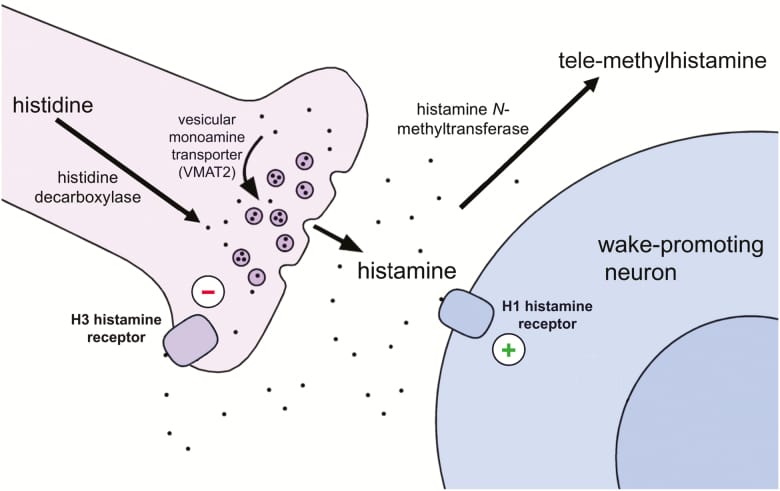
The tuberomammillary nucleus, a small cluster of neurons in the posterior hypothalamus, is the brain’s sole source of neuronal histamine (Scammell et al., 2019). These neurons project diffusely to the cortex, thalamus, and many major wake-promoting regions. During wakefulness, they fire actively. During both NREM and REM sleep, they fire little during NREM sleep and are essentially silent during REM sleep.
This on-off behavior is maintained by a mutual inhibition circuit. The ventrolateral preoptic area (VLPO), the brain’s primary sleep-promoting region, releases GABA onto tuberomammillary neurons to suppress histamine output and initiate sleep. In the opposite direction, histamine from the tuberomammillary nucleus inhibits the VLPO to maintain wakefulness. This mutual inhibition creates a stable toggle – the brain is either in a wake-dominant state or a sleep-dominant state, with rapid transitions between them (Saper et al., 2005; Scammell et al., 2019).
The H1 receptor is a major downstream pathway through which histamine promotes wakefulness. In mice lacking the H1 receptor, the arousal-promoting effect of histamine is abolished – even when histamine release is pharmacologically increased, the animals show no wakefulness response (Huang et al., 2006). This is also why first-generation antihistamines (diphenhydramine, doxylamine) cause drowsiness: they cross the blood-brain barrier and block H1 receptors on cortical neurons, reducing the wake-promoting input from the tuberomammillary nucleus.
What makes histamine different from other wake-promoting neurotransmitters is its function during states of heightened arousal. Histamine neurons show their highest activity during attentive wakefulness – exploration, danger assessment, and situations requiring heightened vigilance – rather than during calm rest (Mochizuki, 2022). The brain’s histamine response acts like an alerting mechanism. When mast cells release histamine during sleep, the brain may receive an additional wake-promoting input.
What Is a Histamine Dump at Night?
The tuberomammillary nucleus is not the only source of histamine in the brain. Mast cells – immune cells embedded in brain tissue – contribute a large share of total brain histamine. When mast cells are absent in animal models, basal sleep-wake amounts are not significantly different, but rebound after sleep deprivation is attenuated, compound 48/80 no longer increases wakefulness, and some H1-receptor-blocking antihistamines lose their sleep-promoting effect (Chikahisa et al., 2013). This means mast cell-derived histamine is a contributor to the brain’s arousal response, especially when mast cells are activated.
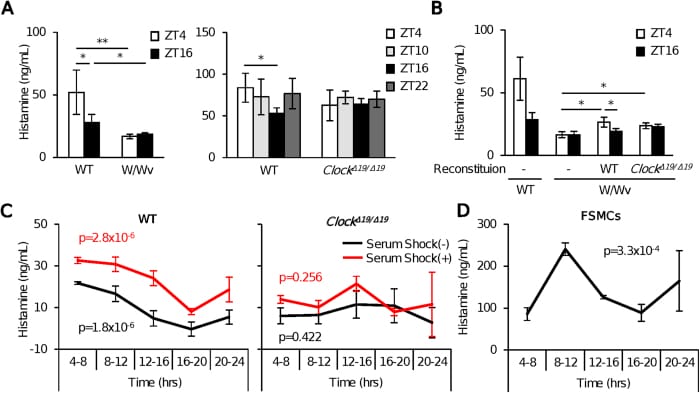
What makes the nocturnal histamine peak predictable is that mast cells have their own internal molecular clock. Nakamura et al. (2017) demonstrated that mast cells contain clock genes (CLOCK, BMAL1, Period2) that drive circadian oscillation of histamine release through transcriptional control of OCT3, a histamine transporter. In mast cell-deficient mice, plasma histamine lost its circadian rhythm. When these mice were reconstituted with mast cells carrying a mutant Clock gene, the circadian histamine pattern did not return. The mast cell clock is one important source of the histamine rhythm.
In one small study of 12 healthy volunteers, plasma histamine showed its largest rise in the early morning hours, with an average peak around 5:25am (Rehn et al., 1987). This peak coincides with the timing of allergic flares in asthmatics and the early-morning waking pattern described here. During normal conditions, the peak usually stays below the arousal threshold and sleep continues. But when mast cell activation is elevated – from chronic inflammation, immune imbalance, or prolonged stress – the amplitude of the peak may increase. More histamine may be present in the late sleep period than the sleep-maintenance circuit can override, and the result is sudden, full wakefulness.
Stress desynchronizes this clock. In the same study, mice subjected to chronic restraint stress showed complete loss of circadian histamine oscillation – the normal rhythm flattened, and histamine release became erratic rather than timed (Nakamura et al., 2017). This matters because stress can alter mast-cell clock timing in animal models, which may help explain why stress and immune activation can make early-morning waking more likely.
Does Cortisol Affect Histamine Levels at Night?
The cortisol awakening response – a rapid increase in cortisol output across the first 30 to 45 minutes after morning awakening – is a normal part of the diurnal hormonal rhythm. Its function is to prepare the body for daytime activity: mobilizing energy, shaping immune activity, and increasing alertness.
The problem arises when this cortisol rise intersects with an already-elevated histamine peak. This interaction is better understood as convergence rather than direct cortisol-triggered histamine release. Glucocorticoids generally restrain mast-cell degranulation and mediator release. Cortisol-related alerting and histamine-related alerting can still occur in the same late-sleep window.
This creates a possible convergence of arousal signals during a vulnerable time. Between the late sleep period and early morning, the mast cell clock may be driving histamine toward a circadian high. As morning approaches, cortisol-related alerting also increases. These inputs may converge and make the VLPO-TMN sleep-maintenance circuit more likely to switch toward waking (Saper et al., 2005; Scammell et al., 2019; Stalder et al., 2025).
Meckes & Meckes (2025) documented a case in which a 74-year-old individual with post-viral inflammatory insomnia – with Oura Ring sleep scores in the 30-40 range – showed recovery to scores above 75 within 24 hours of initiating histamine-targeted steps (initial H1 blockade and environmental histamine reduction, followed later by low-histamine diet, loratadine, and famotidine). The speed of this response is consistent with histamine pathways contributing to the arousal pattern, although a single case report cannot establish histamine as the primary driver for everyone.
How Common Is Histamine-Driven Insomnia?
Weinstock et al. (2025) studied 553 people with mast cell activation syndrome (MCAS) alongside 558 controls. Among women with MCAS, 58.7% reported severe chronic insomnia, compared to 24.0% of controls – an odds ratio of 4.8. Among men with MCAS, 42.1% reported severe chronic insomnia versus 9.0% of controls – an odds ratio of 7.7. Sleep attacks (sudden, irresistible sleep episodes) occurred in over 40% of women in the MCAS group.
These numbers represent the formally identified end of a broader spectrum. MCAS identification requires meeting defined criteria, and many people with elevated mast cell activity or histamine intolerance do not meet that threshold. The gap between full MCAS and normal mast cell function contains a range of intermediate states where histamine may be elevated enough to disrupt sleep but not elevated enough to produce the multi-organ involvement that prompts a full workup.
Several patterns may indicate that histamine is contributing to sleep disruption. Waking between 2am and 4am with sudden full alertness (rather than the gradual, groggy waking of other sleep disturbances) is consistent with a histamine-mediated arousal. Accompanying congestion, nasal swelling, skin flushing, itching, or a racing heart during the waking episode can accompany mast-cell mediator release. A pattern that worsens with high-histamine foods consumed in the evening (aged cheese, fermented foods, wine, cured meats) or improves with dietary histamine reduction is another pattern to consider.
The Weinstock et al. (2025) data also showed that antihistamine therapy rated 6.3 out of 10 on a self-reported benefit scale for neuropsychiatric effects across the MCAS population – partial but not complete relief, consistent with histamine being one of several mediators released by activated mast cells.
Many people have more than one cause contributing to their sleep disruption. Histamine-driven waking may compound with autonomic, metabolic, hormonal, or circadian factors. Identifying which causes might be involved is a useful next step.
Find out which causes might be driving your 3am wakeups ->
Frequently Asked Questions
Does Histamine Cause Insomnia?
Histamine promotes wakefulness through the H1 receptor on cortical neurons. When histamine is elevated during sleep hours – whether from tuberomammillary neuron activity that does not fully suppress, or from mast cell degranulation – the brain receives a sustained wake-promoting input that opposes sleep maintenance. The circadian peak in histamine release during the late sleep period or early morning means that even a moderate elevation in baseline mast cell activity can become sufficient to break through sleep during this window. In the Weinstock et al. (2025) study, the strong association between mast cell activation and chronic insomnia (odds ratios of 4.8-7.7) provides population-level evidence for histamine as a contributor to sleep disruption.
Does Histamine Prevent Deep Sleep?
The tuberomammillary nucleus must reduce firing for NREM sleep and become silent for REM sleep to occur. Histamine-deficient mice (HDC knockouts) show altered sleep architecture with changes in both NREM and REM distribution (Scammell et al., 2019). In the other direction, elevated histamine holds the tuberomammillary neurons in a firing state, maintaining cortical arousal and making it harder for the brain to transition into the deeper stages where slow-wave activity and memory consolidation occur. The result can be lighter, more fragmented sleep even when total sleep time appears adequate.
How Do You Stop Histamine From Waking You at Night?
Reducing dietary histamine load in the evening (limiting aged cheeses, fermented foods, cured meats, and alcohol) may reduce total histamine burden in people with histamine intolerance. Supporting diamine oxidase (DAO), the enzyme that breaks down ingested histamine in the gut, is another avenue – DAO activity can be impaired by alcohol, certain medications, and gut inflammation. Reducing overall inflammatory load through gut health, stress management, and identifying immune triggers addresses the upstream activation that drives mast cell degranulation. The combination of contributing factors varies between individuals, which is why identifying the specific upstream driver – gut permeability, chronic immune activation, stress – matters more than applying the same dietary or enzyme-support steps to everyone.
Are Mast Cells Connected to Circadian Rhythm?
Nakamura et al. (2017) demonstrated that mast cells are not passive immune cells that release histamine only in response to allergens – they follow an internally generated circadian rhythm of activation. The transcription factor CLOCK binds to the promoter region of OCT3 (a histamine transporter) in mast cells, creating a time-dependent pattern of histamine release that peaks in the early morning hours. When this clock is intact, the histamine peak is predictable and, in healthy individuals, stays below the arousal threshold. When chronic stress or circadian disruption (such as irregular sleep schedules or overnight work rotations) desynchronizes the mast cell clock, histamine release can become less rhythmic or mistimed – both of which may increase the likelihood of nocturnal waking.
Related Reading
- Inflammatory Sleep Disruption — the cause overview for cytokines, histamine, gut inflammation, neuroinflammation, and circadian immune timing
- Can Histamine Intolerance Cause Sleep Problems? — how DAO capacity and mast-cell activation can compound sleep disruption
- Why Is Inflammation Worse at Night? — how NF-kB and circadian immune timing shape pre-dawn inflammatory activity
- Can Inflammation Cause 3am Wakeups? — how inflammatory signaling can create early-morning wakeups
- Can Chronic Stress Cause Insomnia Through Inflammation? — how stress load, inflammatory signaling, and hyperarousal reinforce each other
- Mast Cell Activation and Sleep — how mast-cell mediators can disrupt sleep and nighttime arousal
- Circadian Disruption and Inflammation — how circadian misalignment can amplify inflammatory sleep disruption
References
1. Amin, K. (2012). The role of mast cells in allergic inflammation. Respiratory Medicine, 106(1), 9-14. https://pubmed.ncbi.nlm.nih.gov/22112783/
2. Chikahisa, S., Kodama, T., Soya, A., Sagawa, Y., Ishimaru, Y., Sei, H., & Nishino, S. (2013). Histamine from brain resident MAST cells promotes wakefulness and modulates behavioral states. PLoS ONE, 8(10), e78434. https://pubmed.ncbi.nlm.nih.gov/24205232/
3. Huang, Z. L., Mochizuki, T., Qu, W. M., Hong, Z. Y., Watanabe, T., Urade, Y., & Hayaishi, O. (2006). Altered sleep-wake characteristics and lack of arousal response to H3 receptor antagonist in histamine H1 receptor knockout mice. Proceedings of the National Academy of Sciences of the United States of America, 103(12), 4687-4692. https://pubmed.ncbi.nlm.nih.gov/16537376/
4. Maintz, L., & Novak, N. (2007). Histamine and histamine intolerance. The American Journal of Clinical Nutrition, 85(5), 1185-1196. https://pubmed.ncbi.nlm.nih.gov/17490952/
5. Meckes, A. J., & Meckes, J. W. (2025). Case Report: A case of post-viral inflammatory insomnia: observed sleep restoration associated with histamine-targeted interventions and implications for mast cell pathways. Frontiers in Sleep, 4, 1736866. https://pubmed.ncbi.nlm.nih.gov/41640426/
6. Mochizuki, T. (2022). Histamine as an alert signal in the brain. Current Topics in Behavioral Neuroscience, 59, 413-425. https://pubmed.ncbi.nlm.nih.gov/34448132/
7. Nakamura, Y., Ishimaru, K., Shibata, S., & Nakao, A. (2017). Regulation of plasma histamine levels by the mast cell clock and its modulation by stress. Scientific Reports, 7, 39934. https://pubmed.ncbi.nlm.nih.gov/28074918/
8. Rehn, D., Reimann, H. J., von der Ohe, M., Schmidt, U., Schmel, A., & Hennings, G. (1987). Biorhythmic changes of plasma histamine levels in healthy volunteers. Agents and Actions, 22(1-2), 24-29. https://pubmed.ncbi.nlm.nih.gov/3687597/
9. Saper, C. B., Scammell, T. E., & Lu, J. (2005). Hypothalamic regulation of sleep and circadian rhythms. Nature, 437(7063), 1257-1263. https://pubmed.ncbi.nlm.nih.gov/16251950/
10. Scammell, T. E., Jackson, A. C., Franks, N. P., Wisden, W., & Dauvilliers, Y. (2019). Histamine: neural circuits and new medications. Sleep, 42(1), zsy183. https://pubmed.ncbi.nlm.nih.gov/30239935/
11. Stalder, T., Oster, H., Abelson, J. L., Huthsteiner, K., Klucken, T., & Clow, A. (2025). The cortisol awakening response: Regulation and functional significance. Endocrine Reviews, 46(1), 43-59. https://pubmed.ncbi.nlm.nih.gov/39177247/
12. Weinstock, L. B., Afrin, L. B., Reiersen, A. M., Brook, J., Blitshteyn, S., Ehrlich, G., Schofield, J. R., Kinsella, L., Kaufman, D., Dempsey, T., & Molderings, G. J. (2025). Prevalence and treatment response of neuropsychiatric disorders in mast cell activation syndrome. Brain, Behavior, & Immunity – Health, 48, 101048. https://pubmed.ncbi.nlm.nih.gov/40686928/
Written by Kat Fu, M.S., M.S. ? Last reviewed: January 19, 2026 ? 12 references cited