

“Wired but exhausted” is a recurring description in insomnia communities — tired enough to collapse, but the brain remains alert. This maps to a documented inflammatory timing pattern: in one chronic insomnia study, IL-6 peaked in the evening rather than around 4am, while TNF-α lost its normal circadian rhythm and followed a regular 4-hour daytime rhythm. That timing change may contribute to daytime fatigue while weakening the nighttime cytokine pattern linked with sleep consolidation.
This article covers the inflammatory mechanism behind that experience — the bidirectional relationship between inflammation and insomnia, the cytokine timing change that may contribute to daytime exhaustion with nighttime hyperarousal, and the evidence that improving insomnia can lower selected inflammatory markers. For the broader overview of how inflammation disrupts sleep, see the parent article: Inflammatory Sleep Disruption.
How Does Inflammation Cause Insomnia?
The relationship between inflammation and sleep is not linear. IL-1β and TNF-α are classified as sleep-regulatory substances — at low, physiological concentrations, they promote NREM sleep duration. When inflammatory activity remains elevated or higher-dose, that sleep-regulatory role can become disruptive. Experimental sleep-immunity work shows that higher doses can suppress REM and, at high levels, inhibit both NREM and REM.
TNF-α acts locally in the cortex. When TNF-α or IL-1β is applied to one side of the cortex in animal models, it changes slow-wave activity on that side more than the opposite side. That suggests cytokine effects on sleep can be regional rather than uniform across the brain.
The meta-analytic evidence supports this relationship in humans. Irwin et al. (2016) analyzed 72 studies with over 50,000 participants and found that chronic sleep disturbance was associated with elevated IL-6 (effect size 0.20) and CRP (effect size 0.12). These are modest individual effect sizes, but they are consistent across study designs and populations — and they represent sustained, low-grade inflammation rather than an acute immune response.
At the molecular level, the clearest human evidence in this article is NF-κB activation after partial sleep deprivation. Sleep-immunity reviews also place IL-1β and TNF-α within innate immune pathways that help regulate NREM sleep.
How Does Sleep Loss Cause Inflammation?
The reverse direction of the inflammation-insomnia relationship — sleep restriction driving inflammation — is also documented.
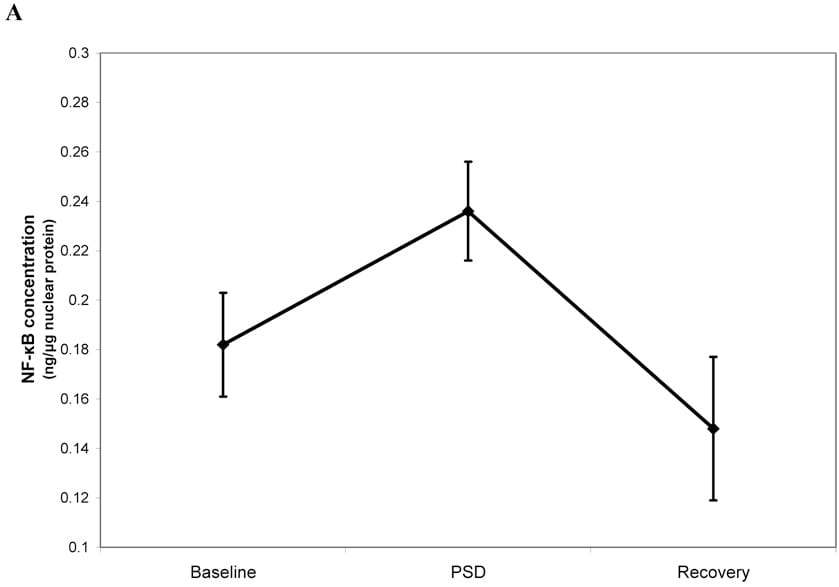
Irwin et al. (2008) conducted one of the earliest mechanistic studies. In 14 healthy adults (mean age 51.8 years), a single night of partial sleep deprivation produced a 30% increase in NF-κB activation in peripheral blood mononuclear cells compared to baseline. NF-κB is a central inflammatory transcription factor — it helps regulate the expression of genes encoding IL-6, TNF-α, and IL-1β. One night was enough to activate it.
The study also revealed a sex difference: the NF-κB response was statistically detectable in female participants but not in male participants. Leukocyte populations did not change, indicating that the effect was direct molecular activation of existing immune cells — not recruitment of new inflammatory cells.
NF-κB DNA binding in peripheral blood mononuclear cells after baseline, partial night sleep deprivation, and recovery sleep in total sample (A) and in separate groups of females and males (B). Irwin, M. R., et al. (2008). Biological Psychiatry, 64(6), 538-540.
When sleep restriction extends beyond a single night, the inflammatory load can accumulate. Haack et al. (2007) randomized 18 healthy adults to either 4-hour or 8-hour sleep conditions across a 12-day study period, with inflammatory sampling after the 10th experimental day. The 4-hour group showed sustained IL-6 elevation that correlated with heightened pain sensitivity (r=0.67, P<0.01). This is not an abstract biomarker finding — the elevated IL-6 from sleep restriction was strongly associated with increased physical pain, which itself can further fragment sleep.
The speed of this cascade matters. Different inflammatory measures appear on different timelines: NF-κB activation changed after one partial night of sleep deprivation in Irwin et al. (2008), while circulating IL-6 and CRP changes were detected after three or more nights of partial sleep restriction in Ballesio et al. (2026).
Why Does Inflammation Make You Tired But Unable to Sleep?
This is the finding that may help explain one part of the “wired but tired” experience at the molecular level.
Vgontzas et al. (2002) compared 24-hour cytokine secretion patterns in 11 chronic insomnia participants and 11 healthy controls. In healthy sleepers, IL-6 secretion peaked at approximately 4am and TNF-α followed a regular circadian pattern — a timing pattern consistent with overnight sleep consolidation. In the chronic insomnia group, the IL-6 peak had moved to approximately 7pm, and TNF-α lost its circadian rhythm, instead following a regular but abnormal 4-hour secretory pulse pattern throughout the day.
The distinction is not just elevated cytokines — it is temporal timing. The participants with chronic insomnia were not producing more cytokines overall; they were producing them at a different time. Daytime cytokine surges may contribute to the fatigue, cognitive sluggishness, and sensation of exhaustion that characterize chronic insomnia. Flattened nighttime cytokine concentrations may reduce the immune contribution to sleep consolidation.
The cortisol data adds another dimension. Dressle et al. (2022) conducted a meta-analysis of 20 case-control studies (449 people with insomnia, 357 healthy controls) and found that people with chronic insomnia show moderately elevated cortisol compared to healthy sleepers (standardized mean difference = 0.50). The authors frame chronic insomnia as a 24-hour hyperarousal state. Higher cortisol is consistent with that model because cortisol supports arousal physiology: heart rate, alertness, and energy mobilization.
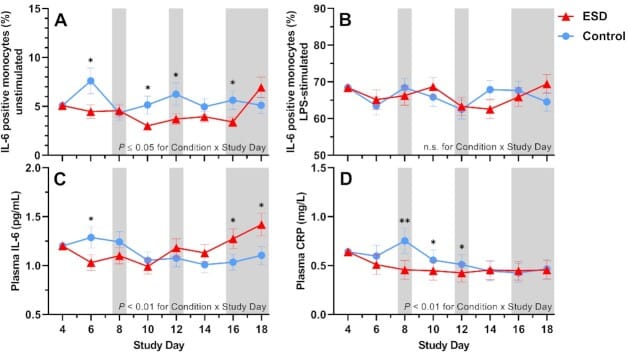
The sex-dependent dimension matters here. Besedovsky et al. (2022) used a controlled 19-day in-hospital study design to examine how prolonged sleep disturbance affects inflammation differently in women and men. In women, peripheral inflammatory markers (IL-6, CRP) decreased — possibly related to intermittent cortisol increases during the experimental sleep-disturbance condition. In men, the response was predominantly pro-inflammatory, with reduced cortisol and elevated IL-6 and monocyte cytokine production. This means the “wired but tired” phenotype may be driven by different inflammatory profiles depending on sex, and blood markers alone may not capture the full picture in women.
*Effects of ESD on humoral immune parameters. Data present estimated marginal means ± SEM based on GLMMs for (A) unstimulated IL-6 positive monocytes, (B) LPS-stimulated IL-6 positive monocytes, (C) plasma IL-6 levels, and (D) plasma CRP levels for the ESD condition (red lines) and the control condition (blue lines). The gray shaded area indicates recovery periods with an 8-hour sleep opportunity per night; **P < 0.01, P < 0.05; n.s., not significant. n = 22-24. Besedovsky, L., et al. (2022). Differential effects of an experimental model of prolonged sleep disturbance on inflammation in healthy females and males. PNAS Nexus, 1(1), pgac004.
Can Resolving Insomnia Lower Inflammation?
This is the finding that closes the loop.
Irwin et al. (2015) randomized 123 older adults with insomnia to one of three groups: CBT-I, Tai Chi Chih (a movement-based practice), or a sleep education control. Compared with the sleep-education control, the CBT-I group showed reduced CRP at months 4 and 16, reduced monocyte production of pro-inflammatory cytokines at month 2, and reduced pro-inflammatory gene expression at month 4. Both CBT-I and Tai Chi reduced NF-κB and AP-1 transcriptional activity — inflammatory transcription pathways involved in cytokine activity.
The durability of the effect is notable. At 16-month follow-up, the CRP reduction in the CBT-I group persisted. In that marker, the effect remained after the active phase of the study ended.
Savin et al. (2023) conducted a review of 15 randomized controlled trials (N=2,067 participants) examining CBT-I effects on cardiometabolic biomarkers. HbA1c and CRP showed improvements reported consistently across studies, with CRP reductions reported in three studies versus controls. IL-6 and TNF-α effects were more variable across studies, suggesting CRP is among the inflammatory markers with consistent evidence of improvement to insomnia resolution.
What this means for the bidirectional relationship: insomnia-focused behavioral approaches can reduce selected inflammatory markers even when the strategy does not target inflammation directly. As sleep continuity improves, the inflammatory contribution from sleep loss may ease as well.
Chronic insomnia can be both a downstream consequence of inflammation and a modifiable contributor to inflammatory load. When the insomnia side of the relationship improves, selected inflammatory markers can improve too.
Chronic inflammation might be one of several causes contributing to 3am waking — but it often compounds with other mechanisms. Autonomic dysregulation, hormonal changes, circadian misalignment, or gut permeability might all be active at the same time, each amplifying the others. Identifying which causes might be driving your pattern is a useful next step before deciding where to focus.
Find out which causes might be driving your 3am wakeups ->
Frequently Asked Questions
Can Cytokines Cause Insomnia?
Part of the mechanism is direct. TNF-α and IL-1β are classified as somnogenic cytokines — they have direct effects on local cortical networks and sleep-regulatory pathways that regulate sleep-wake transitions. Chronic elevation from conditions like autoimmune disease, persistent gut inflammation, or sustained psychological stress may contribute to fragmented sleep when cytokine activity remains elevated or mistimed. The meta-analytic data from Irwin et al. (2016) — 72 studies, over 50,000 participants — supports that this association is consistent across populations and study designs.
What Inflammatory Markers Are Associated With Poor Sleep?
TNF-α has a strong mechanistic role in sleep regulation, but Irwin et al. (2016) did not find a consistent meta-analytic association between circulating TNF-α and sleep disturbance or sleep duration. Its measurement in standard blood panels is also less standardized than CRP. Fasting insulin and ferritin are indirect markers that can provide context about metabolic or iron-related inflammatory status, but they are not sleep-specific inflammatory markers.
For someone tracking the inflammation-insomnia relationship over time, hs-CRP is a practical marker with a broad sleep-inflammation evidence base. It is inexpensive, widely available, and is among the markers that improved in CBT-I biomarker studies (Savin et al., 2023).
Does Interleukin-6 Affect Sleep?
The circadian IL-6 timing change is one of the clearest inflammatory timing findings in chronic insomnia. Vgontzas et al. (2002) also found altered TNF-α timing, which suggests inflammatory insomnia can involve timing changes across more than one cytokine.
Can Tumor Necrosis Factor Cause Sleep Problems?
In the chronic insomnia population studied by Vgontzas et al. (2002), TNF-α lost its normal circadian rhythm and instead followed a regular but abnormal 4-hour secretory pulse pattern throughout the day. This loss of TNF-α circadian patterning, combined with the IL-6 temporal timing change, may contribute to the 24-hour dysregulation of immune and arousal pathways that maintains the “wired but tired” state.
Related Reading
- Inflammatory Sleep Disruption — the cause overview for cytokines, histamine, gut inflammation, neuroinflammation, and circadian immune timing
- How Does Leaky Gut Affect Sleep? — how gut permeability and LPS signaling can contribute to sleep fragmentation
- Gut Bacteria and Insomnia — which microbial pathways and metabolites are linked with sleep
- Does Poor Sleep Cause Brain Inflammation? — how neuroinflammation and sleep loss can reinforce each other
- How Does the Glymphatic System Work During Sleep? — how brain waste clearance depends on sleep depth and continuity
References
1. Ballesio, A., Fiori, V., & Lombardo, C. (2026). Effects of experimental sleep deprivation on peripheral inflammation: An updated meta-analysis of human studies. Journal of Sleep Research, 35(1), e70099. https://pubmed.ncbi.nlm.nih.gov/40474574/
2. Besedovsky, L., Dang, R., Engert, L. C., Goldstein, M. R., Devine, J. K., Bertisch, S. M., Mullington, J. M., Simpson, N., & Haack, M. (2022). Differential effects of an experimental model of prolonged sleep disturbance on inflammation in healthy females and males. PNAS Nexus, 1(1), pgac004. https://pubmed.ncbi.nlm.nih.gov/36380854/
3. Dressle, R. J., Feige, B., Spiegelhalder, K., Schmucker, C., Benz, F., Mey, N. C., & Riemann, D. (2022). HPA axis activity in patients with chronic insomnia: A systematic review and meta-analysis of case-control studies. Sleep Medicine Reviews, 62, 101588. https://pubmed.ncbi.nlm.nih.gov/35091194/
4. Haack, M., Sanchez, E., & Mullington, J. M. (2007). Elevated inflammatory markers in response to prolonged sleep restriction are associated with increased pain experience in healthy volunteers. Sleep, 30(9), 1145-1152. https://pubmed.ncbi.nlm.nih.gov/17910386/
5. Irwin, M. R., Wang, M., Ribeiro, D., Cho, H. J., Olmstead, R., Breen, E. C., Martinez-Maza, O., & Cole, S. (2008). Sleep loss activates cellular inflammatory signaling. Biological Psychiatry, 64(6), 538-540. https://pubmed.ncbi.nlm.nih.gov/18561896/
6. Irwin, M. R., Olmstead, R., Breen, E. C., Witarama, T., Carrillo, C., Sadeghi, N., Arevalo, J. M. G., Ma, J., Nicassio, P., Bootzin, R., & Cole, S. (2015). Cognitive behavioral therapy and tai chi reverse cellular and genomic markers of inflammation in late-life insomnia: A randomized controlled trial. Biological Psychiatry, 78(10), 721-729. https://pubmed.ncbi.nlm.nih.gov/25748580/
7. Irwin, M. R., Olmstead, R., & Carroll, J. E. (2016). Sleep disturbance, sleep duration, and inflammation: A systematic review and meta-analysis of cohort studies and experimental sleep deprivation. Biological Psychiatry, 80(1), 40-52. https://pubmed.ncbi.nlm.nih.gov/26140821/
8. Krueger, J. M. (2008). The role of cytokines in sleep regulation. Current Pharmaceutical Design, 14(32), 3408-3416. https://pubmed.ncbi.nlm.nih.gov/19075717/
9. Krueger, J. M., Clinton, J. M., Winters, B. D., Zielinski, M. R., Taishi, P., Jewett, K. A., & Davis, C. J. (2011). Involvement of cytokines in slow wave sleep. Progress in Brain Research, 193, 39-47. https://pubmed.ncbi.nlm.nih.gov/21854954/
10. Savin, K. L., Clark, T. L., Perez-Ramirez, P., Allen, T. S., Tristão Parra, M., & Gallo, L. C. (2023). The effect of cognitive behavioral therapy for insomnia (CBT-I) on cardiometabolic health biomarkers: A systematic review of randomized controlled trials. Behavioral Sleep Medicine, 21(6), 671-694. https://pubmed.ncbi.nlm.nih.gov/36476211/
11. Vgontzas, A. N., Zoumakis, M., Papanicolaou, D. A., Bixler, E. O., Prolo, P., Lin, H. M., Vela-Bueno, A., Kales, A., & Chrousos, G. P. (2002). Chronic insomnia is associated with a shift of interleukin-6 and tumor necrosis factor secretion from nighttime to daytime. Metabolism, 51(7), 887-892. https://pubmed.ncbi.nlm.nih.gov/12077736/
Written by Kat Fu, M.S., M.S. ? Last reviewed: January 25, 2026 ? 11 references cited