

The glymphatic system is the brain’s waste drainage network – a fluid transport pathway that clears metabolic byproducts, including amyloid-beta and tau, from brain tissue. It is most active during sleep and is strongly linked to NREM slow-wave sleep, when the interstitial space between brain cells expands by approximately 60%, allowing cerebrospinal fluid to flush through the brain parenchyma. During wakefulness, this clearance is largely suppressed. Sleep deprivation allows waste-related proteins to accumulate, and that accumulation can contribute to further neuroinflammation and additional sleep disruption.
The discovery of the glymphatic system in 2012 changed the understanding of why sleep is biologically necessary – the brain physically clears metabolic waste during deep sleep. Since then, human studies have confirmed that sleep deprivation can acutely increase waste-related protein levels in cerebrospinal fluid. This article covers how the glymphatic system works, which sleep stage activates it, what happens when clearance fails, and what the emerging human evidence shows about sleep-dependent waste removal. It does not cover the full inflammatory sleep disruption picture – that is in the parent article. The glymphatic system is one mechanism within a broader set of inflammatory causes. For the full overview of how inflammation fragments sleep, see Inflammatory Sleep Disruption.
What Is the Glymphatic System and Why Does It Need Sleep?
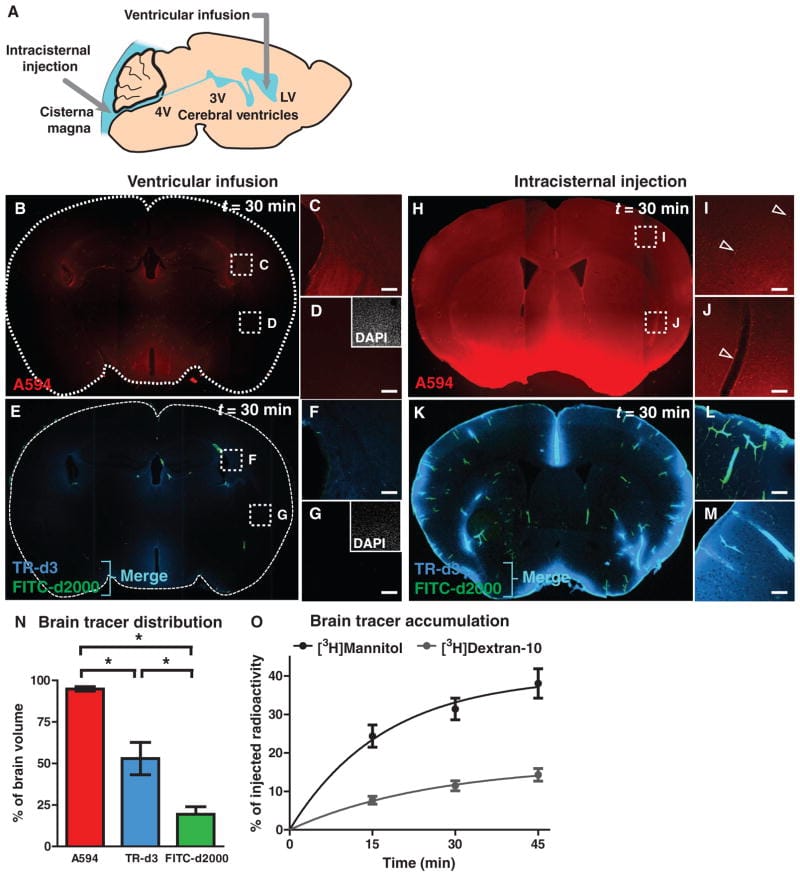
Discovered in 2012, the glymphatic system is a network of channels surrounding blood vessels in the brain, lined by astrocyte cells that express AQP4 water channels. During slow-wave sleep, the interstitial space between brain cells expands by approximately 60%, allowing cerebrospinal fluid to flow along these channels and flush metabolic waste into lymphatic drainage for disposal. This clearance process is largely suppressed during wakefulness.
The term “glymphatic” combines “glial” and “lymphatic” – a glial-cell-dependent drainage pathway that performs a lymphatic-like function inside the brain, where no conventional lymphatic vessels exist.
Iliff et al. (2012) mapped the pathway: cerebrospinal fluid (CSF) enters brain tissue along perivascular spaces surrounding penetrating arteries, flows through the interstitial space, and exits along paravenous drainage routes. The movement depends on aquaporin-4 (AQP4) water channels concentrated on astrocytic endfeet – the extensions of astrocyte cells that wrap around blood vessels. In mice lacking AQP4, interstitial solute clearance dropped by approximately 70% (Iliff et al., 2012).
Xie et al. (2013) demonstrated that the glymphatic system is approximately twice as active during sleep compared to wakefulness. Using in vivo two-photon imaging in mice, they found that the interstitial space expanded by roughly 60% during sleep, widening the channels for fluid flow. The specific cell types responsible for this volume change have not been definitively identified. Amyloid-beta was cleared twice as fast during sleep as during waking.
The reason sleep is required is neurochemical. During wakefulness, norepinephrine – a neurotransmitter involved in arousal – maintains an arousal state associated with narrower interstitial channels. When norepinephrine drops during NREM sleep, the interstitial space opens, and CSF can flow through the tissue to carry waste out. CSF enters along arteries, mixes with interstitial fluid to pick up metabolic waste (amyloid-beta, tau, lactate), and drains out along veins. The entire process depends on the interstitial space being open – and that opening is supported by the low-norepinephrine, low-arousal state of deep sleep, while newer mouse evidence also shows that infraslow norepinephrine oscillations during NREM sleep help drive the vasomotion that moves CSF.
What Stage of Sleep Is Best for Glymphatic Clearance?
NREM stage 3 – slow-wave sleep – appears to be the sleep stage most closely tied to glymphatic clearance. The large, synchronized neural oscillations of slow-wave sleep create pressure differentials that drive cerebrospinal fluid through the glymphatic channels. A 2025 study in Cell identified norepinephrine-driven vasomotion (rhythmic blood vessel pulsation) during NREM sleep as a mechanical pump for this fluid movement in mice (Hauglund et al., 2025).
The connection between slow-wave sleep and glymphatic clearance is mechanical. The large delta waves (0.5-4 Hz) characteristic of NREM stage 3 occur alongside coordinated fluctuations in cerebral blood volume and CSF movement. These fluctuations create pressure gradients that physically push CSF through the interstitial space.
Hauglund et al. (2025), published in Cell, identified the mechanical driver in mice. Infraslow norepinephrine fluctuations originating from the locus coeruleus – a brainstem nucleus involved in arousal regulation – drive rhythmic arterial constriction and dilation during NREM sleep. This vasomotion acts as a pump: as arteries rhythmically expand and contract, CSF is pushed into and through the perivascular spaces. Using optogenetic stimulation of the locus coeruleus in mice, the researchers produced coordinated vasomotion and CSF dynamics – confirming in that model that these oscillations drive fluid movement. Synchronized oscillations in norepinephrine, cerebral blood volume, and CSF were the strongest predictors of glymphatic clearance efficiency.
One finding from the Hauglund study carries relevance for people taking sleep medications. In the mouse model, zolpidem – a widely prescribed sleep aid – suppressed norepinephrine oscillations and impaired glymphatic flow. The drug induced sleep, but the type of sleep it produced lacked the vasomotor dynamics needed for waste clearance in that model. Whether this translates to humans at standard doses is not yet confirmed, but the mechanism raises a question about whether medication-induced sleep supports the same degree of brain waste removal as unmedicated slow-wave sleep.
Human evidence supports the NREM-clearance link. Ju et al. (2017) experimentally disrupted slow-wave activity in 17 healthy adults using auditory tones delivered during NREM – without reducing total sleep time. The disruption of slow-wave activity correlated with increased CSF amyloid-beta40 levels (r = 0.610, P = 0.009). The effect was selective for slow-wave disruption and selective for amyloid-beta – total sleep efficiency, tau, and other CSF proteins did not change. This demonstrated in humans that the quality of NREM slow-wave sleep – not sleep duration alone – is linked to amyloid-beta clearance.
A 2025 randomized crossover trial added further human evidence. Lyckenvik et al. (2025) measured CSF amyloid-beta and tau in 12 healthy adults across three conditions: a night of sleep, total sleep deprivation, and an afternoon control. CSF amyloid-beta and tau tended to be lower after sleep compared to deprivation, with amyloid-beta40 and amyloid-beta42 reaching statistical significance while some tau and amyloid-beta measures did not. The clearance was selective – neurofilament light chain and glial fibrillary acidic protein did not change, indicating protein-selective clearance rather than bulk dilution.
What Happens When the Glymphatic System Does Not Work Properly?
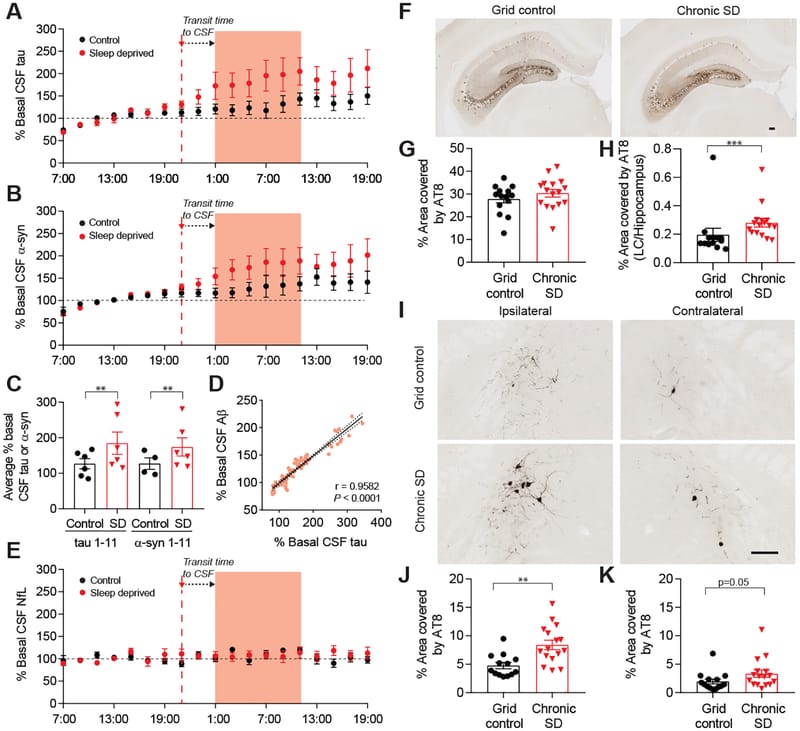
When glymphatic clearance is impaired – by fragmented sleep, aging, or chronic inflammation – metabolic waste proteins can accumulate in brain tissue. One night of sleep deprivation raised CSF tau by 51.5% in a small sample of healthy adults aged 30-60 (n = 6) (Holth et al., 2019). Amyloid-beta and tau can promote inflammatory signaling when they accumulate: they can activate microglia, which release cytokines that fragment the deep sleep needed for clearance. This creates a self-reinforcing loop.
Holth et al. (2019) measured CSF tau in healthy adults aged 30-60 (n = 6) using lumbar catheter sampling during sleep and during sleep deprivation. After a single night without sleep, CSF tau increased by 51.5%. In the mouse arm of the same study, interstitial fluid tau increased approximately 90% during normal wakefulness compared to sleep, and approximately 100% during sleep deprivation. Chronic sleep deprivation in transgenic mice accelerated the spreading of tau pathology – sustained sleep loss promoted the propagation of tau aggregation across brain regions in that model.
Aging compounds the problem. Kress et al. (2014) found that glymphatic clearance of amyloid-beta was impaired by 40% in old mice compared to young mice. The underlying changes included a 27% reduction in arterial wall pulsatility and widespread mislocalization of AQP4 water channels – AQP4 becomes redistributed away from astrocytic endfeet, where it facilitates fluid exchange, across the broader astrocyte surface, reducing its effectiveness.
Nedergaard and Goldman (2020), in a Science review, framed impaired glymphatic clearance as “a final common pathway” across multiple dementias – Alzheimer’s, Parkinson’s, and vascular dementia. Impaired glymphatic flow leads to stagnation of extracellular proteins, promoting misfolding and seeding of amyloid-beta, tau, and alpha-synuclein. The review also noted that cardiovascular disease – by reducing arterial pulsatility – indirectly impairs glymphatic function, connecting vascular health to brain waste clearance.
The forward-feeding loop is the central concern. Poor sleep reduces glymphatic clearance. Reduced clearance allows amyloid-beta and tau to accumulate. Accumulated amyloid-beta can activate microglia – the brain’s resident immune cells – which release pro-inflammatory cytokines including TNF-alpha and IL-6. Those cytokines can fragment sleep architecture, reducing slow-wave sleep. Less slow-wave sleep means less clearance, more accumulation, more inflammation, and progressively worse sleep.
This is not a theoretical concern reserved for older adults. Holth et al. (2019) demonstrated the tau increase after a single night of sleep deprivation in adults aged 30-60. Even short periods of poor sleep engage the acute end of this accumulation – whether the full feedback loop develops depends on duration and whether sleep quality recovers.
Can You Improve Glymphatic Function?
Several factors that influence glymphatic clearance are modifiable. Sleep position (lateral or side sleeping may facilitate drainage in animal studies), regular exercise, and – above all – improving slow-wave sleep quality all may support glymphatic function. Because the glymphatic system depends on consolidated deep sleep to function, addressing the upstream causes of sleep fragmentation is the primary route to supporting brain waste clearance.
The research points to two categories of modifiable factors:
Factors that support glymphatic clearance:
- Slow-wave sleep quality. This is the primary determinant. Factors that increase time in NREM stage 3 and delta oscillation amplitude support the vasomotor dynamics that drive CSF flow. Reducing sleep fragmentation – from inflammation, cortisol dysregulation, histamine excess, or environmental disruption – has a downstream effect on glymphatic efficiency.
- Sleep position. Animal studies suggest lateral (side) sleeping may facilitate glymphatic transport compared to supine or prone positions. Human evidence on this is limited, and no controlled human trials have confirmed the effect.
- Exercise. In animal models, regular physical activity is associated with improved glymphatic clearance and lower amyloid-beta burden. Human data on exercise and glymphatic function specifically is still emerging.
Factors that impair glymphatic clearance:
- Alcohol. Alcohol can alter sleep architecture and fragment sleep continuity, especially later in the night. Because glymphatic clearance depends on consolidated NREM dynamics, alcohol-related fragmentation may reduce the window during which clearance can run, although direct human glymphatic data are limited.
- Sleep fragmentation from any cause. Each arousal from deep sleep interrupts the low-norepinephrine state and NREM oscillatory pattern the interstitial space needs to remain expanded and moving fluid. Frequent micro-arousals – whether from sleep apnea, pain, environmental sound, or inflammatory activation – reduce the cumulative time the glymphatic pathway has to move fluid.
- Aging-related AQP4 changes. The mislocalization of AQP4 away from astrocytic endfeet (Kress et al., 2014) is age-dependent and not yet directly modifiable – but vascular health, neuroinflammation, and sleep quality all influence the process.
Glymphatic health is downstream of sleep quality. Addressing whatever is fragmenting or shallowing deep sleep is the direct route to supporting brain waste clearance. For many people, that means identifying inflammatory causes of sleep disruption – which is the focus of the broader Inflammatory Sleep Disruption overview.
Impaired glymphatic clearance and neuroinflammation might be one piece of what is disrupting your sleep – but they often compound with other causes. Glymphatic impairment may overlap with histamine-driven waking, circadian dysregulation, or hormonal disruption, each of which might be independently fragmenting deep sleep or amplifying the inflammatory loop. Identifying which causes might be active in your pattern is a useful next step.
Find out which causes might be driving your 3am wakeups ->
Frequently Asked Questions
Does Deep Sleep Detox the Brain?
Yes – glymphatic clearance of metabolic waste peaks during NREM slow-wave sleep. “Detox” is a reasonable shorthand for what is a fluid-dynamic waste removal process rather than a chemical detoxification.
The term “detox” in this context refers to the physical flushing of metabolic byproducts – amyloid-beta, tau, lactate – through CSF movement along the glymphatic pathway. Xie et al. (2013) demonstrated that this clearance runs approximately twice as fast during sleep compared to wakefulness, with the 60% expansion of interstitial space providing the physical channels for fluid transport.
The process is not detoxification in the liver-enzyme sense. CSF physically carries waste out of brain tissue and into lymphatic drainage for processing. There is no chemical breakdown of waste molecules within the brain itself during this process.
Can Poor Sleep Cause Alzheimer’s?
Impaired glymphatic clearance from chronic poor sleep allows amyloid-beta and tau to accumulate – both of which are hallmark proteins in Alzheimer’s pathology. The research establishes a plausible mechanism and a risk association, not a single-cause relationship.
Nedergaard and Goldman (2020) described impaired glymphatic clearance as “a final common pathway” leading to dementia – one mechanism through which multiple risk factors (poor sleep, cardiovascular disease, aging) converge on the same outcome. The evidence includes: 51.5% increased CSF tau after one night of sleep deprivation in a small adult sample (Holth et al., 2019), 40% reduced amyloid-beta clearance in aging mouse brains (Kress et al., 2014), and increased CSF amyloid-beta from slow-wave disruption alone in healthy adults (Ju et al., 2017).
Alzheimer’s is a multifactorial condition. Impaired glymphatic clearance from poor sleep is one contributor – but one with a mechanistic chain now supported by both animal and human evidence.
What Waste Products Does the Brain Flush During Sleep?
The primary waste products cleared by the glymphatic system during sleep include amyloid-beta, tau, and lactate. These are normal metabolic byproducts of neural activity that become problematic when clearance falls behind production.
These are not foreign substances. Amyloid-beta is a byproduct of amyloid precursor protein processing, tau is a microtubule-associated protein released into interstitial fluid during neuronal activity, and lactate is a metabolic byproduct of glucose utilization. They accumulate during wakefulness as a normal consequence of neural activity (Holth et al., 2019).
The problem arises when clearance does not keep pace with production. Lyckenvik et al. (2025) demonstrated selective sleep-linked changes in amyloid-beta and tau measures, while neurofilament light chain and glial fibrillary acidic protein were not affected – indicating that sleep-dependent clearance affects some waste-related proteins more than others rather than bulk-flushing everything.
How Does Amyloid Beta Relate to Sleep?
The relationship between amyloid-beta and sleep is bidirectional. Amyloid-beta accumulates during wakefulness and is cleared during deep sleep. When clearance is impaired, accumulated amyloid-beta can contribute to inflammatory signaling that disrupts sleep architecture, creating a self-reinforcing cycle of accumulation and sleep degradation.
During waking hours, neural activity produces amyloid-beta. During NREM slow-wave sleep, the glymphatic system clears amyloid-beta at approximately twice the waking rate (Xie et al., 2013). When sleep is insufficient or fragmented, amyloid-beta can accumulate in the interstitial space – and Ju et al. (2017) showed that disrupting slow-wave activity for a single night, without changing total sleep time, increased CSF amyloid-beta in healthy adults.
The bidirectional component: accumulated amyloid-beta can activate microglia and cytokine release, which can fragment subsequent sleep, reducing the clearance window further. Each incomplete clearance cycle may leave a larger residual amyloid-beta burden for the next night.
Does Norepinephrine Drive Glymphatic Flow During Sleep?
Norepinephrine plays a dual role. Its withdrawal during sleep helps allow the interstitial space to expand, and its infraslow oscillations during NREM sleep drive the vasomotion (rhythmic blood vessel pulsation) that mechanically pumps cerebrospinal fluid through the glymphatic pathway in mice (Hauglund et al., 2025).
Hauglund et al. (2025) found that during NREM sleep, norepinephrine does not drop to zero – it oscillates at infraslow frequencies. These oscillations, originating from the locus coeruleus, drive rhythmic constriction and dilation of cerebral arteries. That vasomotion creates the pressure differentials that push CSF through perivascular spaces.
The requirement is not the absence of norepinephrine but rather its oscillation at the frequency and amplitude that drive vasomotion – conditions that occur during consolidated NREM sleep. When arousal disrupts this oscillation pattern, the vasomotor pump loses its rhythm and CSF flow decreases. This is why zolpidem impaired glymphatic flow in the Hauglund mouse study: the drug suppressed the norepinephrine oscillations driving the clearance pump.
Related Reading
- Inflammatory Sleep Disruption — the cause overview for cytokines, histamine, gut inflammation, neuroinflammation, and circadian immune timing
- How Does Leaky Gut Affect Sleep? — how gut permeability and LPS signaling can contribute to sleep fragmentation
- Gut Bacteria and Insomnia — which microbial pathways and metabolites are linked with sleep
- Does Poor Sleep Cause Brain Inflammation? — how neuroinflammation and sleep loss can reinforce each other
- What Is the Connection Between Chronic Inflammation and Insomnia? — how cytokines, sleep loss, and arousal can form a repeating loop
References
1. Colrain, I. M., Nicholas, C. L., & Baker, F. C. (2014). Alcohol and the sleeping brain. Handbook of Clinical Neurology, 125, 415-431. https://pubmed.ncbi.nlm.nih.gov/25307588/
2. Hauglund, N. L., Andersen, M., Tokarska, K., Radovanovic, T., Kjaerby, C., Sorensen, F. L., Bojarowska, Z., Untiet, V., Ballestero, S. B., Kolmos, M. G., Weikop, P., Hirase, H., & Nedergaard, M. (2025). Norepinephrine-mediated slow vasomotion drives glymphatic clearance during sleep. Cell, 188(3), 606-622.e17. https://pubmed.ncbi.nlm.nih.gov/39788123/
3. He, X. F., Liu, D. X., Zhang, Q., Liang, F. Y., Dai, G. Y., Zeng, J. S., Pei, Z., Xu, G. Q., & Lan, Y. (2017). Voluntary exercise promotes glymphatic clearance of amyloid beta and reduces the activation of astrocytes and microglia in aged mice. Frontiers in Molecular Neuroscience, 10, 144. https://pubmed.ncbi.nlm.nih.gov/28579942/
4. Holth, J. K., Fritschi, S. K., Wang, C., Pedersen, N. P., Cirrito, J. R., Mahan, T. E., Finn, M. B., Manis, M., Geerling, J. C., Fuller, P. M., Lucey, B. P., & Holtzman, D. M. (2019). The sleep-wake cycle regulates brain interstitial fluid tau in mice and CSF tau in humans. Science, 363(6429), 880-884. https://pubmed.ncbi.nlm.nih.gov/30679382/
5. Iliff, J. J., Wang, M., Liao, Y., Plogg, B. A., Peng, W., Gundersen, G. A., Benveniste, H., Vates, G. E., Deane, R., Goldman, S. A., Nagelhus, E. A., & Nedergaard, M. (2012). A paravascular pathway facilitates CSF flow through the brain parenchyma and the clearance of interstitial solutes, including amyloid beta. Science Translational Medicine, 4(147), 147ra111. https://pubmed.ncbi.nlm.nih.gov/22896675/
6. Ju, Y. S., Ooms, S. J., Sutphen, C., Macauley, S. L., Zangrilli, M. A., Jerome, G., Fagan, A. M., Mignot, E., Zempel, J. M., Claassen, J. A. H. R., & Holtzman, D. M. (2017). Slow wave sleep disruption increases cerebrospinal fluid amyloid-beta levels. Brain, 140(8), 2104-2111. https://pubmed.ncbi.nlm.nih.gov/28899014/
7. Kress, B. T., Iliff, J. J., Xia, M., Wang, M., Wei, H. S., Zeppenfeld, D., Xie, L., Kang, H., Xu, Q., Liew, J. A., Plog, B. A., Ding, F., Deane, R., & Nedergaard, M. (2014). Impairment of paravascular clearance pathways in the aging brain. Annals of Neurology, 76(6), 845-861. https://pubmed.ncbi.nlm.nih.gov/25204284/
8. Lee, H., Xie, L., Yu, M., Kang, H., Feng, T., Deane, R., Logan, J., Nedergaard, M., & Benveniste, H. (2015). The effect of body posture on brain glymphatic transport. The Journal of Neuroscience, 35(31), 11034-11044. https://pubmed.ncbi.nlm.nih.gov/26245965/
9. Lyckenvik, T., Olsson, M., Forsberg, M., Wasling, P., Zetterberg, H., Hedner, J., & Hanse, E. (2025). Sleep reduces CSF concentrations of beta-amyloid and tau: A randomized crossover study in healthy adults. Fluids and Barriers of the CNS, 22(1), 84. https://pubmed.ncbi.nlm.nih.gov/40830882/
10. Nedergaard, M., & Goldman, S. A. (2020). Glymphatic failure as a final common pathway to dementia. Science, 370(6512), 50-56. https://pubmed.ncbi.nlm.nih.gov/33004510/
11. Xie, L., Kang, H., Xu, Q., Chen, M. J., Liao, Y., Thiyagarajan, M., O’Donnell, J., Christensen, D. J., Nicholson, C., Iliff, J. J., Takano, T., Deane, R., & Nedergaard, M. (2013). Sleep drives metabolite clearance from the adult brain. Science, 342(6156), 373-377. https://pubmed.ncbi.nlm.nih.gov/24136970/
Written by Kat Fu, M.S., M.S. ? Last reviewed: January 24, 2026 ? 11 references cited