

Women aged 38 to 45 who develop new-onset insomnia often do not connect it to perimenopause. The association between menopause and hot flashes is so deeply embedded that sleep disruption without thermal episodes tends to get attributed to stress, aging, or anxiety. But the hormonal data tell a different story: progesterone drops before estrogen does, and progesterone is the hormone that maintains consolidated sleep.
This article covers why insomnia can precede every other perimenopause-related change, the hormonal timeline that makes this possible, and the wave pattern of sleep disruption that characterizes early perimenopause. For the broader overview of how hormonal changes affect sleep through multiple pathways, see Hormonal Women Sleep Disruption.
Hormonal changes are one of several causes of sleep disruption. The parent pillar covers the full picture — including cortisol, circadian, inflammatory, and metabolic contributors.
Does Progesterone Decline Before Estrogen in Early Perimenopause?
The timeline matters. In the Study of Women’s Health Across the Nation (SWAN), McConnell et al. (2021) analyzed daily urinary hormone levels in 763 women aged 43 to 53 in early perimenopause. Lowered pregnanediol glucuronide — the principal urinary metabolite of progesterone — combined with a variable luteinizing hormone pattern, reflecting anovulatory cycles, was associated with increased vasomotor episodes. Estradiol, at this stage, remained variable rather than uniformly low. The progesterone metabolite dropped first. The hot flashes came after.
This is not a single-study finding. Haufe, Baker, and Leeners (2022) published the largest review to date on ovarian hormones and perimenopausal sleep disruption, analyzing 86 studies across multiple designs. Their review indicated that: perimenopausal decline in estrogen and progesterone contributes to sleep disturbances, and that progesterone insufficiency may be an early driver of sleep disruption in the menopausal transition. Progesterone metabolites, particularly allopregnanolone, are positive allosteric modulators of GABA-A receptors. When these metabolites decline, the GABAergic tone that supports sleep maintenance weakens.
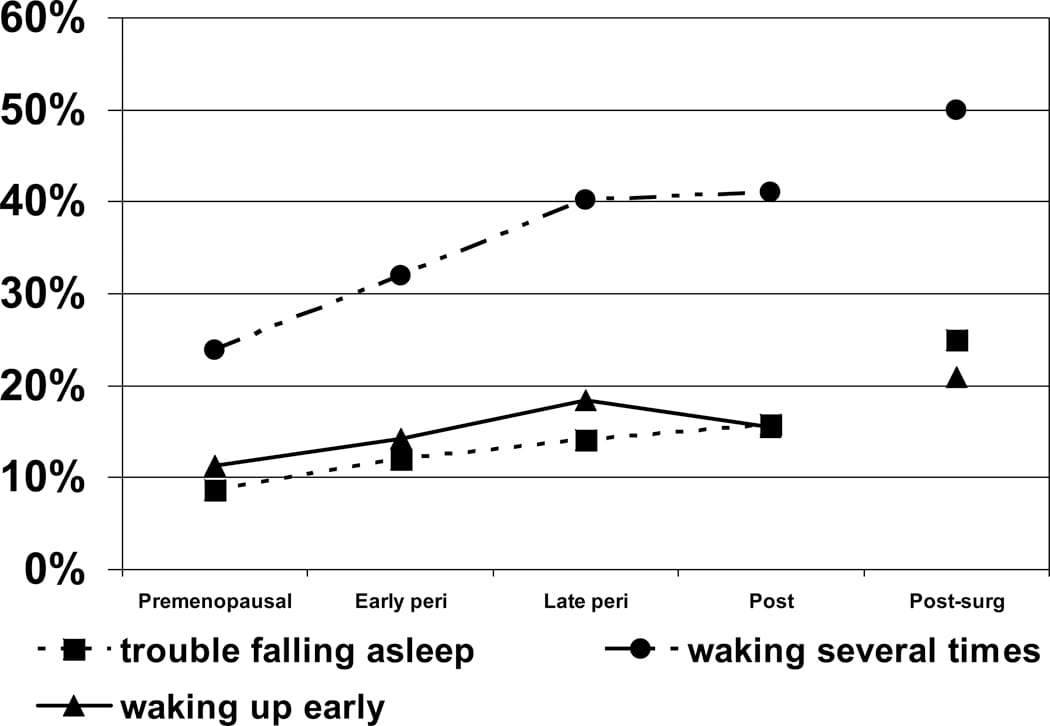
The SWAN longitudinal data (Kravitz & Joffe, 2011) tracked 3,045 women across menopausal stages and found that decrements in estradiol and increments in follicle-stimulating hormone (FSH) were associated with greater sleep disruption — even after controlling for age. Three types of sleep difficulty — trouble falling asleep, waking multiple times, and waking earlier than planned — all increased across the menopausal transition. The association persisted even in women without vasomotor episodes, though it was weaker — meaning the sleep disruption was not fully a downstream consequence of hot flashes. The hormones were affecting sleep through pathways that are not fully mediated by hot flashes.
Can You Have Perimenopause Insomnia Without Any Other Changes?
Objective brain measurements — not self-report questionnaires — provide the strongest evidence for insomnia as an independent perimenopause feature.
Matthews et al. (2021) followed 159 women with in-home ambulatory polysomnography over approximately 3.5 years. At follow-up, women who had transitioned to postmenopause showed elevated beta-band EEG power during NREM sleep compared to women who remained premenopausal. Elevated beta power during sleep is an electrophysiological marker of cortical hyperarousal — the brain is more alert than it should be during rest. This elevation persisted after statistically controlling for self-reported hot flashes.
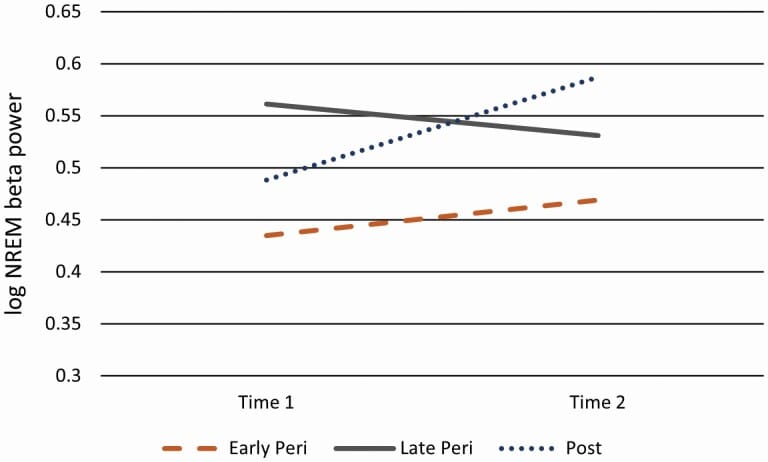
That dissociation is important. The menopausal transition itself — independent of whether a woman experiences hot flashes — drives measurable changes in sleep neurophysiology. Sleep duration and wakefulness after sleep onset did not differ between menopausal stage groups in this study, which suggests that the hyperarousal develops at the level of sleep architecture before it manifests as fragmented or shortened sleep. This may explain why some perimenopausal women report unrestorative sleep despite logging what appears to be adequate total sleep time.
Coborn et al. (2022) added further granularity. In an 8-week observational study of 45 perimenopausal women with weekly hormone measurements, estradiol levels in the postmenopausal range predicted increased nightly awakenings (beta = 0.14; P = 0.007), and higher FSH independently predicted more awakenings as well (beta = 0.12; P = 0.02). All of these hormonal associations were independent of vasomotor and depressive episodes. The hormones were associated with sleep disruption independently of hot flashes.
The experience women describe — “I wake up three times a night but I don’t have hot flashes, so my doctor says it can’t be hormonal” — has a measurable physiological basis.
Why Does Perimenopause Insomnia Come and Go in Waves?
A “good weeks and bad weeks” pattern is one of the least explained aspects of early perimenopause insomnia. Women describe stretches of normal sleep followed by ten days of waking at 2 or 3 AM, followed by another stretch of consolidated sleep. The inconsistency makes it difficult to identify a cause — and easy to attribute the bad stretches to stress or diet changes rather than hormonal fluctuation.
While McConnell et al. (2021) studied vasomotor episodes rather than sleep directly, their SWAN daily-hormone data help explain the hormonal pattern behind this. In the 763 women studied, progesterone metabolite excretion was variable and unpredictable in early perimenopause. Cycles alternated between ovulatory (with adequate luteal progesterone) and anovulatory (with insufficient progesterone). The anovulatory cycles produced the progesterone drops associated with reduced progesterone. Because the alternation between ovulatory and anovulatory cycles is itself unpredictable in early perimenopause, the resulting insomnia appears in irregular waves rather than a steady decline.
Kravitz and Joffe (2011) documented this variability in the SWAN cohort of 3,045 women: sleep disruption intensity varied with hormonal status across the transition, with the greatest sleep variability corresponding to the greatest hormonal fluctuations. Late perimenopause, when hormone levels are more consistently low, tends to produce more consistent (though still disrupted) sleep patterns. Early perimenopause — when hormone levels are swinging between adequate and insufficient — generates the chaotic, wave-like insomnia.
The Haufe, Baker, and Leeners (2022) 86-study review supports this: the irregular nature of hormonal decline in perimenopause, as opposed to the more gradual and consistent decline of postmenopause, may produce the intermittent insomnia pattern. Postmenopausal women report more stable sleep patterns — disrupted, but predictably so. Perimenopausal women report the opposite: unpredictable stretches of normal sleep punctuated by unexplained bouts of insomnia.
This wave pattern is itself a distinguishing feature. Insomnia driven by chronic stress or anxiety tends to be more constant. Insomnia that comes in waves — good stretches followed by bad stretches, with no obvious external trigger — is consistent with the erratic hormonal fluctuations of early perimenopause.
Many people have more than one cause contributing to their sleep disruption. Hormonal changes that produce intermittent insomnia may compound with autonomic, metabolic, inflammatory, or circadian factors — and those additional causes do not fluctuate in waves. Identifying which causes might be involved is a useful next step.
Find out which causes might be driving your 3am wakeups →
Frequently Asked Questions
Is Insomnia the First Sign of Perimenopause?
The SWAN data (Kravitz & Joffe, 2011) provide direct evidence for this timeline. Decrements in estradiol and increments in FSH — both markers of the menopausal transition — were associated with sleep disruption, controlling for age and vasomotor status. This means the hormonal markers were associated with sleep disruption even in women who had no hot flashes.
This does not mean that insomnia is always hormonal. Other causes of new-onset insomnia in the late 30s and 40s include autonomic dysregulation, inflammatory load, and circadian changes. But when insomnia appears without an identifiable external cause in a woman in this age range, the hormonal pathway is one to investigate.
Can Perimenopause Start in Your Late 30s?
The variability in timing matters. Some women begin experiencing anovulatory cycles and progesterone decline in their late 30s. Because early perimenopause can be subtle — the menstrual cycle may still appear regular even when luteal progesterone is already declining — the hormonal transition can begin before any external marker would suggest it (Haufe, Baker, & Leeners, 2022).
Haufe, Baker, and Leeners (2022) show that the perimenopause-to-menopause transition spans a wide age range across populations, and that the earliest hormonal changes — including progesterone metabolite decline — can precede menstrual irregularity.
Why Didn’t Your Doctor Connect Your Insomnia to Perimenopause?
Zeng et al. (2025) analyzed 12 studies involving 11,928 perimenopausal women and found that hot flashes (OR = 2.70) and depression (OR = 2.73) were among the strongest risk factors for sleep disorders in this population. The research itself has been organized around these associations — which means the pathway where insomnia develops independently of both hot flashes and mood changes has received less attention. When a woman presents with insomnia but no hot flashes and no depression, the presentation does not fit the studied profile, and the hormonal connection is less likely to be identified.
For a deeper examination of why standard blood work often does not capture early perimenopause, see Your Blood Tests Are Normal But You Can’t Sleep.
Does Perimenopause Insomnia Without Hot Flashes Respond to the Same Approaches?
The Haufe, Baker, and Leeners (2022) review found that both estrogen and progesterone replacement improved sleep quality across multiple study types. Progesterone acts through neurosteroid metabolites that modulate GABA-A receptors — directly enhancing the sleep-maintenance mechanism that early perimenopause weakens. Estrogen acts primarily through thermoregulatory stabilization, which addresses hot flash-mediated awakenings.
For women whose insomnia is not accompanied by hot flashes, the progesterone pathway may be more relevant than the estrogen pathway. For detailed evidence on each: Does HRT Help with Sleep in Menopause? and Does Progesterone Help You Sleep?.
How Do You Know If Your Insomnia Is Hormonal or Something Else?
The Matthews et al. (2021) polysomnography data provide a useful framework. The cortical hyperarousal they measured — elevated beta-EEG power during NREM sleep — was specific to the menopausal transition. It developed independently of vasomotor episodes, mood disturbance, and age. The physiological signature was distinct from the hyperarousal patterns associated with generalized anxiety or chronic stress.
Pattern recognition can help narrow the possibilities. Hormonal perimenopause insomnia tends to center on sleep maintenance (waking at 2 AM, 3 AM, 4 AM) rather than sleep onset difficulty. It fluctuates in waves that do not correspond to identifiable stressors. And it is often accompanied by a sense that sleep is unrestorative even when total sleep time appears adequate — consistent with the subclinical hyperarousal that Matthews et al. documented at the EEG level.
This is not a self-assessment tool. Multiple causes of sleep disruption can produce overlapping patterns. But the wave pattern, the maintenance-focused disruption, and the absence of an external trigger form a recognizable cluster that points toward the hormonal pathway. For the full picture of why standard testing often misses this connection, see Your Blood Tests Are Normal But You Can’t Sleep.
Related Reading
- Hormonal Women Sleep Disruption — Parent guide to how estrogen, progesterone, cortisol, temperature, melatonin, and cycle changes interact with sleep.
- Why Did You Become a Light Sleeper in Perimenopause? — Why progesterone and GABA decline can lower the arousal threshold during perimenopause.
- Why Are Your Blood Tests Normal When Perimenopause Is Disrupting Your Sleep? — Why fluctuating FSH and estradiol can make perimenopause sleep disruption hard to capture with one blood draw.
- Why Did Your Sleep Medication Stop Working During Menopause? — Why sedating medication may stop matching the sleep-maintenance pattern common in menopause insomnia.
- How Long Does Menopause Insomnia Last? — Sleep disruption across perimenopause, menopause, and postmenopause, including stage-specific contributors.
- What Supplements Have Evidence for Menopause Insomnia? — Supplement options for menopause insomnia by evidence, mechanism, and limits.
References
1. Kravitz, H. M., & Joffe, H. (2011). Sleep during the perimenopause: a SWAN story. Obstetrics and Gynecology Clinics of North America, 38(3), 567–586. https://pubmed.ncbi.nlm.nih.gov/21961720/
2. Haufe, A., Baker, F. C., & Leeners, B. (2022). The role of ovarian hormones in the pathophysiology of perimenopausal sleep disturbances: A systematic review. Sleep Medicine Reviews, 66, 101710. https://pubmed.ncbi.nlm.nih.gov/36356400/
3. McConnell, D. S., Crawford, S. L., Gee, N. A., Bromberger, J. T., Kazlauskaite, R., Avis, N. E., Crandall, C. J., Joffe, H., Kravitz, H. M., Derby, C. A., Gold, E. B., El Khoudary, S. R., Harlow, S., Greendale, G. A., & Lasley, B. L. (2021). Lowered progesterone metabolite excretion and a variable LH excretion pattern are associated with vasomotor episodes but not negative mood in the early perimenopausal transition: Study of Women’s Health Across the Nation. Maturitas, 147, 26–33. https://pubmed.ncbi.nlm.nih.gov/33832644/
4. Matthews, K. A., Lee, L., Kravitz, H. M., Joffe, H., Neal-Perry, G., Swanson, L. M., Evans, M. A., & Hall, M. H. (2021). Influence of the menopausal transition on polysomnographic sleep characteristics: a longitudinal analysis. Sleep, 44(11). https://pubmed.ncbi.nlm.nih.gov/34081126/
5. Coborn, J., de Wit, A., Crawford, S., Nathan, M., Rahman, S., Finkelstein, L., Wiley, A., & Joffe, H. (2022). Disruption of Sleep Continuity During the Perimenopause: Associations with Female Reproductive Hormone Profiles. The Journal of Clinical Endocrinology and Metabolism, 107(10), e4144–e4153. https://pubmed.ncbi.nlm.nih.gov/35878624/
6. Zeng, W., Xu, J., Yang, Y., Lv, M., & Chu, X. (2025). Factors influencing sleep disorders in perimenopausal women: a systematic review and meta-analysis. Frontiers in Neurology, 16, 1460613. https://pubmed.ncbi.nlm.nih.gov/39990264/
Written by Kat Fu, M.S., M.S. · Last reviewed: April 12, 2026 · 6 references cited