

Women enduring menopause insomnia ask this question constantly — “Does this ever end?” — and rarely get a direct answer. The data exists, but it paints a more complex picture than “it gets better after menopause.”
This article covers what longitudinal research shows about sleep across each stage of the menopausal transition, whether sleep improves after menopause, and what determines whether insomnia persists or resolves. For the full overview of hormonal sleep disruption, see Hormonal Women Sleep Disruption.
Hormonal changes are one of several causes driving sleep disruption during and after menopause. The combination of causes — and the way they change across stages — is what makes the duration question difficult to answer with a single number.
How Does Sleep Change Across Each Stage of the Menopause Transition?
The longest-running longitudinal data on sleep across menopausal stages comes from the Study of Women’s Health Across the Nation (SWAN), which followed 3,045 multi-ethnic women aged 42-52 at baseline. Kravitz et al. (2008) tracked self-reported sleep difficulties across multiple visits and found that the odds of trouble falling asleep and staying asleep increased progressively through early perimenopause, late perimenopause, and into postmenopause.
Lower estradiol levels independently correlated with increased odds of both trouble falling asleep and staying asleep. Rising FSH was associated with higher odds of sleep-maintenance problems. Vasomotor episodes — hot flashes and night sweats — were associated with higher odds of each type of sleep difficulty across all stages. The data also showed racial and ethnic differences in sleep maintenance and early-morning waking, underscoring that sleep trajectories during the menopausal transition are not uniform across populations.

Objective data from polysomnography (PSG) — overnight sleep lab recordings — adds measurable numbers to these self-reports. Lampio et al. (2017) conducted a 6-year prospective PSG study in 60 women, starting at a mean age of 46. Over the follow-up period, total sleep time decreased by approximately 37 minutes, sleep efficiency dropped by 6.5%, wake after sleep onset increased by nearly 38 minutes, and awakenings per hour rose by 1.8 events.
One finding from the Lampio data adds nuance: higher FSH concentration during the transition was independently associated with increased slow-wave sleep (deep sleep). The hormonal picture is not uniformly negative — some aspects of sleep architecture may be partially preserved even as sleep continuity deteriorates.
A 2025 review by Troia et al. notes that perimenopause affects 80-90% of women and that sleep disturbances — encompassing insomnia, sleep-related breathing disorders, and restless legs — are common among this population. The review maps multiple contributing factors — vasomotor episodes, circadian disruption, reduced melatonin production, and comorbid mood changes — establishing that the duration of sleep disruption depends on which of these mechanisms are involved.
Does Sleep Improve After Menopause?
This is the question. And the answer requires more honesty than the standard “it varies” response provides.
Thurston et al. (2024) published a 22-year SWAN longitudinal analysis following 2,964 midlife women (baseline ages 42-52) with up to 16 sleep assessments. The study identified four distinct insomnia trajectories:
- Low (38.5%): These women maintained low insomnia probability throughout the 22-year observation period.
- Moderate-decreasing (19.0%): These women started with moderate insomnia that decreased over time — the trajectory that represents postmenopausal improvement.
- Low-increasing (19.9%): These women started with low insomnia that increased across the observation period.
- High (22.6%): These women maintained a high probability of insomnia across all 22 years.
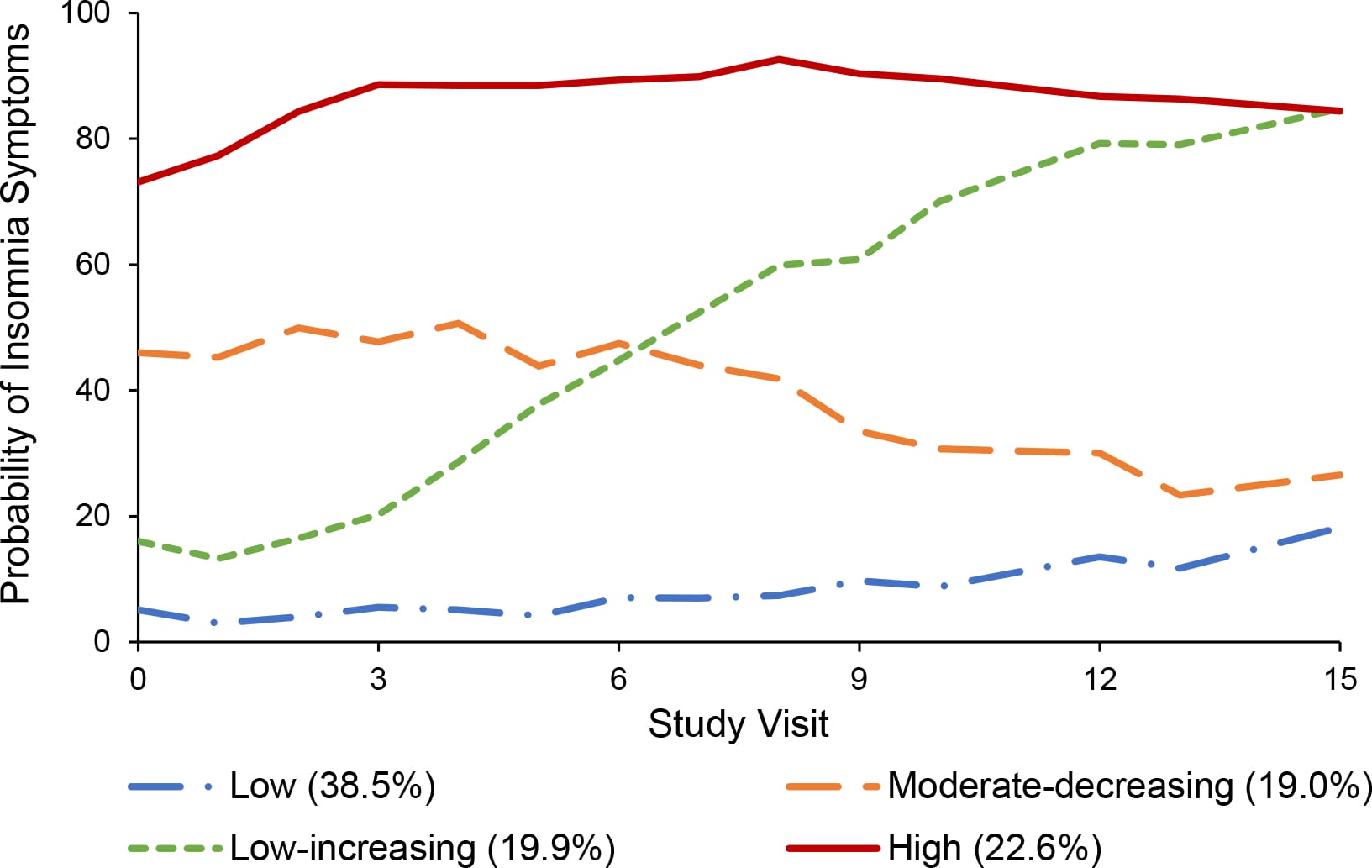
Women in the persistently high trajectory had a 71% higher risk of cardiovascular disease events compared to women in the low trajectory (HR: 1.71; 95% CI: 1.19-2.46). This is not a quality-of-life finding. It is a cardiovascular risk finding.
A separate SWAN trajectory analysis by Kravitz et al. (2020) followed 176 surgically menopausal women over a median of 15.3 years. This study also identified four trajectory groups — and the central finding was the same: pre-transition sleep quality was the strongest predictor of post-transition sleep quality. Women with good sleep before menopause tended to return to good sleep. Women with poor sleep before menopause tended to remain poor. For the majority of women, sleep maintenance complaints were relatively stable across the post-surgical period rather than worsening.
There is also a compounding factor that can emerge after the hormonal transition itself has ended. Young et al. (2003), using overnight polysomnography in 589 women from the Wisconsin Sleep Cohort Study, found that postmenopausal women had 2.6 times the odds of obstructive sleep apnea (AHI >= 5 events per hour) compared to premenopausal women (OR: 2.6; 95% CI: 1.4-4.8). For more severe sleep-disordered breathing (>= 15 events per hour), the odds ratio rose to 3.5.
This means a woman whose insomnia began with hormonal fluctuation during perimenopause may find that a different mechanism — airway collapsibility from progesterone loss — sustains the same waking pattern after hormone levels have stabilized. The cause changed, but the experience did not.
What Determines Whether Your Insomnia Persists or Resolves?
The Kravitz et al. (2020) trajectory data makes one point with particular clarity: pre-menopausal sleep quality is the strongest predictor of postmenopausal sleep quality. Women who had good sleep before perimenopause tended to return to good sleep. Women who had poor sleep before perimenopause tended to remain poor. Menopause amplified a pre-existing vulnerability rather than creating a new one.
A 2025 meta-analysis by Zeng et al. synthesized data from 12 studies encompassing 11,928 perimenopausal women to quantify the independent risk factors for persistent sleep disruption. Two factors stood out:
- Depression: OR 2.73 (95% CI: 1.65-4.52)
- Hot flashes: OR 2.70 (95% CI: 1.81-4.02)
Psychotropic drug use showed the highest point estimate (OR: 3.19), though this likely reflects the underlying psychiatric burden rather than a direct pharmacological effect. Chronic disease burden independently predicted sleep disruption as well (OR: 1.39; 95% CI: 1.24-1.56).
The implication: when depression and vasomotor episodes compound the hormonal mechanism, the probability of spontaneous resolution after menopause decreases.
A 2025 review by Carmona et al. adds one more consideration about timing. Sleep changes can appear in early perimenopause — before the final menstrual period and before hormone-level changes are detectable by standard assays. The review supports the use of cognitive behavioral therapy for insomnia (CBT-I) alongside pharmacological and hormonal options, and the implication is that addressing insomnia during perimenopause rather than waiting for postmenopause may change the long-term trajectory.
This does not mean menopause insomnia that has persisted for years is unresponsive to change. It means the approach may need to address the factors sustaining it — whether those are hormonal, respiratory, mood-related, or a combination — rather than waiting for time alone to resolve it.
Many people have more than one cause contributing to their sleep disruption. Hormonal changes that drive menopause insomnia may compound with autonomic, metabolic, inflammatory, or circadian factors — and the combination can determine whether insomnia persists or resolves. Identifying which causes might be involved is a useful next step.
Find out which causes might be driving your 3am wakeups →
Frequently Asked Questions
Does Menopause Insomnia Go Away on Its Own?
The Thurston et al. (2024) trajectory data shows that 19% of women followed a moderate-decreasing trajectory — meaning their insomnia improved over time. But 22.6% followed a persistently high trajectory, and 19.9% followed a low-increasing trajectory where insomnia worsened. Whether insomnia resolves on its own depends on which factors are driving it. Hormonal fluctuation as a primary driver has a higher probability of resolving once hormone levels stabilize. When depression, sleep-disordered breathing, or pre-existing poor sleep compound the picture, spontaneous resolution is less likely.
Can Menopause Insomnia Last More Than Ten Years?
The Thurston et al. (2024) study observed women for 22 years, and the persistently high trajectory (22.6% of participants) maintained elevated insomnia probability throughout the entire observation window. The Kravitz et al. (2020) surgical menopause analysis, with 15.3 years of follow-up, showed a similar pattern — one in five women showed increasing sleep problems over the presurgical period, and post-surgical sleep remained tied to pre-surgical patterns. When perimenopause spans 4-8 years and insomnia continues into postmenopause, total duration can extend well beyond a decade.
Does Sleep Apnea Risk Increase After Menopause?
Young et al. (2003) used polysomnography in 589 women and found the postmenopausal odds ratio for sleep apnea (AHI >= 5) was 2.6 (95% CI: 1.4-4.8), rising to 3.5 for more severe sleep-disordered breathing (AHI >= 15). The association persisted after controlling for age, body mass index, and smoking — pointing to a hormonally mediated effect beyond the contribution of aging alone. The pattern was notable: the increase appeared at postmenopause, not perimenopause, suggesting that sustained loss of estrogen and progesterone — rather than transitional hormonal fluctuation — drives the emergence of sleep apnea. For a deeper look at how sleep apnea interacts with menopause insomnia, see Could Sleep Apnea Be Behind Your Menopause Insomnia?.
Does the Type of Menopause Affect How Long Insomnia Lasts?
Kravitz et al. (2020) studied 176 surgically menopausal women and found four distinct trajectory groups. For the majority, sleep maintenance complaints were relatively stable across the post-surgical period. Pre-surgical sleep quality predicted post-surgical trajectory, with adjusted beta coefficients ranging from -0.957 to -1.716 (all p < 0.01). One in five women showed increasing sleep problems in the presurgical period, suggesting a window of vulnerability.
Huang et al. (2018) examined over 100,000 women from the Nurses’ Health Study and found that surgical menopause was associated with a 27% higher risk of developing obstructive sleep apnea compared to natural menopause (pooled HR: 1.27; 95% CI: 1.17-1.38). This risk was more pronounced in non-obese women and those who had never used hormone therapy, supporting a model in which abrupt estrogen and progesterone withdrawal — rather than gradual decline — is the primary driver.
What Are the Long-Term Health Consequences of Persistent Menopause Insomnia?
Thurston et al. (2024) quantified this directly: the persistently high insomnia trajectory carried a 71% higher risk of incident cardiovascular disease events compared to the low trajectory (HR: 1.71; 95% CI: 1.19-2.46). Women carrying the combined burden of persistently high insomnia and short sleep duration (~5 hours) demonstrated the highest cardiovascular risk (HR: 1.75; 95% CI: 1.03-2.98).
Swanson et al. (2025) added cognitive data from 1,177 postmenopausal SWAN participants (mean age 65). Using actigraphy to measure sleep timing regularity, the study found that irregular sleep timing was associated with worse scores on tests of recall (beta = -0.29; p = .020) and worse delayed recall (beta = -0.36; p = .006). Late sleep timing independently predicted worse processing speed (beta = -1.80; p = .008). Cardiovascular disease risk modified several of these associations — early sleep timing’s negative effect on delayed memory was amplified in women with higher cardiovascular risk.
The cardiovascular and cognitive data together make a case for actively addressing persistent menopause insomnia rather than accepting it as inevitable.
Related Reading
- Hormonal Women Sleep Disruption — Parent guide to how estrogen, progesterone, cortisol, temperature, melatonin, and cycle changes interact with sleep.
- Why Did You Become a Light Sleeper in Perimenopause? — Why progesterone and GABA decline can lower the arousal threshold during perimenopause.
- Can Insomnia Be the First Sign of Perimenopause, Even Without Hot Flashes? — How insomnia can appear before hot flashes or cycle changes when early perimenopause alters progesterone and sleep maintenance.
- Why Are Your Blood Tests Normal When Perimenopause Is Disrupting Your Sleep? — Why fluctuating FSH and estradiol can make perimenopause sleep disruption hard to capture with one blood draw.
- Why Did Your Sleep Medication Stop Working During Menopause? — Why sedating medication may stop matching the sleep-maintenance pattern common in menopause insomnia.
- What Supplements Have Evidence for Menopause Insomnia? — Supplement options for menopause insomnia by evidence, mechanism, and limits.
References
1. Kravitz, H. M., Zhao, X., Bromberger, J. T., Gold, E. B., Hall, M. H., Matthews, K. A., & Sowers, M. R. (2008). Sleep disturbance during the menopausal transition in a multi-ethnic community sample of women. Sleep, 31(7), 979-990. https://pubmed.ncbi.nlm.nih.gov/18652093/
2. Young, T., Finn, L., Austin, D., & Peterson, A. (2003). Menopausal status and sleep-disordered breathing in the Wisconsin Sleep Cohort Study. American Journal of Respiratory and Critical Care Medicine, 167(9), 1181-1185. https://pubmed.ncbi.nlm.nih.gov/12615621/
3. Lampio, L., Polo-Kantola, P., Himanen, S.-L., Kurki, S., Huupponen, E., Engblom, J., Heinonen, O. J., Polo, O., & Saaresranta, T. (2017). Sleep during menopausal transition: A 6-year follow-up. Sleep, 40(7), zsx090. https://pubmed.ncbi.nlm.nih.gov/28525646/
4. Kravitz, H. M., Matthews, K. A., Joffe, H., Bromberger, J. T., Hall, M. H., Ruppert, K., & Janssen, I. (2020). Trajectory analysis of sleep maintenance problems in midlife women before and after surgical menopause: The Study of Women’s Health Across the Nation (SWAN). Menopause, 27(3), 278-288. https://pubmed.ncbi.nlm.nih.gov/31934947/
5. Huang, T., Lin, B. M., Redline, S., Curhan, G. C., Hu, F. B., & Tworoger, S. S. (2018). Type of menopause, age at menopause, and risk of developing obstructive sleep apnea in postmenopausal women. American Journal of Epidemiology, 187(7), 1370-1379. https://pubmed.ncbi.nlm.nih.gov/29365014/
6. Thurston, R. C., Chang, Y., Kline, C. E., Swanson, L. M., El Khoudary, S. R., Jackson, E. A., & Derby, C. A. (2024). Trajectories of sleep over midlife and incident cardiovascular disease events in the Study of Women’s Health Across the Nation. Circulation, 149(7), 545-555. https://pubmed.ncbi.nlm.nih.gov/38284249/
7. Troia, L., Garassino, M., Volpicelli, A. I., Fornara, A., Libretti, A., Surico, D., & Remorgida, V. (2025). Sleep disturbance and perimenopause: A narrative review. Journal of Clinical Medicine, 14(5), 1479. https://pubmed.ncbi.nlm.nih.gov/40094961/
8. Zeng, W., Xu, J., Yang, Y., Lv, M., & Chu, X. (2025). Factors influencing sleep disorders in perimenopausal women: A systematic review and meta-analysis. Frontiers in Neurology, 16, 1460613. https://pubmed.ncbi.nlm.nih.gov/39990264/
9. Carmona, N. E., Solomon, N. L., & Adams, K. E. (2025). Sleep disturbance and menopause. Current Opinion in Obstetrics & Gynecology, 37(2), 75-82. https://pubmed.ncbi.nlm.nih.gov/39820156/
10. Swanson, L. M., Hood, M. M., Thurston, R. C., Butters, M. A., Kline, C. E., Kravitz, H. M., Avis, N. E., Neal-Perry, G., Joffe, H., Harlow, S. D., & Derby, C. A. (2025). Sleep timing, sleep timing regularity, and cognitive performance in women entering late adulthood: The Study of Women’s Health Across the Nation (SWAN). Sleep, 48(5), zsaf041. https://pubmed.ncbi.nlm.nih.gov/39955263/
Written by Kat Fu, M.S., M.S. · Last reviewed: May 2, 2026 · 10 references cited