

When menopause insomnia does not respond to any approach — not medication, not behavioral changes, not hormone therapy — the issue may not be insomnia at all. Obstructive sleep apnea in women presents differently than in men, and that difference can lead to years of misdirected approaches.
This article covers why sleep apnea in women looks like insomnia, how menopause increases the risk, and why standard screening tools miss it. For the full overview of hormonal sleep disruption, see Hormonal Women Sleep Disruption. Hormonal changes are one of several causes of sleep disruption — that parent article covers the broader picture.
Why Does Sleep Apnea in Women Look Like Insomnia?
The stereotypical sleep apnea presentation — loud snoring, gasping, a bed partner who notices pauses in breathing — is a male-predominant pattern. Women with obstructive sleep apnea are more likely to report insomnia, non-restorative sleep, fatigue, mood disturbance, and morning headaches (Antonaglia et al., 2025). The presenting complaint matches insomnia rather than breathing difficulty, which means sleep apnea in women is frequently misidentified.
One reason for this is the concentration of breathing events during REM sleep. A prospective study of 2,169 adults undergoing polysomnography found that 25% of women met criteria for REM-predominant obstructive sleep apnea, compared to 12% of men (Bahammam et al., 2020). Among premenopausal women, the prevalence was even higher — 35%, compared to 18.6% in postmenopausal women. The REM concentration matters because REM-stage events produce fragmented awakenings that women describe as insomnia rather than breathing difficulty.
REM sleep comprises 20-25% of the night. When breathing disruptions concentrate in that window, they produce short, repeated awakenings — the experience of “waking up for no reason” multiple times per night. This is different from the prolonged apneas distributed across all sleep stages that characterize the male-predominant pattern.
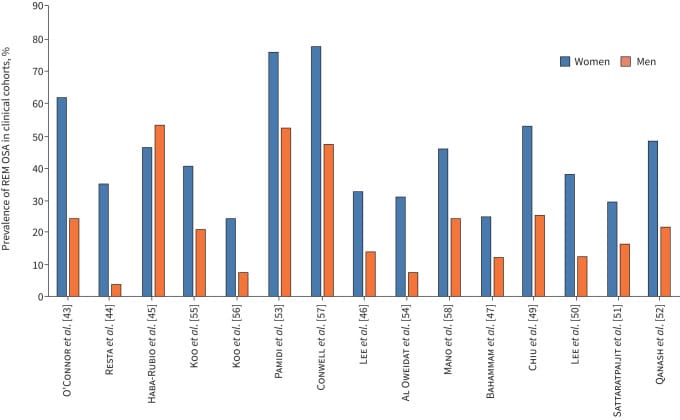
A 2024 review in the European Respiratory Review found that REM-predominant obstructive sleep apnea in women is frequently missed under standard total-AHI thresholds (Bonsignore et al., 2024). CPAP adherence is also more challenging for REM-predominant cases because events concentrate in a narrow sleep stage rather than distributing across the night — the conventional four-hour CPAP compliance benchmark may leave REM-predominant cases unprotected during their highest-risk sleep period.
The combined effect: a woman with obstructive sleep apnea is more likely to seek help for insomnia, receive an insomnia-oriented approach, and continue experiencing disrupted sleep because the underlying breathing issue has not been identified.
How Does Menopause Increase Sleep Apnea Risk?
The connection between menopause and sleep apnea is primarily hormonal — and progesterone is the central mediator.
Popovic and White (1998) measured genioglossus electromyographic activity — the electrical activity of the primary muscle that holds the upper airway open — in 12 premenopausal and 12 postmenopausal women. Genioglossus activity was highest during the luteal phase of the menstrual cycle (peak phasic activity: 23.9%), intermediate during the follicular phase (15.5%), and lowest in postmenopausal women (11.3%). A positive correlation between circulating progesterone concentrations and genioglossus activity identified progesterone as the mediating hormone. Eight postmenopausal participants who received two weeks of hormone replacement therapy showed increased upper airway dilator muscle activity approaching premenopausal values.
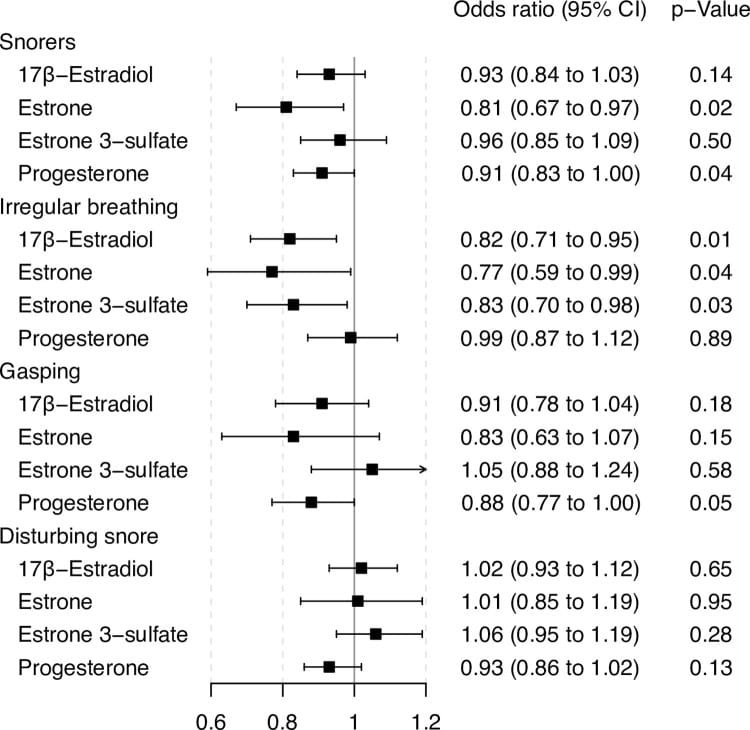
Population-level data supports this mechanism. In a study of 774 European women aged 40-67, a doubling of serum progesterone concentration was associated with 9% decreased odds of snoring, and a doubling of serum estrone concentration was associated with 19% decreased odds of snoring (Sigurdardottir et al., 2022). These associations held after adjustment for age, body mass index, smoking, education, study center, and reproductive aging stage — establishing an independent hormonal contribution beyond what is explained by the menopausal transition alone.
Postmenopausal obstructive sleep apnea prevalence approximately doubles compared to premenopausal prevalence (Schwarz & Schiza, 2024). The mechanisms extend beyond progesterone loss: airway length increases after menopause, and adipose redistribution toward the pharyngeal region adds to upper airway collapsibility. The transition that drives the increase is menopause itself, not chronological age.
A 2025 study of 2,296 adults reinforced this distinction (Hang et al., 2025). In men, airway collapsibility and loop gain (the sensitivity of the ventilatory control center) worsened progressively with age, producing compounding risk over the lifespan. In women, endotypic traits — airway anatomy, arousal threshold, ventilatory control — remained relatively stable with advancing age. The exception was a gradual increase in loop gain. The postmenopausal acceleration in sleep apnea risk is not attributable to progressive aging of individual airway traits, but rather to a discrete hormonal transition. Menopause creates a risk inflection that is distinct from the gradual aging process seen in men.
Why Do Standard Screening Tools Miss Sleep Apnea in Women?
The apnea-hypopnea index (AHI) is the primary metric used to score sleep studies. It counts the number of breathing disruptions per hour, averaged across the full night. This averaging is where the problem begins.
A large multi-ethnic study of over 2,000 adults found that during non-REM sleep, men had 2.49 times higher apnea-hypopnea indices than women (Won et al., 2020). During REM sleep, apnea indices were more similar between the sexes. Pooling NREM and REM into a single overall AHI obscures the relative REM-stage predominance in women. A woman whose breathing disruptions are concentrated in 20-25% of the night (the REM portion) can score as “mild” or “normal” on total AHI while experiencing fragmentation during her REM periods.
The sex difference in REM-predominant breathing disruption is large. In a cohort of 1,540 adults, women had 3.1 times higher prevalence of REM-predominant sleep-disordered breathing than men — 24.5% vs. 7.9% (Koo et al., 2008). Both sexes showed higher prevalence in those younger than 55, with the sex-by-age interaction suggesting that hormonal status and biological aging jointly modulate REM-stage upper airway vulnerability.
Even mild REM-predominant obstructive sleep apnea produces functional consequences. A 2025 comparative study of 209 REM-predominant and 132 non-REM-predominant cases found that people with mild REM-predominant obstructive sleep apnea were twice as likely to report excessive daytime sleepiness compared with non-REM-predominant cases (Wellekens et al., 2025). The distinguishing feature was sleepiness — not anxiety, depression, fatigue measures, or overall sleep quality scores. Women are overrepresented in this group, and current AHI thresholds may deny them further evaluation at “mild” severity levels despite meaningful daytime impact.
The screening tools themselves compound the problem. Questionnaires weighted toward snoring, witnessed apneas, and high BMI — the male-predominant risk profile — are less sensitive for detecting sleep apnea in women who present with insomnia, non-restorative sleep, and fatigue at lower body weight.
Many people have more than one cause contributing to their sleep disruption. Sleep apnea in menopause can compound with hormonal, autonomic, metabolic, inflammatory, or circadian factors — and identifying one does not rule out the others. Identifying which causes may be involved is a useful next step.
Find out which causes might be driving your 3am wakeups →
Frequently Asked Questions
Can You Have Sleep Apnea Without Snoring?
The association between sleep apnea and loud snoring was established in male-predominant research cohorts. Women with obstructive sleep apnea are more likely to present with insomnia, mood disturbance, and fatigue than with the snoring-and-gasping pattern (Antonaglia et al., 2025). Upper airway resistance events and partial obstructions — which characterize the female phenotype — may not produce any sound audible to a bed partner. Co-morbid insomnia and sleep apnea (COMISA) is also more prevalent in women, compounding the presentation overlap (Schwarz & Schiza, 2024). The absence of snoring does not rule out sleep apnea — it may indicate a different presentation pattern rather than the absence of the condition.
How Common Is Sleep Apnea in Postmenopausal Women?
Prevalence is high partly because the condition is broadly defined — many cases fall in the mild range. Postmenopausal obstructive sleep apnea prevalence approximately doubles compared to premenopausal levels, and the increase persists after adjusting for age and body mass index, indicating menopause is an independent risk factor (Schwarz & Schiza, 2024). The 47-67% range reflects differences in study populations, scoring criteria, and AHI cutoff thresholds. What the numbers consistently show is that obstructive sleep apnea becomes more prevalent after menopause regardless of weight or age.
Does Hormone Replacement Affect Sleep Apnea Risk?
The Sigurdardottir et al. (2022) population data shows that higher circulating progesterone and estrone concentrations are associated with lower odds of snoring and obstructive breathing — a 9% reduction per doubling of progesterone and 19% per doubling of estrone. The Popovic and White (1998) data showed that postmenopausal women receiving hormone replacement therapy had increased upper airway dilator muscle activity approaching premenopausal values. These findings suggest progesterone has a measurable effect on airway tone, though the research on hormone therapy for sleep apnea is limited and effect sizes are modest. For more on hormone therapy and sleep, see Does HRT Help with Sleep in Menopause? and Does Progesterone Help You Sleep?.
What Does Rapid Eye Movement-Predominant Sleep Apnea Mean?
During REM sleep, generalized skeletal muscle atonia (reduced muscle tone) renders the upper airway more vulnerable to collapse. The result is that breathing events during REM tend to be longer in duration and produce greater oxygen desaturation than events during NREM sleep (Bonsignore et al., 2024).
The sex difference is consistent across studies. Women had 25% REM-predominant prevalence vs. 12% in men in a cohort of 2,169 adults (Bahammam et al., 2020). In a separate cohort of 1,540 adults, women had 3.1 times higher REM-predominant sleep-disordered breathing prevalence — 24.5% vs. 7.9% (Koo et al., 2008). The total-AHI pooling method masks this pattern: NREM AHI is 2.49 times higher in men, but REM AHI is similar between the sexes, so averaging the two dilutes the female REM-stage burden (Won et al., 2020).
How Do You Get Evaluated for Sleep Apnea as a Woman?
Requesting that sleep study results include REM-specific AHI alongside the total AHI changes what the scoring can detect. Standard scoring reports a single number averaged across the full night, which can dilute REM-concentrated events into the “mild” or “normal” range.
When discussing evaluation with your physician, describe the presenting pattern — insomnia, non-restorative sleep, fatigue, morning headaches — rather than waiting to be screened for snoring or witnessed apneas. The screening tools commonly used in primary care were developed from male-predominant cohorts and may not flag the female presentation (Bonsignore et al., 2024).
If you are postmenopausal and insomnia has not responded to multiple approaches, sleep-disordered breathing evaluation is a reasonable next step. This is true regardless of body weight — the mechanisms linking menopause to sleep apnea (progesterone loss, airway lengthening, adipose redistribution) are independent of the BMI-driven risk pathway that dominates the male presentation.
Related Reading
- Hormonal Women Sleep Disruption — Parent guide to how estrogen, progesterone, cortisol, temperature, melatonin, and cycle changes interact with sleep.
- Why Does One Glass of Wine Ruin Your Sleep During Menopause? — Why alcohol can fragment REM sleep, increase cortisol rebound, and worsen night sweats during menopause.
- Why Does Perimenopause Give You Nightmares That Disrupt Your Sleep? — How REM fragmentation, awakenings, and estrogen-linked emotional reactivity can increase dream recall and nightmares in perimenopause.
- Why Do Restless Legs Get Worse in Perimenopause? — How estrogen, dopamine, iron status, and heavy bleeding connect to restless legs that disturb sleep in perimenopause.
- Why Does Menopause Make You Wake Up to Pee at Night? — How estrogen decline can affect bladder tissue, antidiuretic hormone rhythm, nighttime urine production, and sleep fragmentation.
- Why Does Menopause Joint Pain Get Worse at Night? — The sleep-pain relationship between estrogen decline, inflammation, collagen changes, nighttime pain, and fragmented sleep.
- Why Does Your Skin Crawl at Night During Perimenopause? — Formication, itching, histamine timing, skin-barrier changes, and sensory nerve changes that can disturb sleep.
References
1. Antonaglia, C., Citton, G. M., Siciliano, M., Ruaro, B., Salton, F., & Confalonieri, M. (2025). Obstructive Sleep Apnea Syndrome in women: gender in sleep respiratory medicine is a first step towards personalized medicine. Sleep & Breathing, 29(4), 250. https://pubmed.ncbi.nlm.nih.gov/40699446/
2. Bahammam, R. A., Al-Qahtani, K. M., Aleissi, S. A., Olaish, A. H., Almeneessier, A. S., & Bahammam, A. S. (2020). The Associations of Gender, Menopause, Age, and Asthma with REM-Predominant Obstructive Sleep Apnea: A Prospective Observational Study. Nature and Science of Sleep, 12, 721-735. https://pubmed.ncbi.nlm.nih.gov/33117008/
3. Bonsignore, M. R., Mazzuca, E., Baiamonte, P., Bouckaert, B., Verbeke, W., & Pevernagie, D. A. (2024). REM sleep obstructive sleep apnoea. European Respiratory Review, 33(171), 230166. https://pubmed.ncbi.nlm.nih.gov/38355150/
4. Hang, L. W., Tsai, Y. C., Finnsson, E., Agustsson, J. S., Sands, S. A., & Cheng, W. J. (2025). Sex-specific age-related worsening of pathological endotypic traits in patients with obstructive sleep apnea. Sleep, 48(1). https://pubmed.ncbi.nlm.nih.gov/39127876/
5. Koo, B. B., Dostal, J., Ioachimescu, O., & Budur, K. (2008). The effects of gender and age on REM-related sleep-disordered breathing. Sleep & Breathing, 12(3), 259-264. https://pubmed.ncbi.nlm.nih.gov/18074161/
6. Popovic, R. M., & White, D. P. (1998). Upper airway muscle activity in normal women: influence of hormonal status. Journal of Applied Physiology, 84(3), 1055-1062. https://pubmed.ncbi.nlm.nih.gov/9480969/
7. Schwarz, E. I., & Schiza, S. (2024). Sex differences in sleep and sleep-disordered breathing. Current Opinion in Pulmonary Medicine, 30(6), 593-599. https://pubmed.ncbi.nlm.nih.gov/39189037/
8. Sigurdardottir, E. S., Gislason, T., Benediktsdottir, B., Hustad, S., Dadvand, P., Demoly, P., Franklin, K. A., Heinrich, J., Holm, M., van der Plaat, D. A., Jogi, R., Leynaert, B., Lindberg, E., Martinez-Moratalla, J., Sainz De Aja, L., Pesce, G., Pin, I., Raherison, C., Pereira-Vega, A., Real, F. G., & Triebner, K. (2022). Female sex hormones and symptoms of obstructive sleep apnea in European women of a population-based cohort. PLoS ONE, 17(6), e0269569. https://pubmed.ncbi.nlm.nih.gov/35731786/
9. Wellekens, S., Vanderhelst, E., Verbanck, S., & De Weerdt, S. (2025). REM-predominant obstructive sleep apnea: an unmet clinical need. Sleep & Breathing, 29(1), 97. https://pubmed.ncbi.nlm.nih.gov/39934482/
10. Won, C. H. J., Reid, M., Sofer, T., Azarbarzin, A., Purcell, S., White, D., Wellman, A., Sands, S., & Redline, S. (2020). Sex differences in obstructive sleep apnea phenotypes, the multi-ethnic study of atherosclerosis. Sleep, 43(5). https://pubmed.ncbi.nlm.nih.gov/31687772/
11. Young, T., Finn, L., Austin, D., & Peterson, A. (2003). Menopausal status and sleep-disordered breathing in the Wisconsin Sleep Cohort Study. American Journal of Respiratory and Critical Care Medicine, 167(9), 1181-1185. https://pubmed.ncbi.nlm.nih.gov/12615621/
Written by Kat Fu, M.S., M.S. · Last reviewed: May 19, 2026 · 11 references cited