

People with MCAS describe a recognizable disruption pattern: waking between 2am and 4am with racing heart, skin flushing, itching, or an abrupt whole-body arousal response. Existing MCAS-sleep content focuses on histamine. But mast cells release at least a dozen sleep-relevant mediators, and the nocturnal timing of MCAS flares involves circadian mechanisms that extend beyond histamine receptor activation.
This article covers the multi-mediator cascade, why the 2-4am window is the highest-risk period, brain-resident mast cells and their direct role in sleep-wake regulation, and the MCAS/EDS/POTS comorbidity triad. For histamine as a general mechanism, see Histamine and 3am Waking and Histamine Intolerance and Sleep. For the broader inflammatory framework, see Inflammatory Sleep Disruption.
What Mediators Do Mast Cells Release That Affect Sleep?
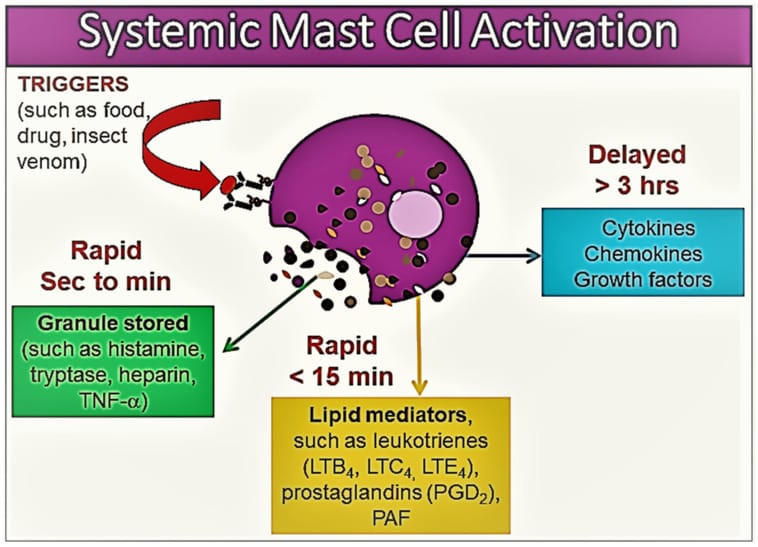
A single nocturnal degranulation event can disrupt sleep across multiple stages of the same night. Preformed mediators exit within seconds. Lipid mediators — prostaglandin D2 (PGD2) and prostaglandin E2 (PGE2) — follow over 5 to 30 minutes. Cytokines including IL-6 and IL-1beta are synthesized over 1 to 24 hours (Molderings et al., 2011; Valent et al., 2022). A degranulation event at 2am can therefore disrupt sleep architecture through different mechanisms at 2:05am, 2:30am, and 4am.
Up to 20-40% of hippocampal serotonin may originate from mast cells. Mast cell-deficient mice show hippocampal serotonin deficits, and neuronal sources cannot fully compensate for this mast cell-derived serotonin (Nautiyal et al., 2012). MCAS-driven mast cell activation therefore alters brain serotonin levels relevant to sleep architecture.
IL-6 released in the cytokine wave is associated with reduced slow-wave sleep and unrefreshing sleep. In people with MCAS, elevated serum IL-6 has been associated with neuropsychiatric profiles including cognitive impairment and fatigue (Valent et al., 2022).
Tryptase creates an amplifying loop. Tryptase activates PAR-2 receptors (protease-activated receptor 2) on sensory nerves and nearby immune cells, triggering up to a 6.7-fold increase in local mast cell numbers via PAR-2/ICAM-1 signaling (Liu et al., 2016). This amplification sustains neurogenic inflammation and pain-mediated arousals throughout a night.
Mast cells are also a primary peripheral source of PGD2 during activation. PGD2 is somnogenic (sleep-promoting) while PGE2 promotes wakefulness — the net effect depends on which prostaglandin dominates in the CNS compartment (Valent et al., 2022). For a deeper look at prostaglandin-sleep interactions, see Prostaglandins and Sleep.
Why Do Mast Cell Activation Syndrome Flares Peak Between 2am and 4am?
Five converging lines of evidence explain why people with MCAS wake in the 2-4am window. This synthesis has not been published as a single integrated study — it is a mechanistic inference from multiple independent findings.
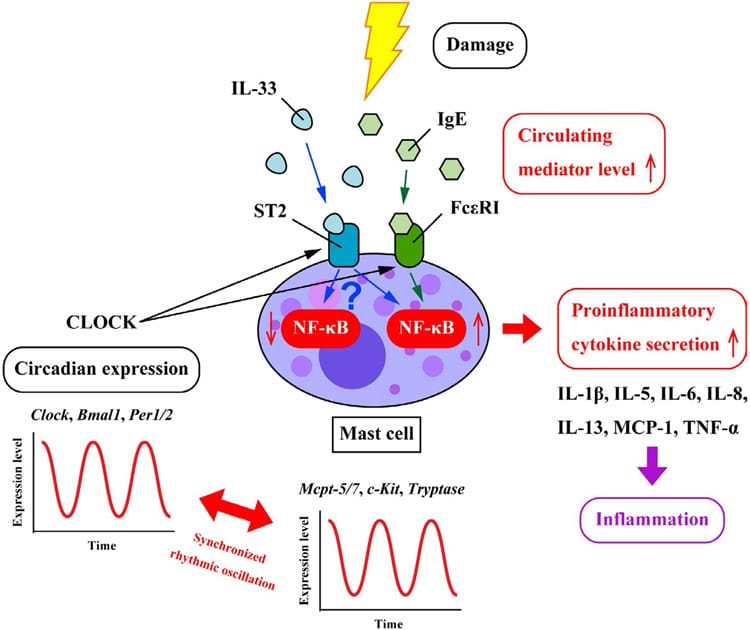
Mast cells have intrinsic circadian clocks. The clock gene CLOCK controls time-of-day expression of the high-affinity IgE receptor (FcepsilonRI) and the IL-33 receptor ST2 on mast cells, producing a sensitivity peak at night. Clock gene mutation abolishes temporal variation in IgE-mediated degranulation both in vivo and in vitro — demonstrating that the variation is cell-intrinsic (Christ et al., 2018).
Cortisol’s nadir opens a permissive window. Cortisol and ACTH reach their nadir in the late night to early morning hours. The mast cell clock is entrained by glucocorticoid inputs — adrenalectomy disrupts circadian degranulation variation (Christ et al., 2018). When cortisol drops, glucocorticoid suppression of mast cell activation is removed.
CRH directly activates brain mast cells. Corticotropin-releasing hormone (CRH) from the hypothalamus activates mast cells via CRH-R1 receptors, independently of peripheral immune triggers (Theoharides & Cochrane, 2004; Silverman et al., 2000). CRH begins rising in the pre-dawn hours as part of the cortisol awakening response — activating mast cells at the 2-4am window.
Melatonin decline reduces mast cell restraint. Melatonin inhibits mast cell degranulation in preclinical models. When melatonin signaling is lower, that anti-degranulation input may be weaker, which can make nocturnal mast cell activation easier to sustain (Maldonado et al., 2016; Maldonado et al., 2023).
Plasma histamine peaks nocturnally. Histamine concentrations peak during the night and early morning hours. Mast cell-specific Clock mutation flattens this circadian histamine profile (Nakamura et al., 2014).
The convergence of lowered activation threshold, absent cortisol suppression, declining melatonin, rising CRH, and peaking histamine makes 2-4am the period when the fewest restraining mechanisms are active and the most activating inputs are present.
Do Brain Mast Cells Directly Regulate Sleep?
Using Kit mutant mast cell-deficient mice and inducible Mas-TRECK mice, Nishino and colleagues (2022) demonstrated that brain mast cells regulate sleep/wake phenotypes. Histamine from brain-resident — not peripheral — mast cells promotes wakefulness through a mechanism separate from peripheral histamine circulation.
In a chronic mild stress model, brain mast cell numbers increased in animals developing insomnia. Both a histamine H1 antagonist and cromolyn (a mast cell stabilizer) rescued the insomnia phenotype — supporting mast cell involvement beyond histamine receptor activity alone (Chikahisa et al., 2017; Nishino et al., 2022).
Brain mast cells concentrate at blood-brain barrier sites and near hypothalamic CRH neurons and the pineal gland (Silverman et al., 2000). This positioning enables them to sense circadian inputs — melatonin, glucocorticoids, CRH — and release mediators directly into sleep-governing CNS tissue.
Melatonin is one of the circadian inputs that can restrain mast cell activation. When nocturnal mast cell activity is elevated while melatonin signaling is lower, sleep-disrupting mediator release has less circadian restraint. That is the conservative interpretation supported by the preclinical melatonin-mast-cell evidence (Maldonado et al., 2016; Maldonado et al., 2023).
Why Does the Mast Cell, Ehlers-Danlos, and Dysautonomia Triad Worsen Sleep?
In a cohort of POTS participants, MCAS prevalence was 31% in POTS+hEDS versus 2% in EDS without POTS — suggesting POTS is the key amplifier of MCAS expression in this triad (Wang et al., 2021).
POTS independently disrupts sleep through nocturnal sympathetic surges and heart rate variability abnormalities. In the triad, these autonomic disruptions overlay mast cell mediator-driven arousal — POTS-related nocturnal tachycardia and mast cell-driven histamine flushing can produce overlapping nighttime arousals.
In a large MCAS cohort (N=553), insomnia, fatigue, cognitive impairment, and headaches were highly prevalent. MCAS-targeted approaches produced improvement in neuropsychiatric presentations including sleep-related complaints (Weinstock, Afrin et al., 2025).
People with MCAS also have a 3.2-fold higher prevalence of restless legs syndrome compared to spousal controls — 40.8% versus 12.9%. The proposed mechanism involves mast cell-derived mediators increasing hepcidin production at the blood-brain barrier, reducing iron transport into dopamine neurons. Peripheral iron deficiency was uncommon (6.5%), but low-normal ferritin was common (45.7%) — consistent with CNS-specific iron transport impairment rather than a body-wide deficiency (Weinstock et al., 2020).
Mast cell activation is one of several inflammatory pathways that might be disrupting your sleep. Histamine imbalance, prostaglandin imbalance, neuroinflammation, gut barrier impairment, and autonomic instability can all produce nocturnal waking — and in MCAS, multiple pathways often activate at the same time. Identifying which of these might be overlapping is a useful next step before deciding where to focus.
Find out which causes might be driving your 3am wakeups ->
Frequently Asked Questions
Does Melatonin Help Mast Cell Activation?
The preclinical data shows melatonin can inhibit mast cell degranulation and reduce inflammatory signaling in mast cells (Maldonado et al., 2016; Maldonado et al., 2023). Controlled trials of melatonin supplementation in MCAS-related insomnia are not yet available; the sleep relevance is mechanistic reasoning from mast-cell and circadian biology, not a tested MCAS sleep strategy.
Can Mast Cell Activation Cause Restless Leg Syndrome?
Weinstock et al. (2020) studied 174 people with MCAS and 85 spousal controls. The RLS prevalence held across sexes — 42.5% in women, 32.1% in men. Peripheral iron deficiency was uncommon (6.5%), but low-normal ferritin was common (45.7%), consistent with CNS-specific iron transport impairment. Standard oral iron supplementation may not address a mechanism localized to the blood-brain barrier.
How Does a Mast Cell Stabilizer Help With Sleep?
The cromolyn evidence comes from a mouse model where cromolyn-treated mice showed recovery of both sleep fragmentation and metabolic abnormalities versus untreated stress-exposed mice (Chikahisa et al., 2017). Weng et al. (2012) found quercetin at 100 micromolar inhibited IL-8 and TNF release from human cultured mast cells more effectively than cromolyn at equivalent concentrations. A detail often overlooked: cromolyn loses efficacy if not added simultaneously with the trigger, and quercetin must be administered prophylactically. These are mechanistic findings from cell and animal models, not tested approaches for MCAS-related insomnia.
What Is the Difference Between Histamine Intolerance and Mast Cell Activation Syndrome Sleep Problems?
Antihistamines alone may resolve histamine intolerance-driven sleep disruption because histamine is the primary mediator. In MCAS, antihistamines are often insufficient because IL-6, tryptase, and PGE2 continue disrupting sleep through independent pathways — IL-6 reduces slow-wave sleep, tryptase sustains neurogenic inflammation, PGE2 promotes wakefulness. Addressing one mediator while other waves remain active explains the incomplete response to antihistamine-only approaches (Molderings et al., 2011; Valent et al., 2022). For histamine-specific mechanisms, see Histamine and 3am Waking and Histamine Intolerance and Sleep.
Related Reading
- Inflammatory Sleep Disruption — the cause overview for cytokines, histamine, gut inflammation, neuroinflammation, and circadian immune timing
- Why Does Histamine Wake You Up at 3am? — how brain histamine and mast-cell timing can drive early-morning waking
- Can Histamine Intolerance Cause Sleep Problems? — how DAO capacity and mast-cell activation can compound sleep disruption
- Why Is Inflammation Worse at Night? — how NF-kB and circadian immune timing shape pre-dawn inflammatory activity
- Can Inflammation Cause 3am Wakeups? — how inflammatory signaling can create early-morning wakeups
- Can Chronic Stress Cause Insomnia Through Inflammation? — how stress load, inflammatory signaling, and hyperarousal reinforce each other
- Circadian Disruption and Inflammation — how circadian misalignment can amplify inflammatory sleep disruption
References
1. Christ, P., Sowa, A. S., Froy, O., & Lorentz, A. (2018). The circadian clock drives mast cell functions in allergic reactions. Frontiers in Immunology, 9, 1526. https://pubmed.ncbi.nlm.nih.gov/30034393/
2. Gülen, T. (2023). A puzzling mast cell trilogy: Anaphylaxis, MCAS, and mastocytosis. Diagnostics, 13(21), 3307. https://pubmed.ncbi.nlm.nih.gov/37958203/
3. Oster, H., Challet, E., Ott, V., Arvat, E., de Kloet, E. R., Dijk, D. J., Lightman, S., Vgontzas, A., & Van Cauter, E. (2017). The functional and clinical significance of the 24-hour rhythm of circulating glucocorticoids. Endocrine Reviews, 38(1), 3-45. https://pubmed.ncbi.nlm.nih.gov/27749086/
4. Liu, X., Wang, J., Zhang, H., Zhan, M., Chen, H., Fang, Z., Xu, C., Chen, H., & He, S. (2016). Induction of mast cell accumulation by tryptase via a protease activated receptor-2 and ICAM-1 dependent mechanism. Mediators of Inflammation, 2016, 6431574. https://pubmed.ncbi.nlm.nih.gov/27378825/
5. Maldonado, M. D., Garcia-Moreno, H., Gonzalez-Yanes, C., & Calvo, J. R. (2016). Possible involvement of the inhibition of NF-kB factor in anti-inflammatory actions that melatonin exerts on mast cells. Journal of Cellular Biochemistry, 117(8), 1926-1933. https://pubmed.ncbi.nlm.nih.gov/26756719/
6. Maldonado, M. D., Gutierrez-Perez, M. C., Flores, J. A., & Ales, E. (2023). Melatonin reduces exo-endocytosis in mast cells, making it a useful therapeutic tool in inflammatory diseases. Annals of Allergy, Asthma & Immunology, 131(5), 670-672. https://pubmed.ncbi.nlm.nih.gov/37557953/
7. Molderings, G. J., Brettner, S., Homann, J., & Afrin, L. B. (2011). Mast cell activation disease: A concise practical guide for diagnostic workup and therapeutic options. Journal of Hematology & Oncology, 4, 10. https://pubmed.ncbi.nlm.nih.gov/21418662/
8. Nakamura, Y., Nakano, N., Ishimaru, K., Hara, M., Ikegami, T., Tahara, Y., Katoh, R., Ogawa, H., Okumura, K., Shibata, S., Nishiyama, C., & Nakao, A. (2014). Circadian regulation of allergic reactions by the mast cell clock in mice. Journal of Allergy and Clinical Immunology, 133(2), 568-575. https://pubmed.ncbi.nlm.nih.gov/24060274/
9. Nautiyal, K. M., Dailey, C. A., Jahn, J. L., Rodriquez, E., Son, N. H., Sweedler, J. V., & Silver, R. (2012). Serotonin of mast cell origin contributes to hippocampal function. European Journal of Neuroscience, 36(3), 2347-2359. https://pubmed.ncbi.nlm.nih.gov/22632453/
10. Nishino, S., Sakai, N., Nishino, N., & Ono, T. (2022). Brain mast cells in sleep and behavioral regulation. Current Topics in Behavioral Neurosciences, 59, 427-446. https://pubmed.ncbi.nlm.nih.gov/35711025/
11. Silverman, A. J., Sutherland, A. K., Wilhelm, M., & Silver, R. (2000). Mast cells migrate from blood to brain. Journal of Neuroscience, 20(1), 401-408. https://pubmed.ncbi.nlm.nih.gov/10627616/
12. Theoharides, T. C., & Cochrane, D. E. (2004). Critical role of mast cells in inflammatory diseases and the effect of acute stress. Journal of Neuroimmunology, 146(1-2), 1-12. https://pubmed.ncbi.nlm.nih.gov/14698841/
13. Valent, P., Hartmann, K., Bonadonna, P., Niedoszytko, M., Oude Elberink, J. N., et al. (2022). Mast cell activation syndromes: Collegium Internationale Allergologicum update 2022. International Archives of Allergy and Immunology, 183(7), 693-705. https://pubmed.ncbi.nlm.nih.gov/35605594/
14. Wang, E., Ganti, T., Vaou, E., & Hohler, A. (2021). The relationship between mast cell activation syndrome, postural tachycardia syndrome, and Ehlers-Danlos syndrome. Allergy and Asthma Proceedings, 42(3), 243-246. https://pubmed.ncbi.nlm.nih.gov/33980338/
15. Weinstock, L. B., Walters, A. S., Brook, J. B., Kaleem, Z., Afrin, L. B., & Molderings, G. J. (2020). Restless legs syndrome is associated with mast cell activation syndrome. Journal of Clinical Sleep Medicine, 16(3), 401-408. https://pubmed.ncbi.nlm.nih.gov/31994488/
16. Weinstock, L. B., Afrin, L. B., Reiersen, A. M., Brook, J., Blitshteyn, S., Ehrlich, G., Schofield, J. R., Kinsella, L., Kaufman, D., Dempsey, T., & Molderings, G. J. (2025). Prevalence and treatment response of neuropsychiatric disorders in mast cell activation syndrome. Brain, Behavior, and Immunity – Health, 48, 101048. https://pubmed.ncbi.nlm.nih.gov/40686928/
17. Weng, Z., Zhang, B., Asadi, S., Sismanopoulos, N., Butcher, A., Fu, X., Katsarou-Katsari, A., Antoniou, C., & Theoharides, T. C. (2012). Quercetin is more effective than cromolyn in blocking human mast cell cytokine release and inhibits contact dermatitis and photosensitivity in humans. PLoS One, 7(3), e33805. https://pubmed.ncbi.nlm.nih.gov/22470478/
18. Chikahisa, S., Harada, S., Shimizu, N., Shiuchi, T., Otsuka, A., Nishino, S., & Sei, H. (2017). Mast cell involvement in glucose tolerance impairment caused by chronic mild stress with sleep disturbance. Scientific Reports, 7, 14162. https://doi.org/10.1038/s41598-017-14162-w
Written by Kat Fu, M.S., M.S. ? Last reviewed: June 21, 2026 ? 18 references cited