

Sleeping a full night but waking exhausted is a widespread and poorly understood complaint. For people with ME/CFS, Long COVID, fibromyalgia, or unexplained chronic fatigue, the experience is persistent: the body logs hours asleep, but no restoration occurs. Research now identifies a specific immune mechanism — the NLRP3 inflammasome — that explains how inflammation can make sleep unrestorative even when duration appears adequate.
This article covers what the NLRP3 inflammasome is, how sleep deprivation activates it, how it disrupts sleep architecture, and the circadian clock interaction that governs its activity. For the broader view, see Inflammatory Sleep Disruption.
What Is the NLRP3 Inflammasome?
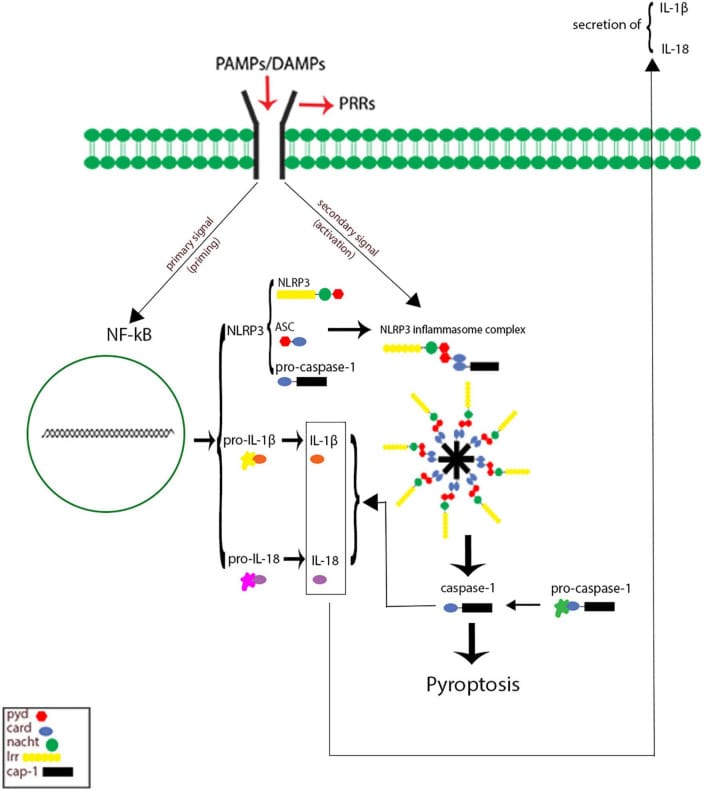
NLRP3 is assembled from three components: the NLRP3 sensor protein, the adaptor protein ASC, and the effector enzyme procaspase-1. When the sensor detects a danger input, these three proteins assemble into the inflammasome complex (Amini et al., 2022).
Activation requires two inputs. The first (priming) involves NF-kB upregulating NLRP3 components and pro-cytokine transcription. The second (activation) is triggered by danger-associated molecular patterns (DAMPs), ATP, mitochondrial reactive oxygen species (ROS), or hypoxic stress. Both must be present simultaneously for NLRP3 to fire. Sleep deprivation provides both — NF-kB priming from sleep loss plus ROS from metabolic stress (Amini et al., 2022).
Once assembled, caspase-1 cleaves pro-IL-1beta and pro-IL-18 into their mature forms. Caspase-1 also activates Gasdermin D, which forms pores in the cell membrane causing pyroptosis — the cell ruptures, releasing all pro-inflammatory contents at once (Fan et al., 2021).
How Does Sleep Deprivation Activate the NLRP3 Inflammasome?
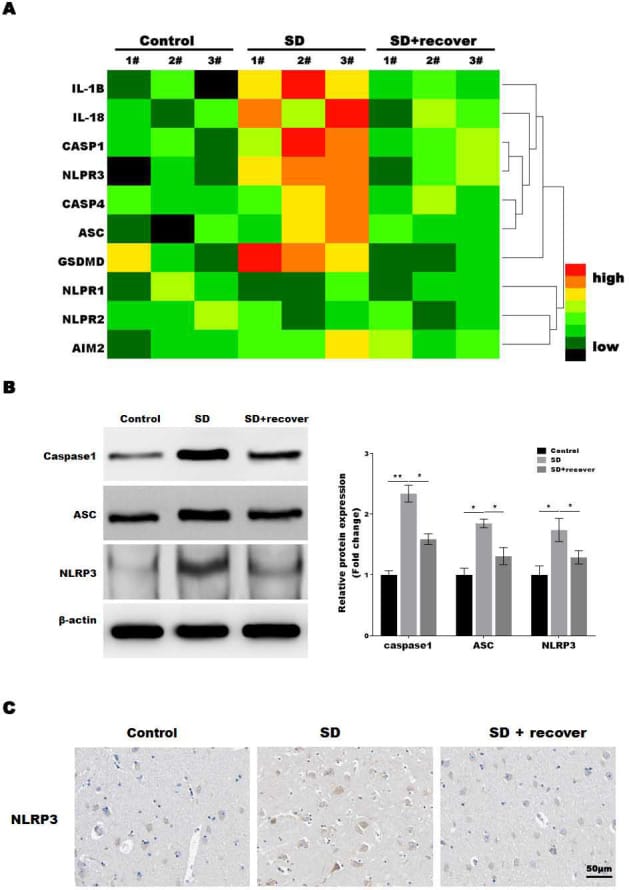
In rodent models, all three forms of sleep loss independently elevate NLRP3 mRNA, caspase-1 activity, IL-1beta, IL-18, and TNF-alpha in brain tissue and peripheral blood (Amini et al., 2022; Fan et al., 2021). Zielinski et al. (2017) provided the first evidence that NLRP3 directly regulates sleep: in the somatosensory cortex, NLRP3, ASC, and IL-1beta mRNA along with caspase-1 activity all peaked at the end of the wake-active period and after forced sleep deprivation. These elevations were absent in NLRP3 knockout mice.
In a chronic model, NLRP3 activation in the cortex and hippocampus was accompanied by microglial activation. NLRP3 deficiency prevented these changes (Smith et al., 2021).
Sleep deprivation activates NLRP3 in neurons via P38 and ERK-MAPK pathways, leading to Gasdermin D-dependent pyroptotic cell death (Fan et al., 2021). The result is a self-reinforcing loop: sleep loss accumulates ROS, which activates NLRP3, which releases IL-1beta and IL-18, which activates microglia, which disrupts sleep architecture, which causes further sleep loss (Amini et al., 2022; Smith et al., 2019).
Does the NLRP3 Inflammasome Control Deep Sleep Recovery?
NLRP3 knockout mice showed attenuated NREM sleep and delta activity following sleep deprivation (Zielinski et al., 2017). IL-1beta is the downstream somnogenic mediator: administered centrally, IL-1beta enhanced NREM sleep in both wild-type and NLRP3 knockout mice, confirming it acts downstream of the inflammasome to promote sleep pressure (Zielinski et al., 2017). NLRP3 deficiency suppressed anxiety-like consequences of sleep deprivation (Smith et al., 2021).
The circadian clock may influence NLRP3 activity. BMAL1, a core circadian clock gene, decreases in the hippocampus during chronic sleep deprivation, coinciding with increased NLRP3 expression — suggesting a regulatory relationship mediated through NF-κB signaling (Smith et al., 2021). Circadian disruption may also amplify inflammatory cell death through related inflammasome pathways (Shim et al., 2024). When sleep is consistent and aligned with the circadian rhythm, BMAL1 may help restrain NLRP3 activity. When sleep is misaligned — from rotating schedules, jet lag, or age-related circadian deterioration — this restraint may fail.
Is the NLRP3 Inflammasome Elevated in People with Chronic Insomnia?
In 36 insomnia participants and 20 matched controls, insomnia with objective short sleep duration (under 6 hours) was associated with greater NLRP3 upregulation than insomnia with normal sleep duration or controls. Short sleep duration, decreased slow wave sleep, and sleep fragmentation each correlated with inflammasome dysregulation (Wang et al., 2020).
In obstructive sleep apnea, monocytes from people with severe disease show higher NLRP3 activity than controls, correlating with apnea-hypopnea index. Intermittent hypoxia activates NLRP3 via HIF-1alpha (Diaz-Garcia et al., 2022). NLRP3 deficiency protects against intermittent hypoxia-induced neuroinflammation by preserving PINK1-Parkin mitophagy (Wu et al., 2021). NLRP3 deficiency also produced anxiolytic effects in the cortex and hippocampus (Smith et al., 2021).
NLRP3 inflammasome activation is one inflammatory mechanism that can fragment sleep, but it rarely acts alone. Histamine overactivity, gut permeability, circadian misalignment, and cytokine elevation from other pathways can all contribute. Identifying which might be involved is a practical next step.
Find out which causes might be driving your 3am wakeups ->
Frequently Asked Questions
Does Quercetin Inhibit the NLRP3 Inflammasome?
In sleep-deprived mice, quercetin inhibited microglial activation and suppressed neuronal hyperactivity, modulating sleep architecture (Hua et al., 2025). Quercetin also reduces NLRP3 activation through multiple anti-inflammatory pathways (Wu et al., 2024). A flavanol-rich dietary preparation also reduced anxiety phenotypes in sleep-deprived mice by attenuating NLRP3 and microglial activation (Smith et al., 2021). Human sleep-specific RCT data for quercetin remains limited — the animal and mechanistic evidence points a direction, not a confirmed dose-response.
Does Melatonin Block the NLRP3 Inflammasome?
The SIRT1/Nrf2 pathway is the mechanism: SIRT1 activation upregulates Nrf2, which suppresses NF-kB, which reduces NLRP3 priming (Arioz et al., 2019). In a meta-analysis of randomized controlled trials, melatonin reduced sleep onset latency and increased total sleep time (Fatemeh et al., 2022). Melatonin may therefore address the inflammasome-sleep cycle from both ends. The NLRP3-specific sleep effects have not been isolated in human trials.
Is the NLRP3 Inflammasome Linked to Sleep Apnea?
Repeated oxygen drops stabilize HIF-1alpha, which primes NLRP3. Monocytes exposed to intermittent hypoxia in vitro increase NLRP3 in a HIF-1alpha-dependent manner (Diaz-Garcia et al., 2022). NLRP3 knockout mice showed reduced neuroinflammation and preserved mitophagy after intermittent hypoxia (Wu et al., 2021). Sleep apnea’s multi-organ inflammatory damage runs through this same inflammasome pathway (Bai et al., 2022; She et al., 2022).
Does Sleep Deprivation Cause Brain Inflammation?
The cascade follows a defined sequence: sleep loss accumulates ROS, which activates NLRP3 and caspase-1, which cleaves IL-1beta and Gasdermin D, causing pyroptotic neuronal death and microglial polarization (Smith et al., 2021; Fan et al., 2021). Chronic poor sleep may produce brain inflammation that does not quickly resolve. For the broader picture, see Does Poor Sleep Cause Brain Inflammation?.
Related Reading
- Inflammatory Sleep Disruption — the cause overview for cytokines, histamine, gut inflammation, neuroinflammation, and circadian immune timing
- CRP and Sleep Quality — how inflammatory markers relate to sleep continuity and restriction
- Inflammaging and Sleep — how age-related inflammatory activity changes sleep architecture
- Why Do Men Sleep Worse After 50? — how aging, inflammation, and hormonal change can converge in men
- What Is Autoimmune Insomnia? — how autoimmune cytokine activity can disrupt sleep independently of pain
- Why Does Inflammation Make You Exhausted But Unable to Sleep? — how cytokine signaling can create fatigue without stable sleep
- Does an Anti-Inflammatory Diet Improve Sleep? — how dietary inflammatory load connects gut, immune, and sleep pathways
- Prostaglandins and Sleep — how inflammatory lipid mediators can affect sleep pressure and continuity
References
1. Amini, M., Yousefi, Z., Ghafori, S. S., & Hassanzadeh, G. (2022). Sleep deprivation and NLRP3 inflammasome: Is there a causal relationship? Frontiers in Neuroscience, 16, 1018628. https://pubmed.ncbi.nlm.nih.gov/36620464/
2. Arioz, B. I., Tastan, B., Tarakcioglu, E., Tufekci, K. U., Olcum, M., Ersoy, N., Bagriyanik, A., Genc, K., & Genc, S. (2019). Melatonin attenuates LPS-induced acute depressive-like behaviors and microglial NLRP3 inflammasome activation through the SIRT1/Nrf2 pathway. Frontiers in Immunology, 10, 1511. https://pubmed.ncbi.nlm.nih.gov/31327964/
3. Bai, C., Zhu, Y., Dong, Q., & Zhang, Y. (2022). Chronic intermittent hypoxia induces the pyroptosis of renal tubular epithelial cells by activating the NLRP3 inflammasome. Bioengineered, 13(3), 7528-7540. https://pubmed.ncbi.nlm.nih.gov/35263214/
4. Díaz-García, E., García-Tovar, S., Alfaro, E., Jaureguizar, A., Casitas, R., Sánchez-Sánchez, B., Fernández-Lahera, J., López-Collazo, E., Cubillos-Zapata, C., & García-Río, F. (2022). Inflammasome activation: A keystone of proinflammatory response in obstructive sleep apnea. American Journal of Respiratory and Critical Care Medicine, 205(11), 1337-1348. https://pubmed.ncbi.nlm.nih.gov/35363597/
5. Fan, K., Yang, J., Gong, W.-Y., Pan, Y.-C., Zheng, P., & Yue, X.-F. (2021). NLRP3 inflammasome activation mediates sleep deprivation-induced pyroptosis in mice. PeerJ, 9, e11609. https://pubmed.ncbi.nlm.nih.gov/34268006/
6. Fatemeh, G., Sajjad, M., Niloufar, R., Neda, S., Leila, S., & Khadijeh, M. (2022). Effect of melatonin supplementation on sleep quality: A systematic review and meta-analysis of randomized controlled trials. Journal of Neurology, 269(1), 205-216. https://pubmed.ncbi.nlm.nih.gov/33417003/
7. Hua, R., Wu, B., Fu, P., Liu, Z., Hao, Z., Niu, B., & Zhang, J. (2025). Quercetin modulates sleep architecture and homeostatic recovery by inhibiting neuronal hyperactivity and microglial activation in mice. Journal of Integrative Neuroscience, 24(12), 46911. https://pubmed.ncbi.nlm.nih.gov/41503995/
8. She, N., Shi, Y., Feng, Y., Ma, L., Yuan, Y., Zhang, Y., Cao, Z., Chen, X., Zhao, B., Liu, H., & Ren, X. (2022). NLRP3 inflammasome regulates astrocyte transformation in brain injury induced by chronic intermittent hypoxia. BMC Neuroscience, 23, 70. https://pubmed.ncbi.nlm.nih.gov/36437451/
9. Shim, D.-W., Eo, J.-C., Kim, S., Hwang, I., Nam, B., Shin, J.-E., Han, S. H., & Yu, J.-W. (2024). Deficiency of circadian clock gene Bmal1 exacerbates noncanonical inflammasome-mediated pyroptosis and lethality via Rev-erbα-C/EBPβ-SAA1 axis. Experimental & Molecular Medicine, 56, 370-382. https://pubmed.ncbi.nlm.nih.gov/38297162/
10. Smith, C., Trageser, K. J., & Pasinetti, G. M. (2019). Targeting the NLRP3 inflammasome in mechanisms of sleep deprivation-induced neuroinflammation. Innovation in Aging, 3(Suppl 1), S914. https://pmc.ncbi.nlm.nih.gov/articles/PMC6845347/
11. Smith, C., Trageser, K. J., Wu, H., Herman, F. J., Iqbal, U. H., Sebastian-Valverde, M., Frolinger, T., Zeng, E., & Pasinetti, G. M. (2021). Anxiolytic effects of NLRP3 inflammasome inhibition in a model of chronic sleep deprivation. Translational Psychiatry, 11, 52. https://pubmed.ncbi.nlm.nih.gov/33446652/
12. Wang, J., Wu, X., Liang, W., Chen, M., Zhao, C., & Wang, X. (2020). Objective short sleep duration is related to the peripheral inflammasome dysregulation in patients with chronic insomnia. Nature and Science of Sleep, 12, 759-766. https://pubmed.ncbi.nlm.nih.gov/33117011/
13. Wu, J., Lv, T., Liu, Y., Liu, Y., Han, Y., Liu, X., Peng, X., Tang, F., & Cai, J. (2024). The role of quercetin in NLRP3-associated inflammation. Inflammopharmacology, 32(6), 3585-3610. https://pubmed.ncbi.nlm.nih.gov/39306817/
14. Wu, X., Gong, L., Xie, L., Gu, W., Wang, X., Liu, Z., & Li, S. (2021). NLRP3 deficiency protects against intermittent hypoxia-induced neuroinflammation and mitochondrial ROS by promoting the PINK1-Parkin pathway of mitophagy in a murine model of sleep apnea. Frontiers in Immunology, 12, 628168. https://pubmed.ncbi.nlm.nih.gov/33717152/
15. Zielinski, M. R., Gerashchenko, D., Karpova, S. A., Konanki, V., McCarley, R. W., Sutterwala, F. S., Strecker, R. E., & Basheer, R. (2017). The NLRP3 inflammasome modulates sleep and NREM sleep delta power induced by spontaneous wakefulness, sleep deprivation and lipopolysaccharide. Brain, Behavior, and Immunity, 62, 137-150. https://pubmed.ncbi.nlm.nih.gov/28109896/
Written by Kat Fu, M.S., M.S. ? Last reviewed: June 5, 2026 ? 15 references cited