

Women who managed insomnia with trazodone, zolpidem, or gabapentin for years often find these medications losing effectiveness during the menopausal transition. The dose that worked at 42 stops working at 48 — not because of psychological tolerance in the conventional sense, but because the receptors these drugs target have physically changed.
Understanding why requires looking at what menopause does to the brain’s GABA-A receptors, what the medication evidence looks like in menopausal populations, and what alternatives have stronger data. For the full overview of hormonal sleep disruption across multiple mechanisms, see Hormonal Women Sleep Disruption. Hormonal changes are one of several causes of sleep disruption — the pillar article covers the broader picture.
Why Do Sedative Medications Lose Effectiveness During Menopause?
The GABA-A receptor is the primary target for sedative-hypnotic medications, including benzodiazepines and z-drugs like zolpidem. These drugs work by enhancing chloride ion flow through the receptor, which reduces neuronal excitability and lowers the arousal threshold for sleep onset.
Progesterone’s metabolite allopregnanolone is a potent endogenous modulator of this same receptor. It binds at a site distinct from benzodiazepines and z-drugs, and its presence enhances the receptor’s overall inhibitory capacity. During the menopausal transition, allopregnanolone levels collapse as progesterone production declines (Turkmen et al., 2011).
That collapse does not just remove a source of natural sedation. It triggers a structural change in the receptor itself. Research on allopregnanolone withdrawal shows that the GABA-A receptor α4 subunit is upregulated in the hippocampus — a subunit change that is pharmacologically consequential because α4-containing receptors have reduced sensitivity to benzodiazepines and related sedatives (Turkmen et al., 2011). The receptor’s composition has changed, so the same drug at the same dose produces a diminished effect.
A 2022 review of 86 studies on ovarian hormones and perimenopausal sleep found that estrogen and progesterone decline contributes to sleep disturbances, with evidence consistent with both GABA-A receptor changes and HPA axis hyperarousal in menopausal insomnia (Haufe et al., 2022). Estrogen decline may elevate HPA reactivity and nocturnal cortisol, compounding the GABA deficit with a stress-axis arousal component. The sedative medication is working against two concurrent changes: a receptor that responds less to sedation and an arousal state that is elevated beyond what sedation alone can suppress.
A 2024 review of GABA receptor mechanisms in insomnia documented that GABA-A-targeting medications carry unavoidable side effects such as dependence (Zhu et al., 2024). The receptor remodeling that occurs during menopause — documented in separate research on allopregnanolone withdrawal (Turkmen et al., 2011) — may further increase the likelihood of adverse effects at higher doses.
What Does the Research Show About Trazodone and Zolpidem in Menopause?
Trazodone produces sedation through serotonin receptor antagonism and mild histamine blockade — a different mechanism than GABA-A modulation. A 2024 meta-analysis of 44 randomized controlled trials involving 3,935 participants found that trazodone increased objective total sleep time (measured by polysomnography) by approximately 28 minutes compared to comparators (Kokkali et al., 2024). Subjective total sleep time, however, showed no measurable change — a dissociation suggesting that the sleep extension trazodone produces may not be perceived by the person sleeping.
Sleep quality did improve on self-report measures, and nocturnal awakenings decreased. But dropouts due to adverse effects occurred at 2.3 times the rate of comparators, and sleep-related adverse effects were 4.31 times more frequent with trazodone (Kokkali et al., 2024). Trazodone’s primary benefit appears to be in sleep maintenance rather than sleep onset — the profile that aligns with menopausal insomnia — but the adverse effect burden is high.
A 2026 GRADE-assessed meta-analysis of 1,029 individuals with comorbid depression and sleep disturbances — a profile disproportionately common in menopausal women — found trazodone produced a large effect size for sleep quality improvement (SMD = −0.827), while simultaneously reducing depression scores (Hameed et al., 2026). However, adverse effects were elevated: blurred vision occurred at 17.5 times the control rate, somnolence at 7.34 times, and sedation at 6.53 times. In postmenopausal women whose GABA-A receptors are already remodeled and whose fall risk may be elevated, this adverse effect profile needs to be weighed against the benefit.
Zolpidem targets the GABA-A receptor directly, and its efficacy in menopausal women has been tested in one placebo-controlled randomized trial. In 141 perimenopausal and postmenopausal women, zolpidem 10 mg reduced wake time after sleep onset and number of nocturnal awakenings compared to placebo across all four weeks of the trial, with no evidence of tolerance development over that period (Dorsey et al., 2004). Approximately twice as many women in the zolpidem group reported improved overall sleep quality compared to placebo.
This remains the only randomized placebo-controlled trial of zolpidem conducted exclusively in perimenopausal and postmenopausal women. It demonstrates short-term efficacy — but it is a 4-week trial. Long-term data in menopausal populations is absent, and guidelines recommend against long-term zolpidem use due to dependence risk, rebound insomnia upon discontinuation, and cognitive effects.
Is Cognitive Behavioral Therapy for Insomnia More Effective Than Medication for Menopause Insomnia?
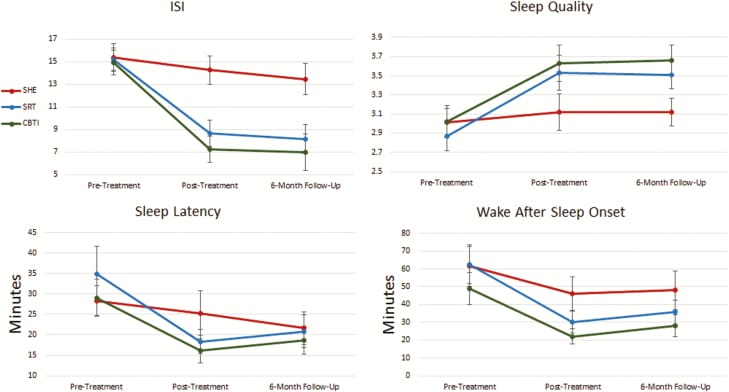
A randomized trial of 150 postmenopausal women with chronic insomnia compared CBT-I, sleep restriction therapy (SRT), and sleep hygiene education (SHE) over 6 months (Drake et al., 2019). Insomnia Severity Index scores decreased by 7.70 points with CBT-I, 6.56 points with SRT, and only 1.12 points with SHE. At 6-month follow-up, women in the CBT-I group slept 40–43 more minutes per night than those in the SHE or SRT groups.
Remission rates at 6 months were 54–84% for CBT-I (depending on the remission criterion used), compared to 38–57% for SRT and 4–33% for SHE. CBT-I was particularly effective at reducing wake after sleep onset — the dimension of insomnia closely tied to hormonal hyperarousal in postmenopausal women (Drake et al., 2019).
A companion trial in 117 postmenopausal women examined the effects of CBT-I, SRT, and SHE on hyperarousal, depression, and maladaptive sleep beliefs (Kalmbach et al., 2019). CBT-I produced moderate-to-large reductions in depression scores from baseline, while SRT produced only moderate reductions that did not emerge until six months after the program ended. Presleep somatic arousal — a physiological marker of the hyperarousal state that is pronounced in menopausal insomnia due to hormonal HPA axis changes — improved in the CBT-I group to a greater extent than in SRT, while SHE produced no durable effect. Sleep hygiene education alone was inadequate as a stand-alone approach across all measured outcomes.
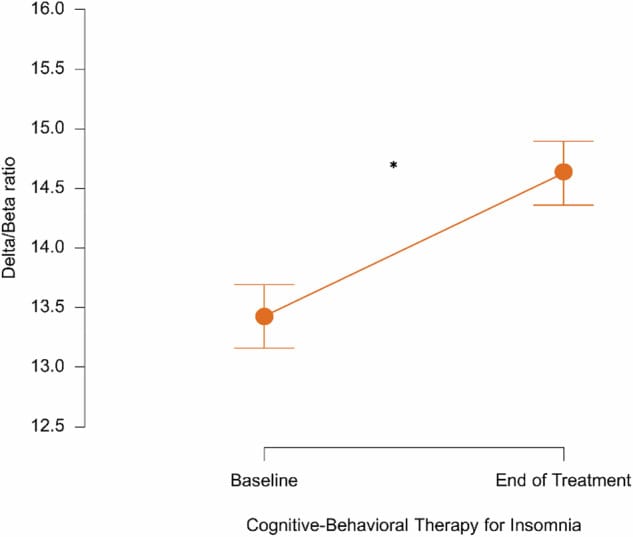
The mechanism question — whether CBT-I addresses hyperarousal at the neurophysiological level, not just the behavioral level — was answered by a 2026 multicenter polysomnographic study (Sforza et al., 2026). In 98 participants with chronic insomnia across five centers, the delta/beta EEG ratio (a validated biomarker of cortical hyperarousal) increased from 13.4 to 14.6 after 6–8 weeks of CBT-I (p = 0.002). A higher delta/beta ratio indicates lower cortical arousal. Sleep stability as measured by microstructural EEG indices also improved (p = 0.005), reflecting normalization of arousal-related sleep fragmentation at the neuronal level.
A 2024 scoping review found that CBT-I efficacy in menopausal women is durable to at least 6 months post-completion and is effective across delivery formats — face-to-face, online, and telephone-based — with no single modality showing consistent superiority over others (Ntikoudi et al., 2024). Online CBT-I may offer a scalable option for women facing geographic or scheduling barriers to in-person behavioral health services.
Many people have more than one cause contributing to their sleep disruption. Hormonal changes that reduce medication responsiveness might compound with autonomic, metabolic, inflammatory, or circadian factors — and each requires a different approach. Identifying which causes might be involved is a useful next step.
Find out which causes might be driving your 3am wakeups →
Frequently Asked Questions
Why Did Trazodone Stop Working for Your Insomnia?
Trazodone does not target GABA-A receptors directly, which means the receptor remodeling described above (the α4 subunit upregulation from allopregnanolone withdrawal) is not the primary reason it loses effectiveness. Instead, trazodone’s serotonergic sedation may become insufficient against the elevated cortical arousal state that develops during menopause — an arousal state driven by both GABA-A receptor changes and HPA axis hyperactivity (Turkmen et al., 2011).
Meta-analysis data shows trazodone’s adverse effect profile is steep — 6.53 times higher sedation rates versus comparators — meaning dose increases to compensate for reduced effectiveness carry escalating risk (Hameed et al., 2026).
Can You Build Tolerance to Zolpidem During Menopause?
The Dorsey et al. (2004) trial showed consistent zolpidem efficacy across all four weeks, with no diminishing response — notable given that tolerance to other GABA-A-targeting sedatives can develop within days in some populations.
However, 4 weeks is a narrow observation window. Zolpidem targets the GABA-A receptor, and the receptor subunit remodeling that occurs during menopause (α4 upregulation) may alter the long-term tolerance trajectory in ways that a 4-week trial cannot detect. Guidelines recommend limiting zolpidem use to the shortest effective duration, and no long-term randomized data exists for menopausal women.
Does Gabapentin Help with Menopause Insomnia?
Gabapentin’s mechanism is distinct from trazodone and zolpidem. It binds to the α2δ subunit of voltage-gated calcium channels, reducing excitatory neurotransmitter release. Because it does not target GABA-A receptors, the allopregnanolone-driven receptor remodeling may not directly reduce its effectiveness.
That said, the evidence base for gabapentin as a primary sleep-promoting agent in menopause is thin. Available data comes primarily from hot flash trials where sleep improvement was a secondary outcome — not from trials designed to assess insomnia as the primary endpoint (Haufe et al., 2022). Whether gabapentin’s calcium channel mechanism is sufficient to address the cortical hyperarousal component of menopausal insomnia has not been rigorously tested.
What Happens When Your Doctor Increases the Dose Instead of Changing the Approach?
When a medication loses effectiveness, the default response is often to increase the dose. If the loss of effectiveness is due to receptor-level changes rather than insufficient drug concentration, dose escalation addresses the wrong variable.
In the case of GABA-A-targeting medications during menopause, the receptor subunit composition has changed — the α4 subunit upregulation reduces the receptor’s inherent sensitivity to sedation. A higher dose of a drug targeting that receptor may produce marginally more sedation, but the adverse effect curve does not flatten the same way. Meta-analysis data shows trazodone sedation rates at 6.53 times the comparator rate (Hameed et al., 2026), and the 2024 GABA receptor review notes that GABA-A-targeting medications carry unavoidable side effects including dependence (Zhu et al., 2024).
Can Medication and Cognitive Behavioral Therapy for Insomnia Work Together?
The Kalmbach et al. (2019) trial demonstrated that CBT-I alone was superior to both sleep restriction therapy and sleep hygiene education across depression, maladaptive sleep beliefs, and somatic arousal domains in postmenopausal women. The question of whether adding medication to CBT-I improves outcomes beyond CBT-I alone has not been tested in a menopause-specific population.
In general insomnia populations, there is evidence that medication use during CBT-I can interfere with the cognitive restructuring component — if medication produces sufficient drowsiness, the person may not fully engage with the sleep restriction and stimulus control techniques that drive CBT-I’s long-term benefit. Whether this applies to the hormonal hyperarousal context of menopausal insomnia remains an open question.
Related Reading
- Hormonal Women Sleep Disruption — Parent guide to how estrogen, progesterone, cortisol, temperature, melatonin, and cycle changes interact with sleep.
- Why Did You Become a Light Sleeper in Perimenopause? — Why progesterone and GABA decline can lower the arousal threshold during perimenopause.
- Can Insomnia Be the First Sign of Perimenopause, Even Without Hot Flashes? — How insomnia can appear before hot flashes or cycle changes when early perimenopause alters progesterone and sleep maintenance.
- Why Are Your Blood Tests Normal When Perimenopause Is Disrupting Your Sleep? — Why fluctuating FSH and estradiol can make perimenopause sleep disruption hard to capture with one blood draw.
- How Long Does Menopause Insomnia Last? — Sleep disruption across perimenopause, menopause, and postmenopause, including stage-specific contributors.
- What Supplements Have Evidence for Menopause Insomnia? — Supplement options for menopause insomnia by evidence, mechanism, and limits.
References
1. Turkmen, S., Backstrom, T., Wahlstrom, G., Andreen, L., & Johansson, I. M. (2011). Tolerance to allopregnanolone with focus on the GABA-A receptor. British Journal of Pharmacology, 162(2), 311–327. https://pubmed.ncbi.nlm.nih.gov/20883478/
2. Haufe, A., Baker, F. C., & Leeners, B. (2022). The role of ovarian hormones in the pathophysiology of perimenopausal sleep disturbances: A systematic review. Sleep Medicine Reviews, 66, 101710. https://pubmed.ncbi.nlm.nih.gov/36356400/
3. Zhu, W., Huang, L., Cheng, H., Li, N., Zhang, B., Dai, W., Wu, X., Zhang, D., Feng, W., Li, S., & Xu, H. (2024). GABA and its receptors’ mechanisms in the treatment of insomnia. Heliyon, 10(23), e40665. https://pubmed.ncbi.nlm.nih.gov/39654705/
4. Kokkali, M., Pinioti, E., Lappas, A. S., Christodoulou, N., & Samara, M. T. (2024). Effects of Trazodone on Sleep: A Systematic Review and Meta-analysis. CNS Drugs, 38(10), 753–769. https://pubmed.ncbi.nlm.nih.gov/39123094/
5. Hameed, A. K., Asiri, M., Fedwi, M. M., Jawad, M., Prahlad, P., Singh, A., Chauhan, A. S., Sahoo, S., Singh, M., & Kadhem, M. (2026). The efficacy and safety of trazodone for sleep problems in depressive patients: a GRADE-assessed systematic review and meta-analysis of clinical trials. Psychopharmacology, 243(3), 457–473. https://pubmed.ncbi.nlm.nih.gov/41081841/
6. Dorsey, C. M., Lee, K. A., & Scharf, M. B. (2004). Effect of zolpidem on sleep in women with perimenopausal and postmenopausal insomnia: a 4-week, randomized, multicenter, double-blind, placebo-controlled study. Clinical Therapeutics, 26(10), 1578–1586. https://pubmed.ncbi.nlm.nih.gov/15598474/
7. Drake, C. L., Kalmbach, D. A., Arnedt, J. T., Cheng, P., Tonnu, C. V., Cuamatzi-Castelan, A., & Fellman-Couture, C. (2019). Treating chronic insomnia in postmenopausal women: a randomized clinical trial comparing cognitive-behavioral therapy for insomnia, sleep restriction therapy, and sleep hygiene education. Sleep, 42(2). https://pubmed.ncbi.nlm.nih.gov/30481333/
8. Kalmbach, D. A., Cheng, P., Arnedt, J. T., Anderson, J. R., Roth, T., Fellman-Couture, C., Williams, R. A., & Drake, C. L. (2019). Treating insomnia improves depression, maladaptive thinking, and hyperarousal in postmenopausal women: comparing cognitive-behavioral therapy for insomnia (CBTI), sleep restriction therapy, and sleep hygiene education. Sleep Medicine, 55, 124–134. https://pubmed.ncbi.nlm.nih.gov/30785053/
9. Sforza, M., Morin, C. M., Dang-Vu, T. T., Pomares, F. B., Perrault, A. A., Gouin, J. P., Buskova, J., Janku, K., Vgontzas, A., Fernandez-Mendoza, J., Bastien, C. H., Riemann, D., Baglioni, C., Carollo, G., Casoni, F., Zucconi, M., Castronovo, V., Galbiati, A., & Ferini-Strambi, L. (2026). The effectiveness of Cognitive behavioral therapy for insomnia on sleep EEG hyperarousal: a multicentric polysomnographic study. Translational Psychiatry, 16(1). https://pubmed.ncbi.nlm.nih.gov/41688421/
10. Ntikoudi, A., Owens, D. A., Spyrou, A., Evangelou, E., & Vlachou, E. (2024). The Effectiveness of Cognitive Behavioral Therapy on Insomnia Severity Among Menopausal Women: A Scoping Review. Life (Basel, Switzerland), 14(11). https://pubmed.ncbi.nlm.nih.gov/39598203/
Written by Kat Fu, M.S., M.S. · Last reviewed: April 25, 2026 · 10 references cited