

Being physically exhausted but unable to sleep deeply is one of the more common complaints in chronic inflammatory conditions. The mechanism behind this paradox involves two prostaglandin molecules — PGD2 and PGE2 — that send opposing instructions to the brain’s sleep and wake centers. PGD2 accumulates during waking hours and drives sleep pressure. PGE2 rises during inflammation and activates arousal circuits. When both are elevated at the same time, the body receives a fatigue cue and a wakefulness cue simultaneously.
This article covers how PGD2 promotes sleep, how PGE2 promotes wakefulness during inflammation, why NSAIDs disrupt sleep despite reducing inflammation, and how sleep deprivation itself redirects prostaglandin production toward PGE2. For the broader framework of inflammatory sleep disruption, see the parent article: Inflammatory Sleep Disruption.
What Does Prostaglandin D2 Do to the Brain During Sleep?
PGD2 is not a sedative that the body releases at bedtime. It accumulates progressively during waking hours as a biochemical pressure molecule — the longer you stay awake, the more PGD2 builds in the cerebrospinal fluid. The enzyme that produces it, lipocalin-type PGD synthase (L-PGDS), is the second most abundant protein in human cerebrospinal fluid, and PGD2 concentrations follow a circadian rhythm tightly coupled to the sleep-wake cycle (Urade & Hayaishi, 2011).
The pathway from PGD2 to sleep onset runs through adenosine. When PGD2 activates DP1 receptors in the basal forebrain and VLPO, astrocytes release adenosine — producing a 40% increase in local adenosine concentrations, measured by real-time purine biosensors (Scharbarg et al., 2023). This adenosine activates sleep-promoting GABA and galanin neurons in the VLPO while inhibiting the histaminergic arousal center in the tuberomammillary nucleus (TMN). The net effect: sleep-promoting neurons turn on, wake-promoting neurons turn off.
The adenosine step is receptor-specific. PGD2’s somnogenic effect is partially dependent on adenosine A2A receptors — not A1 receptors. Mice lacking A2A receptors show an attenuated sleep response to PGD2 — the somnogenic effect is reduced but not eliminated, indicating both A2A-dependent and A2A-independent pathways (Urade et al., 2003; Zhang et al., 2017). PGD2 primarily promotes sleep through the adenosine pathway, though parallel mechanisms exist.
How large is this sleep-pressure effect? In rats, cerebrospinal fluid PGD2 concentrations rise from approximately 703 pg/mL at baseline to 1,734 pg/mL after five hours of sleep deprivation — a 2.5-fold increase that correlates with sleep propensity scores (Ram et al., 1997). PGD2 is not just associated with sleepiness; it is a measurable homeostatic sleep-pressure molecule that accumulates with time awake.
Why Does Inflammation Make You Exhausted But Unable to Sleep?
PGE2 does two things in the brain, and they happen in different locations. Microdialysis studies in primates showed that PGE2 in the posterior hypothalamus produces wakefulness, while its fever-generating effect is maximal in the preoptic area (Onoe et al., 1992). Wakefulness is not a side effect of fever. It is a separate PGE2 function mediated through a distinct brain region.
During inflammation, circulating cytokines — IL-1 beta, TNF-alpha, IL-6 — drive PGE2 production and entry into the brain. In healthy rodents, brain PGE2 is normally undetectable. Within hours of cytokine exposure or lipopolysaccharide (LPS) administration, central PGE2 rises sharply, coinciding with fever and inflammatory signaling (Engblom et al., 2002).
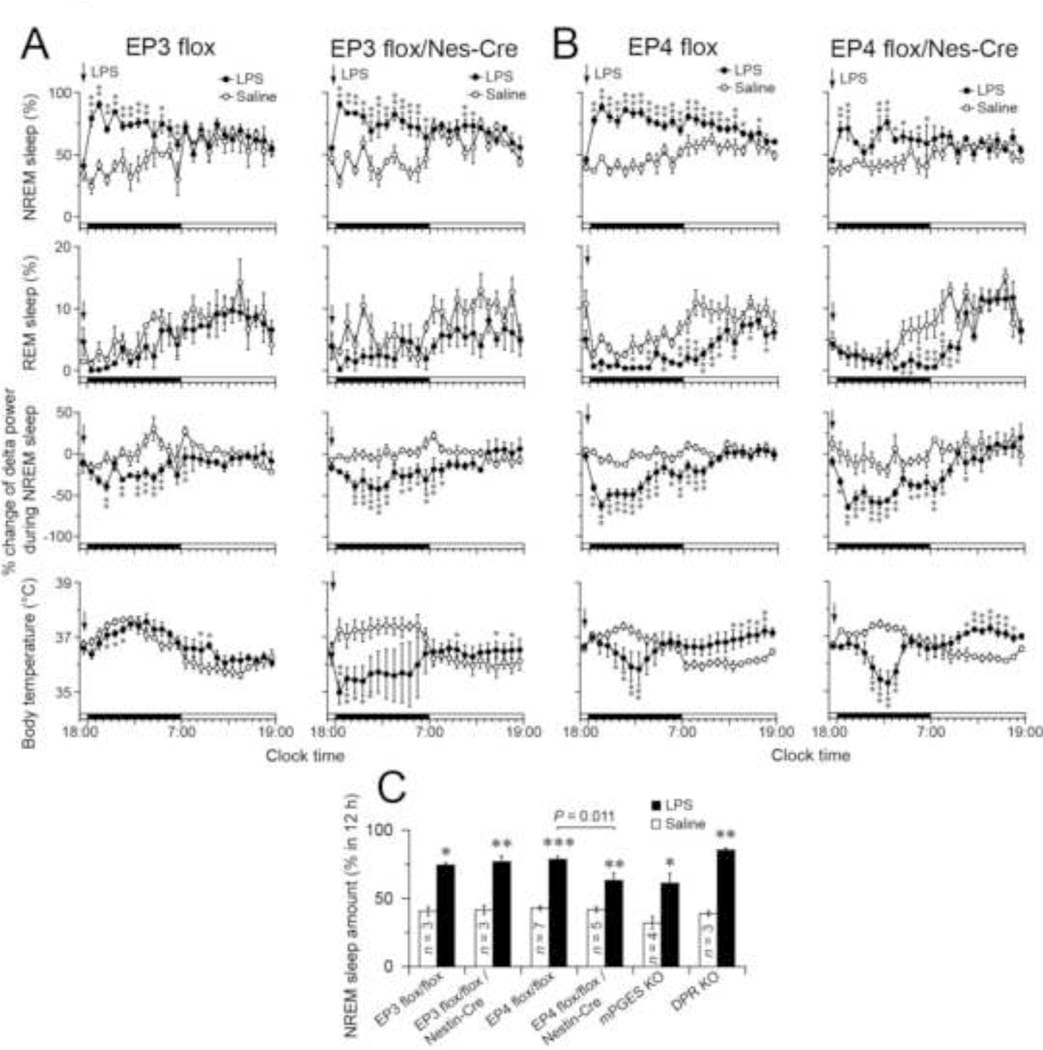
The receptor mediating this sleep disruption has been identified. In mice challenged with LPS, those lacking EP4 receptors on neural cells showed attenuated NREM sleep alterations compared to wild-type animals. REM sleep changes were PGE2-independent — establishing that EP4 receptors contribute to the NREM disruption (Oishi et al., 2015).
The two prostaglandins produce opposite dose-response curves on the same sleep parameters. Intracerebroventricular infusion of PGD2 produces dose-dependent increases in NREM sleep; equivalent doses of PGE2 suppress NREM and increase waking (Huang et al., 2011). During chronic inflammation, elevated PGE2 tilts the balance toward arousal while PGD2 continues generating fatigue — producing the state where the body is exhausted but the brain will not enter deep sleep.
Why Do NSAIDs Like Ibuprofen Disrupt Sleep?
The sleep-disrupting effect of NSAIDs is measurable on polysomnography. In a controlled study of healthy, pain-free adults, aspirin and ibuprofen increased the number of nighttime awakenings and the percentage of time spent awake compared to placebo (Murphy et al., 1994). These effects occurred in subjects without pain, ruling out pain relief as a confounding variable. The drugs themselves disrupted sleep architecture.
The mechanism is upstream of both prostaglandins. COX enzymes are the shared precursor step for producing PGD2 and PGE2. When an NSAID blocks COX, it suppresses both: it removes the inflammatory PGE2 wakefulness input while also removing the PGD2 sleep-pressure input. The brain loses its primary biochemical cue that sleep is needed (Urade & Hayaishi, 2011). This explains a counterintuitive finding: routine NSAID use does not improve sleep quality despite reducing inflammation.
NSAIDs may also affect sleep through a second pathway. NSAIDs can suppress nocturnal melatonin secretion (Murphy et al., 1996). Combined with PGD2 suppression, this creates a dual disruption — the homeostatic sleep drive and the circadian sleep input are both dampened.
This mechanism predicts that reducing inflammation through non-COX pathways — approaches that lower PGE2 without eliminating PGD2 — would preserve sleep architecture better than blanket COX inhibition. That prediction aligns with what is observed in the omega-3 data discussed in the FAQ below.
Does Sleep Deprivation Change Prostaglandin Levels?
The relationship between prostaglandins and sleep runs in both directions. Sleep deprivation does not just allow PGE2 to persist — it actively drives PGE2 production.
In cerebrospinal fluid, PGD2 rises 2.5-fold after five hours of sleep deprivation, consistent with its role as a homeostatic sleep-pressure molecule. But PGE2 and PGF2-alpha also rise after five hours of deprivation — and notably, not after 2.5 hours. This threshold-dependent activation indicates that prolonged sleep loss, not brief waking, triggers the inflammatory prostaglandin arm (Ram et al., 1997).
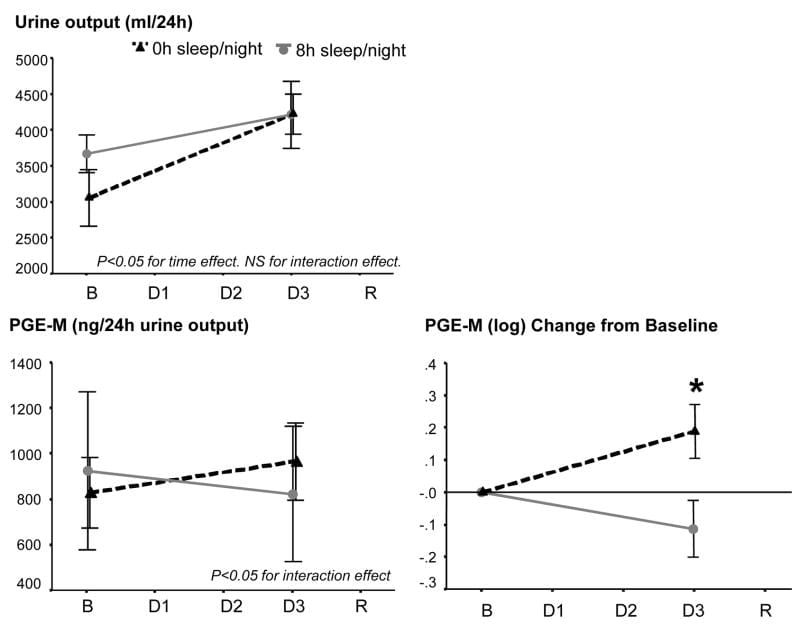
In a randomized study of healthy adults, 88 hours of total sleep deprivation produced an approximately 30% increase in urinary PGE2 metabolite. The PGE2 elevation correlated with increases in spontaneous headache and muscle pain — pain scores rose 5 to 14 units on a 100-point scale during the deprivation period (Haack et al., 2009).
Chronic sleep disruption may move the balance more permanently. Chronic REM sleep deprivation in animal models redirects cerebral prostaglandin biosynthesis away from PGD2 and toward PGE2 in the pituitary, hypothalamus, and hippocampus (Moussard et al., 1994). This suggests prolonged sleep disruption can bias the prostaglandin ratio against sleep in a way that outlasts the original sleep loss.
The feedback loop is: sleep loss raises PGE2 — elevated PGE2 promotes wakefulness and pain — wakefulness and pain cause further sleep loss — which raises PGE2 again. This loop explains why inflammatory insomnia tends to worsen over time if the initial cause is not addressed.
Prostaglandin imbalance is one of several inflammatory pathways that might be disrupting your sleep. Histamine release, gut permeability, neuroinflammation, cytokine timing inversion, and autonomic dysregulation can all produce the same exhausted-but-unable-to-sleep pattern — and these causes often compound each other.
Find out which causes might be driving your 3am wakeups ->
Frequently Asked Questions
What Is the Difference Between PGD2 and PGE2 in Sleep?
The two prostaglandins act through different receptors in different brain regions. PGD2 activates DP1 receptors in the VLPO and basal forebrain, producing adenosine that turns on sleep-promoting GABA neurons and turns off wake-promoting histamine neurons in the TMN. PGE2 activates EP4 receptors in the posterior hypothalamus, directly promoting wakefulness. When both are infused into the brain at equivalent doses, they produce opposite dose-response curves on NREM sleep — PGD2 increases it, PGE2 suppresses it (Huang et al., 2011). Chronic inflammation elevates PGE2 while PGD2 continues accumulating as a fatigue cue, producing the paradox of exhaustion without deep sleep.
Does Chronic Inflammation Cause Poor Sleep Quality?
The prostaglandin pathway is not the only inflammatory mechanism that disrupts sleep. Cytokine timing inversion (IL-6 peaks moving from nighttime to daytime), neuroinflammation, and histamine release from mast cells all contribute independently. In mice lacking neural EP4 receptors, LPS-induced NREM disruption was attenuated but not eliminated — indicating that PGE2 is one contributor among several (Oishi et al., 2015). The parent article, Inflammatory Sleep Disruption, covers the full framework, and Chronic Inflammation and Insomnia details the cytokine-specific mechanism.
Can Omega-3s Help Reduce Inflammatory Sleep Disruption?
The mechanism is competitive displacement. EPA and DHA compete with arachidonic acid for the COX enzyme binding site. When EPA occupies COX, it produces PGE3 instead of PGE2. PGE3 has lower potency at EP receptors than PGE2, meaning the arousal-promoting effect is reduced (Calder, 2006). On the PGD2 side, EPA-derived PGD3 has partial activity at DP receptors but lower potency than PGD2 — so the sleep-promoting effect is reduced but not eliminated. The net result is a move away from inflammation without the blanket PGD2 suppression that NSAIDs produce. Scorza et al. (2013) hypothesized that omega-3 supplementation could improve sleep in people with sleep apnea, attributing the potential benefit to reduced inflammatory mediator production. Sleep-specific omega-3 evidence remains limited, and this is a mechanistic direction rather than an established effect.
Why Does Sleep Deprivation Increase Pain?
In the Haack et al. (2009) study, healthy adults were randomized to either 88 hours of total sleep deprivation or a control sleep condition. Spontaneous pain scores increased 5 to 14 units on a 100-point scale during deprivation. The correlation between urinary PGE2 metabolite and pain scores was measurable in the same individuals — those with the largest PGE2 increases reported the most pain. PGE2 does not just promote wakefulness; it sensitizes nociceptive pathways. This creates a compounding problem: sleep loss raises PGE2, elevated PGE2 increases pain and wakefulness, and both pain and wakefulness prevent sleep recovery.
Related Reading
- Inflammatory Sleep Disruption — the cause overview for cytokines, histamine, gut inflammation, neuroinflammation, and circadian immune timing
- CRP and Sleep Quality — how inflammatory markers relate to sleep continuity and restriction
- Inflammaging and Sleep — how age-related inflammatory activity changes sleep architecture
- Why Do Men Sleep Worse After 50? — how aging, inflammation, and hormonal change can converge in men
- What Is Autoimmune Insomnia? — how autoimmune cytokine activity can disrupt sleep independently of pain
- Why Does Inflammation Make You Exhausted But Unable to Sleep? — how cytokine signaling can create fatigue without stable sleep
- Does an Anti-Inflammatory Diet Improve Sleep? — how dietary inflammatory load connects gut, immune, and sleep pathways
- NLRP3 Inflammasome and Sleep — how inflammasome signaling intersects with sleep regulation
References
1. Calder, P. C. (2006). n-3 polyunsaturated fatty acids, inflammation, and inflammatory diseases. American Journal of Clinical Nutrition, 83(6 Suppl), 1505S-1519S. https://pubmed.ncbi.nlm.nih.gov/16841861/
2. Engblom, D., Ek, M., Saha, S., Ericsson-Dahlstrand, A., Jakobsson, P. J., & Blomqvist, A. (2002). Prostaglandins as inflammatory messengers across the blood-brain barrier. Journal of Molecular Medicine, 80(1), 5-15. https://pubmed.ncbi.nlm.nih.gov/11862319/
3. Haack, M., Lee, E., Cohen, D. A., & Mullington, J. M. (2009). Activation of the prostaglandin system in response to sleep loss in healthy humans: Potential mediator of increased spontaneous pain. Pain, 145(1-2), 136-141. https://pubmed.ncbi.nlm.nih.gov/19560866/
4. Huang, Z. L., Urade, Y., & Hayaishi, O. (2011). The role of adenosine in the regulation of sleep. Current Topics in Medicinal Chemistry, 11(8), 1047-1057. https://pubmed.ncbi.nlm.nih.gov/21401496/
5. Moussard, C., Alber, D., Mozer, J. L., & Henry, J. C. (1994). Effect of chronic REM sleep deprivation on pituitary, hypothalamus and hippocampus PGE2 and PGD2 biosynthesis in the mouse. Prostaglandins, Leukotrienes and Essential Fatty Acids, 51(5), 369-372. https://pubmed.ncbi.nlm.nih.gov/7846109/
6. Murphy, P. J., Badia, P., Myers, B. L., Boecker, M. R., & Wright, K. P. (1994). Nonsteroidal anti-inflammatory drugs affect normal sleep patterns in humans. Physiology & Behavior, 55(6), 1063-1066. https://pubmed.ncbi.nlm.nih.gov/8047572/
7. Murphy, P. J., Myers, B. L., & Badia, P. (1996). Nonsteroidal anti-inflammatory drugs alter body temperature and suppress melatonin in humans. Physiology & Behavior, 59(1), 133-139. https://pubmed.ncbi.nlm.nih.gov/8848472/
8. Oishi, Y., Yoshida, K., Scammell, T. E., Urade, Y., Lazarus, M., & Saper, C. B. (2015). The roles of prostaglandin E2 and D2 in lipopolysaccharide-mediated changes in sleep. Brain, Behavior, and Immunity, 47, 172-177. https://pubmed.ncbi.nlm.nih.gov/25532785/
9. Onoe, H., Watanabe, Y., Ono, K., Koyama, Y., & Hayaishi, O. (1992). Prostaglandin E2 exerts an awaking effect in the posterior hypothalamus at a site distinct from that mediating its febrile action in the anterior hypothalamus. Journal of Neuroscience, 12(7), 2715-2725. https://pubmed.ncbi.nlm.nih.gov/1613554/
10. Ram, A., Pandey, H. P., Matsumura, H., Kasahara-Orita, K., Nakajima, T., Takahata, R., Satoh, S., Terao, A., & Hayaishi, O. (1997). CSF levels of prostaglandins, especially the level of prostaglandin D2, are correlated with increasing propensity towards sleep in rats. Brain Research, 751(1), 81-89. https://pubmed.ncbi.nlm.nih.gov/9098570/
11. Scharbarg, E., Walter, A., Lecoin, L., Gallopin, T., Lemaître, F., Guille-Collignon, M., Rouach, N., & Rancillac, A. (2023). Prostaglandin D2 controls local blood flow and sleep-promoting neurons in the VLPO via astrocyte-derived adenosine. ACS Chemical Neuroscience, 14(6), 1063-1070. https://pubmed.ncbi.nlm.nih.gov/36847485/
12. Scorza, F. A., Cavalheiro, E. A., Scorza, C. A., Galduróz, J. C. F., Tufik, S., & Andersen, M. L. (2013). Sleep apnea and inflammation — getting a good night’s sleep with omega-3 supplementation. Frontiers in Neurology, 4, 193. https://pubmed.ncbi.nlm.nih.gov/24348457/
13. Urade, Y., & Hayaishi, O. (2011). Prostaglandin D2 and sleep/wake regulation. Sleep Medicine Reviews, 15(6), 411-418. https://pubmed.ncbi.nlm.nih.gov/22024172/
14. Urade, Y., Eguchi, N., Qu, W. M., Sakata, M., Huang, Z. L., Chen, J. F., Schwarzschild, M. A., Fink, J. S., & Hayaishi, O. (2003). Sleep regulation in adenosine A2A receptor-deficient mice. Neurology, 61(11 Suppl 6), S94-S96. https://pubmed.ncbi.nlm.nih.gov/14663019/
15. Zhang, B. J., Huang, Z. L., Chen, J. F., Urade, Y., & Qu, W. M. (2017). Adenosine A₂A receptor deficiency attenuates the somnogenic effect of prostaglandin D₂ in mice. Acta Pharmacologica Sinica, 38(4), 469-476. https://pubmed.ncbi.nlm.nih.gov/28112177/
Written by Kat Fu, M.S., M.S. ? Last reviewed: June 13, 2026 ? 15 references cited