

Women in perimenopause frequently report vivid, disturbing dreams and nightmares that leave them anxious upon waking. The experience is often attributed to stress, but the mechanism is neurological — driven by changes in how the brain processes emotional content during sleep.
This article covers why REM disruption leads to nightmares, how estrogen decline changes emotional processing during sleep, and why dream recall increases during perimenopause. For the full overview of hormonal sleep disruption, see Hormonal Women Sleep Disruption. Hormonal changes are one of several causes of sleep disruption — that article covers the broader picture including thermoregulation, cortisol amplification, and serotonin-melatonin impairment.
Why Does Rapid Eye Movement Sleep Disruption Lead to Nightmares?
REM sleep is not passive. It is the stage where the brain reprocesses emotional experiences from the prior day — and the neurochemistry of REM is what makes this possible.
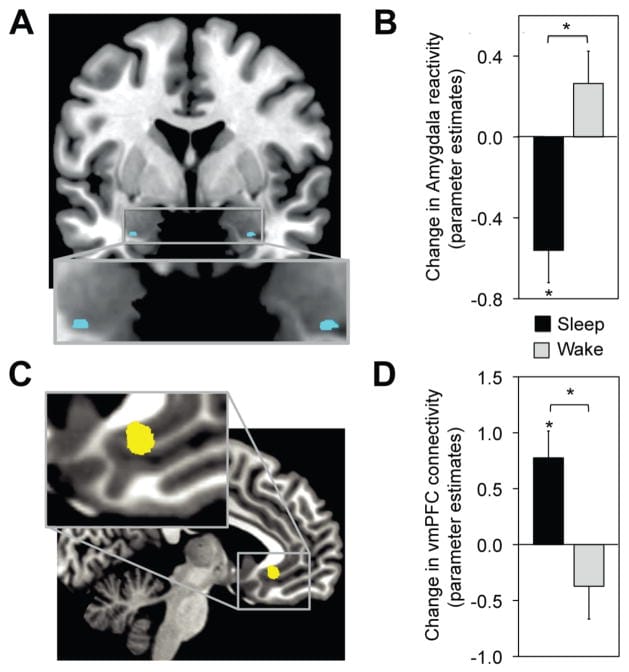
van der Helm et al. (2011) demonstrated this in a controlled experiment using fMRI. Participants viewed emotionally arousing images, then either slept overnight (with EEG-recorded REM) or stayed awake for 12 hours before re-viewing the same images. In the sleep group, amygdala activation decreased from the first to the second viewing — meaning the emotional charge of those images had been reduced overnight. In the wake group, amygdala activation increased. The sleep group also showed strengthened connectivity between the amygdala and the ventromedial prefrontal cortex, a region involved in top-down emotional regulation, while the wake group showed the opposite. Lower prefrontal gamma power during REM correlated with greater overnight decreases in emotional reactivity, providing an EEG marker of effective reprocessing.
The mechanism involves suppression of noradrenaline during REM sleep. While the amygdala-hippocampal network remains active (replaying emotional memories), the absence of noradrenaline allows the emotional intensity to be separated from the memory content. When REM is fragmented — by any cause — this process is interrupted before completion.
Matei et al. (2022) mapped this amygdala behavior during REM in rats using functional ultrasound imaging across 259 brain regions. During the majority of REM episodes, the posterior amygdala was functionally disconnected from nearly all other monitored brain regions — a dissociation not observed in any other structure during REM. The authors propose that this isolation enables internal emotional memory processing while preventing negative emotional content from triggering awakening. When REM architecture is disrupted, this dissociation is incomplete — and emotional material that would normally be contained during REM can surface as vivid or distressing dream content.
Mendoza Alvarez et al. (2025) reported this relationship across a broader evidence base. Their review of 28 studies found that REM fragmentation is present across multiple conditions characterized by emotional dysregulation — including depression, anxiety, and PTSD. Fragmented REM disrupts overnight emotional resolution and is linked to dysphoric (emotionally negative) dreams. The same REM fragmentation produced by hormonal hyperarousal in perimenopause engages this same pathway.
How Does Estrogen Decline Change Dream Content and Emotional Processing?
The REM disruption mechanisms described above apply to anyone with fragmented REM. What makes perimenopause distinct is that estrogen decline compromises emotional processing through two additional pathways: direct stress-response buffering and structural brain changes in the circuits that regulate the amygdala.
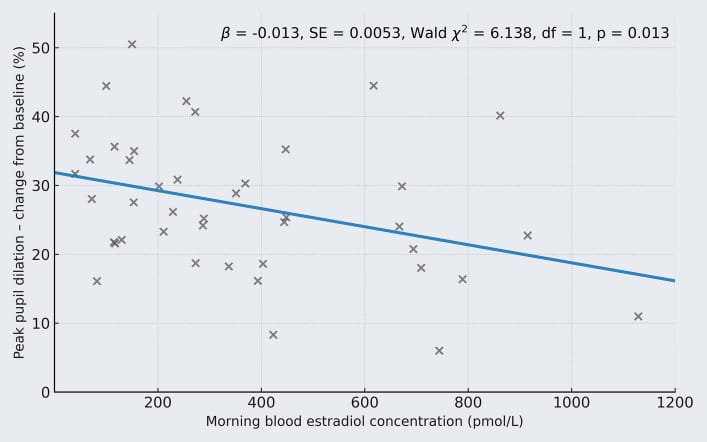
Meth et al. (2025) tested this in a controlled experiment. Forty-two naturally cycling women underwent overnight sleep recording using a wearable EEG device followed by a standardized stress task the next morning, with blood estradiol measured and autonomic arousal tracked via pupillometry. Women with higher estradiol concentrations showed reduced peak pupil dilation during the stress task — a physiological marker of lower autonomic arousal. Separately, women who spent more time in deep (N3) sleep reported lower subjective distress. Estradiol attenuated the physiological stress response while deep sleep attenuated the cognitive-emotional stress response — two independent protective pathways. During perimenopause, estradiol declines and deep sleep is reduced, meaning both buffers are lost in parallel.
Zuhlsdorff et al. (2026) examined the structural side using UK Biobank data from approximately 125,000 women, with a neuroimaging subset of approximately 10,000 who underwent MRI. Postmenopausal women showed reduced gray matter volume in the medial temporal lobe and anterior cingulate cortex compared to premenopausal women. These regions regulate amygdala activity — including during sleep, when the amygdala-hippocampal network replays emotional content. Structural loss in these circuits may impair the overnight emotional resolution process independently of how much REM time is achieved. The study also found that postmenopausal status was linked to elevated rates of anxiety and sleep disturbance after covariate adjustment.
Schwartz and Mong (2011) demonstrated that estradiol alters REM architecture itself. In ovariectomized female rats, estradiol suppressed both spontaneous and recovery REM sleep during the active phase and reduced the homeostatic REM rebound after sleep deprivation. Declining estrogen during perimenopause may alter the timing and homeostatic regulation of REM in ways that change when and how emotional processing occurs during sleep.
Why Do You Remember Dreams More During Perimenopause?
The experience of “more dreams” during perimenopause is a recall phenomenon.
Matthews et al. (2021) provided the objective data. In a longitudinal study of 159 women tracked through the menopausal transition with in-home polysomnography, women who reached postmenopause showed elevated beta-frequency EEG power during NREM sleep compared to those who remained premenopausal. Beta power is a validated biomarker of cortical hyperarousal — heightened neural excitability during sleep that increases the probability of waking. This effect persisted after adjusting for vasomotor events including hot flashes, indicating that the hyperarousal is at least partially independent of night sweats. Conventional sleep metrics — total sleep time, number of awakenings — did not differ across menopausal stages, meaning the standard measurements underestimate the microarchitectural disruption.
Higher cortical arousal during sleep means a lower threshold for waking during any stage, including REM. When you wake during or shortly after a REM period, you remember the dream — and when that dream contains incompletely processed emotional content, it feels vivid and emotionally charged.
Sahola et al. (2024) identified a compounding factor. In a polysomnographic study of 35 menopausal women, fewer REM sleep periods independently predicted elevated cortisol after adjusting for age, BMI, vasomotor episodes, and depressive signs. Subjective reports of insomnia severity showed no association with cortisol — only objective sleep architecture metrics captured the relationship. Reduced REM does not adequately suppress cortisol, and elevated cortisol further fragments sleep, creating a feed-forward loop: less REM produces higher cortisol, higher cortisol produces less REM.
Gervais et al. (2017) reviewed the broader evidence linking ovarian hormone loss to disrupted REM and slow-wave sleep, finding that both are altered by estrogen and progesterone decline in consistent ways across animal and human studies. The REM disruption contributes to the increased dream recall and emotionally charged dream content reported during and after the menopausal transition.
Many people have more than one cause contributing to their sleep disruption. The REM fragmentation driving nightmares during perimenopause may compound with autonomic, metabolic, inflammatory, or circadian factors. Identifying which causes might be involved is a useful next step.
Find out which causes might be driving your 3am wakeups →
Frequently Asked Questions
Can Menopause Cause Nightmares?
The van der Helm et al. (2011) data provide the core explanation: REM sleep depotentiates amygdala reactivity through noradrenergic suppression. When this process is interrupted by REM fragmentation — whether from hormonal changes, stress, or any other cause — the emotional content of memories is not neutralized. The dreams that occur during fragmented REM periods carry higher emotional intensity, and waking during those periods means remembering them.
Nightmares are an indicator of REM quality. The upstream cause is the REM fragmentation, and in perimenopause, the REM fragmentation is driven by hormonal hyperarousal.
Are Vivid Dreams a Sign of Perimenopause?
Matthews et al. (2021) documented elevated cortical beta power in women progressing through the menopausal transition — a hyperarousal marker present even after controlling for hot flashes and psychological variables. This hyperarousal raises the probability of waking during REM, which is the mechanism behind increased dream recall.
Vivid dreams alone do not indicate perimenopause. But if they appeared alongside other sleep architecture changes — lighter sleep, more night waking, early-morning waking — the pattern is consistent with the hormonal changes documented across multiple polysomnographic studies. For women experiencing vivid dreams but no other recognized indicators, see Can Insomnia Be the First Sign of Perimenopause — Even Without Hot Flashes?.
Why Are Nightmares Worse in the Second Half of the Night?
Normal sleep architecture places the longest REM periods in the last third of the night — when emotional processing is concentrated and when fragmentation has the largest effect on dream content.
Sahola et al. (2024) documented the interaction: reduced REM periods predict elevated cortisol in menopausal women. The cortisol rise that begins in the early morning hours (the cortisol awakening response begins ramping up around 3-4am) coincides with the period of densest REM. In perimenopause, where cortical hyperarousal is already elevated, this convergence of REM concentration and cortisol elevation creates the conditions for waking from emotionally charged dreams.
This is also why nightmares during perimenopause often coincide with the 3am waking pattern described in Why Do You Wake Up at 3am During Menopause? — both are driven by the same convergence of cortisol timing and elevated arousal.
Do Nightmares During Perimenopause Mean Something Is Wrong?
Mendoza Alvarez et al. (2025) found that REM fragmentation and dysphoric dreams are present across multiple conditions involving emotional dysregulation — including depression, anxiety, and PTSD. In perimenopause, the source of the REM fragmentation is hormonal rather than psychiatric. The nightmares are an indicator of REM quality, not a sign of an emerging mood or anxiety condition.
When nightmares appear alongside other perimenopause sleep changes, they are part of the same hormonal pattern. Why Did You Become a Light Sleeper in Perimenopause? covers the sensory gating loss mechanism, and What Causes the “Wired but Tired” Feeling in Menopause? covers the cortical hyperarousal pathway. All three — light sleep, wired-but-tired, and nightmares — can stem from the same underlying hormonal changes.
Can Addressing the Underlying Sleep Disruption Reduce Nightmares?
The logic follows from the mechanism: nightmares during perimenopause are produced by REM fragmentation. Anything that improves REM continuity addresses the upstream cause.
Meth et al. (2025) demonstrated that both estradiol and deep sleep independently attenuate stress responses — and that perimenopause removes both buffers simultaneously. Restoring either pathway (or both) may reduce the emotional load that reaches REM processing.
Progesterone supplementation can enhance GABA-mediated sleep maintenance, which may reduce the number of arousals that fragment REM periods. For a detailed review of progesterone and sleep, see Does Progesterone Help You Sleep?.
CBT-I addresses the behavioral and cognitive components of sleep disruption that compound the hormonal changes. Improved sleep continuity reduces the probability of waking during REM — and more uninterrupted REM means more complete amygdala depotentiation and fewer emotionally charged dreams.
Related Reading
- Hormonal Women Sleep Disruption — Parent guide to how estrogen, progesterone, cortisol, temperature, melatonin, and cycle changes interact with sleep.
- Could Sleep Apnea Be Behind Your Menopause Insomnia? — How sleep apnea in women can present as insomnia, fatigue, morning headaches, and repeated awakenings around menopause.
- Why Does One Glass of Wine Ruin Your Sleep During Menopause? — Why alcohol can fragment REM sleep, increase cortisol rebound, and worsen night sweats during menopause.
- Why Do Restless Legs Get Worse in Perimenopause? — How estrogen, dopamine, iron status, and heavy bleeding connect to restless legs that disturb sleep in perimenopause.
- Why Does Menopause Make You Wake Up to Pee at Night? — How estrogen decline can affect bladder tissue, antidiuretic hormone rhythm, nighttime urine production, and sleep fragmentation.
- Why Does Menopause Joint Pain Get Worse at Night? — The sleep-pain relationship between estrogen decline, inflammation, collagen changes, nighttime pain, and fragmented sleep.
- Why Does Your Skin Crawl at Night During Perimenopause? — Formication, itching, histamine timing, skin-barrier changes, and sensory nerve changes that can disturb sleep.
References
1. van der Helm, E., Yao, J., Dutt, S., Rao, V., Saletin, J. M., & Walker, M. P. (2011). REM sleep depotentiates amygdala activity to previous emotional experiences. Current Biology, 21(23), 2029-2032. https://pubmed.ncbi.nlm.nih.gov/22119526/
2. Matei, M., Bergel, A., Pezet, S., & Tanter, M. (2022). Global dissociation of the posterior amygdala from the rest of the brain during REM sleep. Communications Biology, 5(1), 1306. https://pubmed.ncbi.nlm.nih.gov/36443640/
3. Mendoza Alvarez, M., Balthasar, Y., Verbraecken, J., Claes, L., van Someren, E., van Marle, H. J. F., Vandekerckhove, M., & De Picker, L. (2025). Systematic review: REM sleep, dysphoric dreams and nightmares as transdiagnostic features of psychiatric disorders with emotion dysregulation – Clinical implications. Sleep Medicine, 127, 1-15. https://pubmed.ncbi.nlm.nih.gov/39756154/
4. Meth, E. M. S., Noga, D. A., Wedzinga, F., Almajni, A., Pacheco, A. P., Rossi, V., Simonsson, P. C., Heel, C., Zetterlund, C., Noory, S. F. M., Danek, M., Xue, P., & Benedict, C. (2025). Estradiol and non-REM sleep attenuate physiological and emotional responses to social-evaluative stress in healthy women. BMC Medicine, 23(1), 672. https://pubmed.ncbi.nlm.nih.gov/41327271/
5. Zuhlsdorff, K., Langley, C., Bethlehem, R., Warrier, V., Romero Garcia, R., & Sahakian, B. J. (2026). Emotional and cognitive effects of menopause and hormone replacement therapy. Psychological Medicine, 56, e24. https://pubmed.ncbi.nlm.nih.gov/41587742/
6. Schwartz, M. D., & Mong, J. A. (2011). Estradiol suppresses recovery of REM sleep following sleep deprivation in ovariectomized female rats. Physiology & Behavior, 104(5), 962-971. https://pubmed.ncbi.nlm.nih.gov/21722658/
7. Matthews, K. A., Lee, L., Kravitz, H. M., Joffe, H., Neal-Perry, G., Swanson, L. M., Evans, M. A., & Hall, M. H. (2021). Influence of the menopausal transition on polysomnographic sleep characteristics: a longitudinal analysis. Sleep, 44(11). https://pubmed.ncbi.nlm.nih.gov/34081126/
8. Sahola, N., Toffol, E., Kalleinen, N., & Polo-Kantola, P. (2024). Worse sleep architecture but not self-reported insomnia and sleepiness is associated with higher cortisol levels in menopausal women. Maturitas, 187, 108053. https://pubmed.ncbi.nlm.nih.gov/38909441/
9. Gervais, N. J., Mong, J. A., & Lacreuse, A. (2017). Ovarian hormones, sleep and cognition across the adult female lifespan: An integrated perspective. Frontiers in Neuroendocrinology, 47, 134-153. https://pubmed.ncbi.nlm.nih.gov/28803147/
Written by Kat Fu, M.S., M.S. · Last reviewed: June 10, 2026 · 9 references cited