

Many women find that alcohol tolerance changes during the menopausal transition. One glass of wine that previously had no noticeable effect on sleep now produces fragmented nights and early waking. The change is not psychological — it reflects measurable hormonal and neurological interactions.
This article covers three mechanisms: how alcohol changes estrogen metabolism during perimenopause, how even one drink disrupts sleep architecture, and how alcohol triggers hot flashes and night sweats through thermoregulatory pathways. For the full overview of hormonal sleep disruption, see Hormonal Women Sleep Disruption.
Hormonal changes are one of several causes of sleep disruption during this transition. The pillar article covers the broader picture across six mechanisms.
Why Does Alcohol Affect Your Sleep Differently During Menopause?
The timing of this change — why it happens during perimenopause and not before — is hormonal.
A 2025 targeted review of 29 studies examining the relationship between alcohol use and estradiol in women found that acute alcohol consumption temporarily increases estradiol, and this effect may be strongest when gonadotropin levels (LH and FSH) are elevated (Handy et al., 2025). Perimenopause is defined by rising gonadotropins in response to declining ovarian function, which means the same glass of wine may produce a larger estradiol response during this transition than it did in earlier reproductive years.
The magnitude of this interaction was established in a 1996 randomized, double-blind, placebo-controlled crossover trial. In postmenopausal women receiving estrogen replacement therapy, circulating estradiol surged from 297 to 973 pmol/L within 50 minutes of alcohol consumption — a threefold increase that remained elevated for 5 hours (Ginsburg et al., 1996). The mechanism is attributed to alcohol impairing hepatic oxidative metabolism of estradiol, diverting it toward reduction pathways that recirculate the hormone rather than clearing it.
This is not limited to women on hormone therapy. A cross-sectional analysis within the Women’s Health Initiative Observational Study examined 1,864 postmenopausal women and found that alcohol intake was positively associated with circulating oestrone, oestradiol, and 2-hydroxylation oestrogen metabolites (Playdon et al., 2018). Among non-hormone-therapy users, liquor consumption correlated with elevated parent estrogen concentrations, suggesting a differential effect by alcohol type.
What does this mean for sleep? Estradiol fluctuations are linked to vasomotor instability, thermoregulatory disruption, and changes in GABA receptor sensitivity — all of which affect sleep architecture. When alcohol acutely raises bioavailable estradiol in a hormonal environment that is already volatile, the downstream effects on sleep compound.
How Does Even One Drink Disrupt Sleep Architecture?
The pattern many women describe — falling asleep faster after a glass of wine but waking at 2 or 3am and struggling to return to sleep — maps directly to how alcohol moves through sleep architecture in two phases.
In the first half of the night, alcohol enhances slow-wave sleep (deep sleep) through GABA receptor potentiation. This produces faster sleep onset and an initial period of consolidated, deep sleep. It is this first phase that creates the perception of alcohol as a sleep aid (Ebrahim et al., 2013).
In the second half — typically 3 to 4 hours after consumption, as blood alcohol clears — the effect reverses. GABA enhancement dissipates, and cholinergic REM drive is disinhibited, producing a rebound of fragmented REM sleep, lighter sleep stages, and increased awakenings. The timing of this rebound aligns with the 2-3am wake window that is common during menopause, compounding a pattern that may already be driven by cortisol and HPA axis changes (see Why Do You Wake Up at 3am During Menopause?).
A 2025 meta-analysis of 27 studies established that REM disruption occurs at doses as low as two standard drinks (approximately 0.50 g/kg body weight) (Gardiner et al., 2025). The authors noted that future research is needed to determine whether sex-based differences exist in alcohol’s effects on sleep.
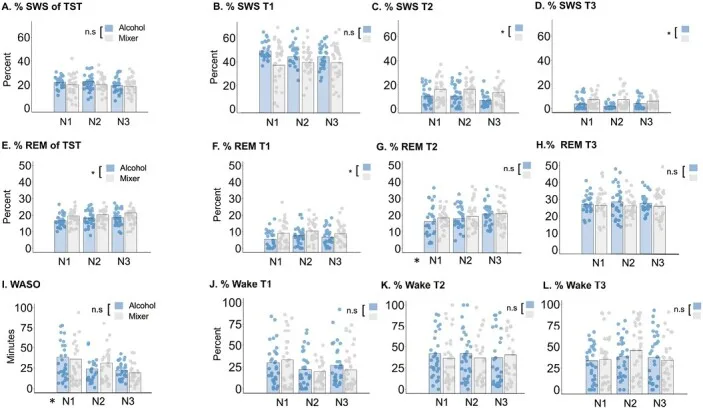
A controlled crossover polysomnography study in 30 adults demonstrated that REM sleep was suppressed across all three consecutive alcohol nights compared to mixer-only nights, though the magnitude of suppression was greatest on the first night and lessened on subsequent nights, suggesting partial adaptation (McCullar et al., 2024). REM sleep remained reduced under alcohol conditions on all nights, but the degree of disruption lessened across consecutive nights. Total REM sleep was lower on all alcohol nights relative to mixer nights, and slow-wave sleep was elevated in the first third of the night across all alcohol nights.
Why Does Alcohol Trigger Hot Flashes and Night Sweats During Menopause?
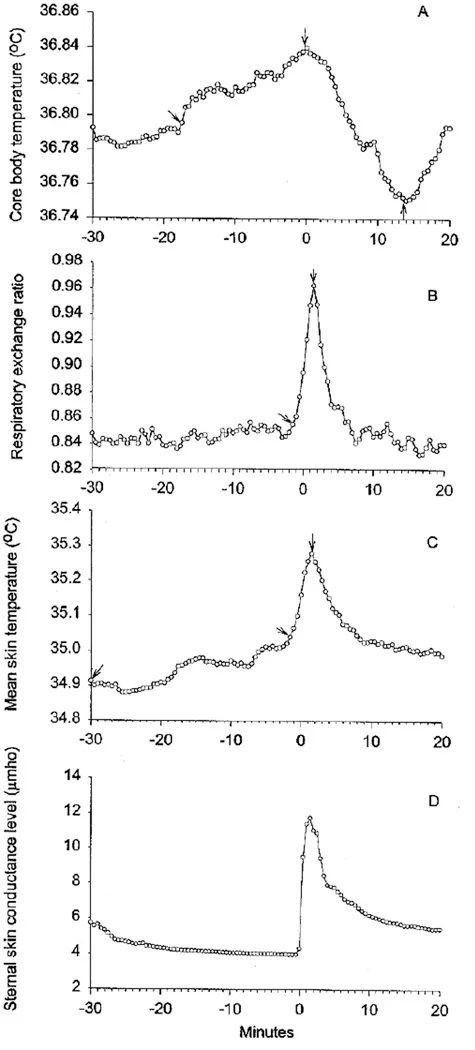
The thermoneutral zone is the core body temperature range within which the body does not activate sweating or shivering. In estrogen-replete women, this zone provides a buffer — minor temperature fluctuations do not trigger a thermoregulatory response. Estrogen depletion narrows this zone, in some women to near zero, meaning almost any thermal perturbation can initiate the cascade of peripheral vasodilation, profuse sweating, and subjective heat sensation that constitutes a hot flash (Freedman, 2014).
Alcohol is a vasodilator. It acutely dilates peripheral blood vessels and raises skin temperature. In a woman whose thermoneutral zone has been compressed by estrogen decline, this vasodilation can be enough to cross the threshold into a hot flash or night sweat — a lower bar for the same physiological response.
A study combining cross-sectional and longitudinal cohort analyses in premenopausal women found that women consuming 40 g/day or more of alcohol had a multivariable-adjusted odds ratio of 3.52 for vasomotor events compared with lifetime abstainers (Kwon et al., 2022). Intermediate consumption levels (10-19 g/day and 20-39 g/day) also showed elevated odds ratios, with a statistically significant dose-response trend (p < 0.01 for prevalent vasomotor episodes; p = 0.02 for incident vasomotor events during follow-up). For incident vasomotor events during follow-up, the hazard ratio was 2.22 for the highest consumption group. The association persisted after adjustment for age, education, smoking, physical activity, and BMI.
A 2024 narrative review further established that alcohol worsens vasomotor frequency, sleep disruption, mood disturbance, and bone mineral density loss during the menopausal transition — positioning alcohol as a compounding factor across multiple domains, not just sleep (Shihab et al., 2024). Both menopause and alcohol independently accelerate bone mineral density loss, and the review identifies midlife as a period of heightened vulnerability where alcohol’s physiological effects are amplified by concurrent hormonal change.
Many people have more than one cause contributing to their sleep disruption. Alcohol’s sleep-disrupting effects may compound with hormonal, autonomic, metabolic, inflammatory, or circadian factors already present during menopause. Identifying which causes might be involved is a useful next step.
Find out which causes might be driving your 3am wakeups →
Frequently Asked Questions
Why Can You No Longer Tolerate Wine During Menopause?
The perimenopausal transition amplifies alcohol’s acute effects on estradiol, particularly when gonadotropin levels are high (Handy et al., 2025). This means the same glass of wine may produce a larger hormonal response than it did in earlier years. Add the changes in hepatic enzyme activity that slow alcohol clearance, and the GABA receptor remodeling that alters how the brain processes alcohol’s sedative effects, and the result is a measurably different physiological response to the same dose.
This is not about willpower or aging in a general sense. It is about the hormonal environment in which the alcohol is metabolized.
Does Alcohol Make Hot Flashes Worse?
The data from Kwon et al. (2022) shows a consistent dose-response gradient: odds ratios increase with each level of consumption, from moderate through heavy intake. Even intermediate consumption (10-19 g/day, roughly one standard drink) elevated the odds of vasomotor events above those of lifetime abstainers.
The mechanism is two-part. Alcohol causes peripheral vasodilation, which is the same heat-dissipation cascade that constitutes a hot flash. In a body where estrogen depletion has compressed the thermoneutral zone — reducing the temperature buffer between baseline and a flash trigger — alcohol’s vasodilatory effect can be sufficient to cross that threshold (Freedman, 2014).
Is There a Safe Amount of Alcohol for Sleep During Menopause?
The 2025 meta-analysis of 27 studies found that REM disruption begins at the lowest dose category studied — approximately 0.50 g/kg, or about two standard drinks (Gardiner et al., 2025). The authors noted that future research is needed on whether personal factors such as sex affect the relationship between alcohol and sleep.
There is no dose at which alcohol has been demonstrated to have zero effect on sleep architecture. The data does not support a “safe” threshold for sleep during menopause — it supports that the threshold is lower than it was before the transition, and that even modest consumption degrades REM sleep in the general adult population, with potential for greater impact during the menopausal transition.
Why Does Alcohol Help You Fall Asleep but Then Wake You Up?
The two-phase pattern is consistent across all doses and both sexes (Ebrahim et al., 2013).
In the first phase, alcohol potentiates GABA-A receptor activity, which promotes inhibition and sleep. Slow-wave sleep increases, sleep onset latency decreases, and the first few hours of sleep are consolidated. This is the mechanism behind the “nightcap” perception.
In the second phase, as blood alcohol clears (typically 3-4 hours post-consumption), GABA potentiation fades and the cholinergic drive that promotes REM sleep is disinhibited. This produces a rebound: REM sleep becomes fragmented, sleep lightens, awakenings increase, and in some cases, sweating and tachycardia occur. For menopausal women who are already experiencing cortisol-driven 2-3am waking (see Why Do You Wake Up at 3am During Menopause?), alcohol’s REM rebound compounds the same window through a different mechanism.
Does the Type of Alcohol Matter for Menopause Sleep?
The evidence is consistent: the effects on sleep architecture — REM suppression, GABA-cholinergic rebound, slow-wave sleep enhancement — are dose-dependent and beverage-independent. This is consistent with the pharmacological principle that ethanol’s effects on sleep architecture are driven by the dose of ethanol itself, regardless of the beverage in which it is consumed.
One relevant distinction: beverages with higher sugar content (cocktails, dessert wines) may produce blood glucose fluctuations that add a metabolic component to nighttime waking. This bridges to the metabolic contributors to sleep disruption — glucose drops during the second half of the night can independently drive cortisol release and awakenings. But the primary sleep architecture effects are ethanol-driven, not beverage-specific.
Related Reading
- Hormonal Women Sleep Disruption — Parent guide to how estrogen, progesterone, cortisol, temperature, melatonin, and cycle changes interact with sleep.
- Could Sleep Apnea Be Behind Your Menopause Insomnia? — How sleep apnea in women can present as insomnia, fatigue, morning headaches, and repeated awakenings around menopause.
- Why Does Perimenopause Give You Nightmares That Disrupt Your Sleep? — How REM fragmentation, awakenings, and estrogen-linked emotional reactivity can increase dream recall and nightmares in perimenopause.
- Why Do Restless Legs Get Worse in Perimenopause? — How estrogen, dopamine, iron status, and heavy bleeding connect to restless legs that disturb sleep in perimenopause.
- Why Does Menopause Make You Wake Up to Pee at Night? — How estrogen decline can affect bladder tissue, antidiuretic hormone rhythm, nighttime urine production, and sleep fragmentation.
- Why Does Menopause Joint Pain Get Worse at Night? — The sleep-pain relationship between estrogen decline, inflammation, collagen changes, nighttime pain, and fragmented sleep.
- Why Does Your Skin Crawl at Night During Perimenopause? — Formication, itching, histamine timing, skin-barrier changes, and sensory nerve changes that can disturb sleep.
References
Ebrahim, I. O., Shapiro, C. M., Williams, A. J., & Fenwick, P. B. (2013). Alcohol and sleep I: effects on normal sleep. Alcoholism, Clinical and Experimental Research, 37(4), 539-549. https://pubmed.ncbi.nlm.nih.gov/23347102/
Freedman, R. R. (2014). Menopausal hot flashes: mechanisms, endocrinology, treatment. The Journal of Steroid Biochemistry and Molecular Biology, 142, 115-120. https://pubmed.ncbi.nlm.nih.gov/24012626/
Gardiner, C., Weakley, J., Burke, L. M., Roach, G. D., Sargent, C., Maniar, N., Huynh, M., Miller, D. J., Townshend, A., & Halson, S. L. (2025). The effect of alcohol on subsequent sleep in healthy adults: A systematic review and meta-analysis. Sleep Medicine Reviews, 80, 102030. https://pubmed.ncbi.nlm.nih.gov/39631226/
Ginsburg, E. S., Mello, N. K., Mendelson, J. H., Barbieri, R. L., Teoh, S. K., Rothman, M., Gao, X., & Sholar, J. W. (1996). Effects of alcohol ingestion on estrogens in postmenopausal women. JAMA, 276(21), 1747-1751. https://pubmed.ncbi.nlm.nih.gov/8940324/
Handy, A. B., Greenfield, S. F., & Payne, L. A. (2025). Estrogen and alcohol use in women: a targeted literature review. Archives of Women’s Mental Health, 28(1), 81-93. https://pubmed.ncbi.nlm.nih.gov/38878133/
Kwon, R., Chang, Y., Kim, Y., Cho, Y., Choi, H. R., Lim, G. Y., Kang, J., Kim, K. H., Kim, H., Hong, Y. S., Park, J., Zhao, D., Rampal, S., Cho, J., Guallar, E., Park, H. Y., & Ryu, S. (2022). Alcohol Consumption Patterns and Risk of Early-Onset Vasomotor Symptoms in Premenopausal Women. Nutrients, 14(11), 2276. https://pubmed.ncbi.nlm.nih.gov/35684078/
McCullar, K. S., Barker, D. H., McGeary, J. E., Saletin, J. M., Gredvig-Ardito, C., Swift, R. M., & Carskadon, M. A. (2024). Altered sleep architecture following consecutive nights of presleep alcohol. Sleep, 47(4), zsae003. https://pubmed.ncbi.nlm.nih.gov/38205895/
Playdon, M. C., Coburn, S. B., Moore, S. C., Brinton, L. A., Wentzensen, N., Anderson, G., Wallace, R., Falk, R. T., Pfeiffer, R., Xu, X., & Trabert, B. (2018). Alcohol and oestrogen metabolites in postmenopausal women in the Women’s Health Initiative Observational Study. British Journal of Cancer, 118(3), 448-457. https://pubmed.ncbi.nlm.nih.gov/29235567/
Shihab, S., Islam, N., Kanani, D., Marks, L., & Vegunta, S. (2024). Alcohol use at midlife and in menopause: a narrative review. Maturitas, 189, 108092. https://pubmed.ncbi.nlm.nih.gov/39180900/
Written by Kat Fu, M.S., M.S. · Last reviewed: May 31, 2026 · 9 references cited