
The retina is the only place in the body where blood vessels and neural tissue can be photographed directly, without a biopsy or invasive procedure. Over the past four years, deep learning models have turned that photograph into an aging estimate — and the gap between predicted retinal age and chronological age predicts mortality, kidney disease outcomes, cardiovascular disease, and dozens of other conditions. This article covers what the retinal age gap measures, how accurate the AI models are, and which diseases it predicts. For the broader picture of how circadian disruption affects sleep after 40, see How Does Circadian Disruption Affect Your Sleep After 40?. Retinal aging is one of several pathways through which circadian function degrades — the circadian cause page covers the full range.
What Is the Retinal Age Gap — and Why Does It Predict Mortality?
The first large-scale study establishing the retinal age gap as a mortality predictor comes from Zhu et al. (2023), who trained a deep learning model on 80,169 fundus images from 46,969 UK Biobank participants. The model predicted chronological age with a correlation of 0.81 and a mean absolute error of 3.55 years. Among the 35,913 participants with available mortality data, each 1-year increase in retinal age gap was independently associated with a 2% higher risk of all-cause mortality (HR 1.02, 95% CI 1.00-1.03) after adjustment for smoking, BMI, blood pressure, glucose, and other standard risk factors. The association was stronger for non-cardiovascular, non-cancer causes of death (HR 1.03, 95% CI 1.00-1.05), suggesting the retinal vasculature captures an aging dimension that runs parallel to the major disease categories rather than overlapping with them.
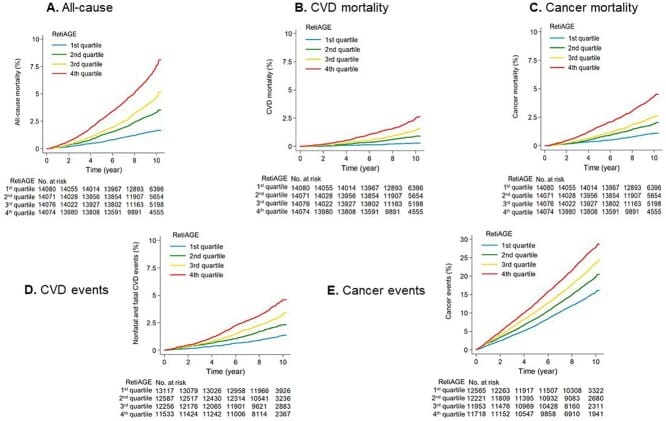
A second model, RetiAGE, validated in 56,301 UK Biobank participants over a 10-year follow-up, demonstrated stronger stratification when participants were grouped by predicted retinal age quartiles (Nusinovici et al., 2022). Participants in the highest RetiAGE quartile had 67% higher all-cause mortality (HR 1.67, 95% CI 1.42-1.95), 142% higher cardiovascular mortality (HR 2.42, 95% CI 1.69-3.48), and 60% higher cancer mortality (HR 1.60, 95% CI 1.31-1.96) compared to the lowest quartile. Cardiovascular disease events increased by 39% and incident cancer events by 18% in the highest quartile. RetiAGE was developed on a Korean cohort and validated in UK Biobank participants, demonstrating that retinal aging patterns generalize across ethnicities.
The reason the retina captures what blood panels do not is anatomical. Retinal vasculature is the only vasculature visible non-invasively — branching patterns, vessel caliber, RNFL (retinal nerve fiber) thickness, and foveal morphology all encode cumulative vascular and neural aging. A blood panel measures circulating biomarkers at a point in time. The retinal photograph captures the structural consequence of decades of vascular wear.
How Accurate Is an AI Retinal Age Clock?
The eyeAge model, developed by Ahadi et al. (2023) using the EyePACS dataset, achieved a mean absolute error of 2.86 years on quality-filtered data and 3.30 years on the UK Biobank cohort. What distinguishes eyeAge from earlier retinal age models is its demonstrated independence from blood-based aging markers. The correlation between eyeAge acceleration and phenoAge acceleration (a blood-derived composite aging marker) was only 0.12 — meaning the retinal clock captures aging information that blood chemistry does not. Even after adjusting for phenoAge, eyeAge maintained a hazard ratio of 1.026 per unit increase for all-cause mortality, supporting additive predictive value. Genome-wide association analysis identified heritable components of retinal aging, with the top locus validated in a Drosophila (fruit fly) model — inhibiting the fly homolog of ALKAL2 improved age-related visual performance in that organism, though this has not been established in humans.
Cross-population generalizability has been a limitation of earlier models trained on single ethnicities. Yu et al. (2025) addressed this with a model trained and validated across 34,433 participants from the UK Biobank and three independent Chinese cohorts. Using longitudinal pre-training and progressive label distribution learning, the model achieved a mean absolute error of 2.79 years — the lowest published to date. Retinal age gap quartiles remained associated with 10-year mortality risk and age-related disease incidence after adjusting for age, sex, socioeconomic status, education, smoking, physical activity, BMI, and comorbidity indices. The multi-ethnic validation provides the broadest cross-population evidence to date that retinal aging markers are consistent across ancestries.
A 2024 scoping review by Grimbly et al. catalogued four published models — Retinal Age (MAE 3.55 years), eyeAge (MAE 3.30 years), a CNN approach (MAE 3.97 years), and RetiAGE (a classification model predicting probability of exceeding age 65, rather than a continuous estimate). All models that evaluated health outcomes found that higher retinal age gap was associated with adverse outcomes, particularly all-cause mortality and cardiovascular disease events.
A 2026 multimodal clock by Ludwig et al. combined optical coherence tomography (OCT) and fundus photography to capture both vascular and structural retinal aging across healthy and diseased eyes. Predicted retinal age from this multimodal model correlated more with the Charlson Comorbidity Index — a validated measure of cumulative disease burden — than chronological age did, meaning retinal age may better reflect accumulated health damage than a birthday.
One reproducibility study is relevant here. Zoellin et al. (2025) measured within-subject test-retest variability and found a mean absolute difference of 2.39 years between imaging sessions on different days and 2.13 years within the same session. Afternoon retinal age predictions were consistently higher than morning measurements in the intravisit cohort, indicating a time-of-day confound. Image quality filtering reduced prediction discrepancies by up to 50%. For longitudinal tracking of retinal age in individuals, standardized time-of-day procedures and consistent image quality thresholds are needed before retinal age functions as a reliable individual biomarker.
What Diseases Does Your Retinal Age Predict Beyond Mortality?
Zhang et al. (2023) extended the retinal age gap from mortality prediction to kidney disease in 35,864 UK Biobank participants without baseline kidney disease. Over 11 years of follow-up, each 1-year increase in retinal age gap was associated with a 10% increase in kidney disease risk (HR 1.10, 95% CI 1.03-1.17). Participants in the highest retinal age gap quartile had 2.77 times the kidney disease risk compared to the lowest quartile (HR 2.77, 95% CI 1.29-5.93). These associations persisted after adjustment for hypertension, diabetes, and baseline eGFR. The connection makes anatomical sense — retinal microvasculature and renal microvasculature share developmental origins and respond to the same vascular stressors. An eye photograph that shows accelerated microvascular aging may reflect the same process occurring in the kidneys.
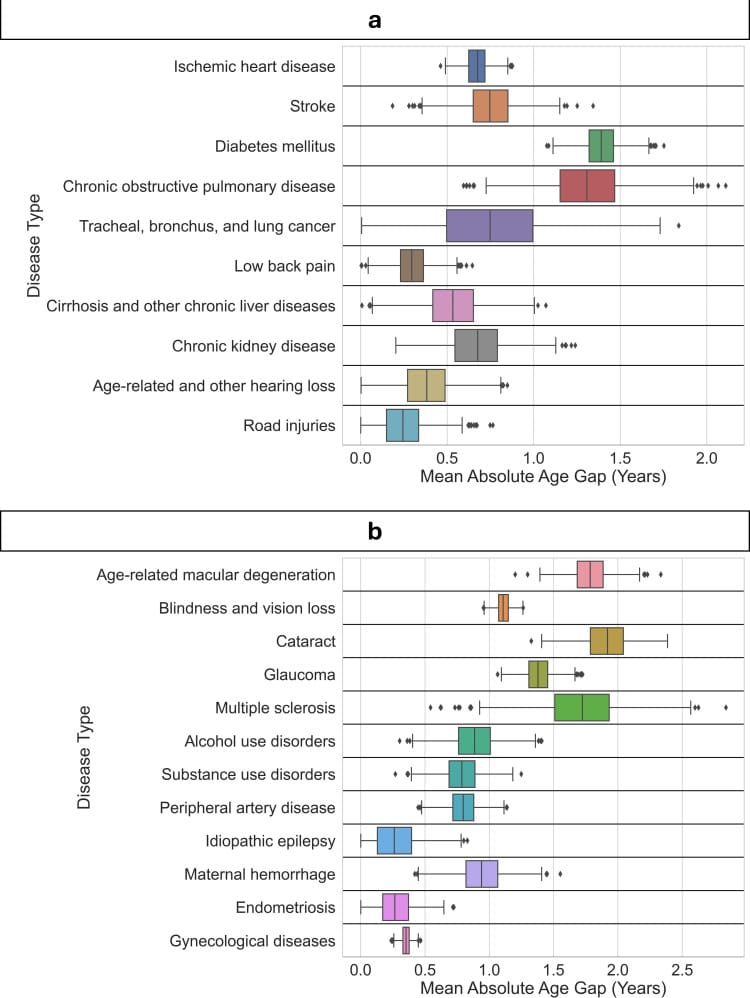
The scope of disease associations broadened further with Nielsen, Wilms, and Forkert (2025), who analyzed 86,522 UK Biobank participants across 159 disease and injury categories from the 2019 Global Burden of Disease Study. Among those 159 categories, 56 (35.2%) showed retinal age gap distributions that differed from healthy controls. The associations were strongest for chronic kidney disease, cardiovascular disease, blindness and vision loss, and diabetes — conditions linked to microvascular aging. External validation in 8,524 participants from a Brazilian cohort supported generalizability across income settings. Because fundus photography requires only a low-cost camera and no specialized laboratory infrastructure, retinal age gap may be deployable as a screening tool in resource-limited settings.
RetiPhenoAge, published in The Lancet Healthy Longevity by Nusinovici et al. (2024), refined the approach by training a deep learning model to predict PhenoAge — a composite blood-based aging marker — directly from retinal photographs. In the UK Biobank development cohort, higher RetiPhenoAge was associated with all-cause mortality (HR 1.92, 95% CI 1.42-2.61), cardiovascular mortality (HR 1.97, 95% CI 1.02-3.82), cancer mortality (HR 2.07, 95% CI 1.29-3.33), and cardiovascular disease events (HR 1.70, 95% CI 1.17-2.47). Two independent validation cohorts — SEED (9,429 participants) and AREDS (3,986 participants) — reproduced these associations. RetiPhenoAge outperformed grip strength, telomere length, and physical activity as a mortality predictor. Two genetic variants (rs3791224 and rs8001273) were associated with RetiPhenoAge, linking the imaging biomarker to aging pathways at the genetic level.
Your retinal age reflects how fast your body is aging — and circadian disruption is one of the mechanisms that may accelerate it. Lens yellowing, melanopsin-containing retinal ganglion cell loss, and UV damage all contribute to circadian input deficits that may compound with autonomic, metabolic, inflammatory, or hormonal causes. Identifying which causes might be contributing is a useful next step.
Find out which causes might be driving your 3am wakeups →
Frequently Asked Questions
Can You Get Your Retinal Age Measured Today?
Fundus photography is already part of routine eye exams in many practices, particularly for glaucoma screening and diabetic retinopathy monitoring. The same photograph used for those purposes contains the information a retinal age model needs. The barrier is not hardware — it is integration. The AI models require computational infrastructure that practices have not yet adopted for aging assessment. Several research groups are working toward FDA-approved or CE-marked software that could run on standard ophthalmology imaging platforms. In the meantime, the retinal age gap remains a research biomarker with strong validation but limited point-of-care availability.
Does Ultraviolet Exposure Accelerate Retinal Aging?
The retinal structures that accumulate UV damage overlap with the structures retinal age models evaluate. Lens yellowing filters short-wavelength light before it reaches the retina, reducing melanopic stimulation. Retinal pigment epithelium melanin loss exposes photoreceptors to oxidative stress. Corneal endothelial cell depletion is irreversible after approximately age 60. Each of these processes is both a contributor to elevated retinal age and a degrader of circadian light transmission. For a deeper discussion of how UV damages the lens and circadian light pathway, see How Does UV Damage Your Eye’s Ability to Set Your Body Clock?. For the broader picture of which eye structures age permanently, see Which Parts of Your Eye Age Permanently — and What Accelerates the Damage?.
Can You Lower Your Retinal Age?
Because retinal age models measure structural features — vessel caliber, RNFL thickness, foveal morphology — the relevant question is whether the vascular and neural changes encoded in the retinal photograph are reversible. Some are: vascular caliber responds to blood pressure management, metabolic improvement, and inflammation reduction. Others are not: corneal endothelial cell count and retinal pigment epithelium melanin content do not regenerate. The practical implication is that retinal age gap may be slowed rather than reversed — and that the inputs likely to affect it are the same ones that affect every other aging clock: metabolic health, cardiovascular fitness, sleep, and cumulative UV exposure.
Is Retinal Age the Same as Eye Health?
The retinal age clock does not measure how well the eye sees. It measures how much the eye’s vasculature and neural tissue have aged relative to what is expected at a given chronological age. Visual acuity depends on lens clarity, refractive error, and photoreceptor function. Retinal age depends on branching density of blood vessels, RNFL thickness, and morphology of the fovea. These are related but distinct: a person with corrected refractive error and normal visual acuity can still have retinal vasculature that looks a decade older than expected, and that vascular aging carries mortality and disease risk independent of vision quality.
How Does Retinal Aging Connect to Sleep?
Melanopsin-containing retinal ganglion cells (mRGCs) are the retina’s dedicated circadian photoreceptors. They send light information to the suprachiasmatic nucleus — the brain’s master circadian clock — to synchronize sleep-wake timing with the external light-dark cycle. mRGC density declines with age, and this decline is associated with reduced circadian amplitude and worse sleep quality. The RNFL, which contains mRGC axons, is one of the features retinal age models evaluate. An elevated retinal age gap may therefore reflect, in part, degradation of the circadian light pathway. Worse circadian function contributes to worse sleep, and worse sleep accelerates whole-body aging — creating a reinforcing loop where retinal aging and circadian decline compound each other. For a detailed discussion of melanopsin cell loss and its consequences, see What Happens to Your Circadian Clock Cells After 50?.
Related Reading
- Circadian Sleep Disruption: What Breaks Your Body Clock and Keeps You Awake – the full overview of circadian mechanisms that can fragment sleep
- How Does UV Light Age Your Eyes? The Two Types of Lens Damage That Affect Your Vision and Your Sleep – how UV damages the lens and degrades circadian light transmission
- Which Parts of Your Eye Age Permanently — and What Accelerates the Damage? – corneal endothelium, retinal pigment, and limbal stem cell aging
- Why Do Your Eyes Get More Vulnerable to UV as You Age — Not Less? – why the same UV dose can do more damage with age
- What Happens to Your Circadian Clock Cells After 50? – melanopsin cell loss, Alzheimer’s connection, and pupillometry
- How Do You Protect Your Eyes From UV Without Blocking Your Body Clock? – practical UV protection without circadian cost
References
Ahadi, S., Wilson, K. A., Babenko, B., McLean, C. Y., Bryant, D., Pritchard, O., Kumar, A., Carrera, E. M., Lamy, R., Stewart, J. M., Varadarajan, A., Berndl, M., Kapahi, P., & Bashir, A. (2023). Longitudinal fundus imaging and its genome-wide association analysis provide evidence for a human retinal aging clock. eLife, 12. https://pubmed.ncbi.nlm.nih.gov/36975205/
Grimbly, M. J., Koopowitz, S. M., Chen, R., Sun, Z., Foster, P. J., He, M., Stein, D. J., Ipser, J., & Zhu, Z. (2024). Estimating biological age from retinal imaging: a scoping review. BMJ Open Ophthalmology, 9(1). https://pubmed.ncbi.nlm.nih.gov/39181547/
Ludwig, C. A., Salvi, A., Mesfin, Y., Arnal, L., Langlotz, C., & Mahajan, V. (2026). A multimodal retinal aging clock for biological age prediction and systemic health assessment via OCT and fundus imaging. Scientific Reports, 16(1), 6465. https://pubmed.ncbi.nlm.nih.gov/41606027/
Nielsen, C., Wilms, M., & Forkert, N. D. (2025). The retinal age gap: an affordable and highly accessible biomarker for population-wide disease screening across the globe. Proceedings. Biological Sciences, 292(2046), 20242233. https://pubmed.ncbi.nlm.nih.gov/40328303/
Nusinovici, S., Rim, T. H., Yu, M., Lee, G., Tham, Y. C., Cheung, N., Chong, C. C. Y., Da Soh, Z., Thakur, S., Lee, C. J., Sabanayagam, C., Lee, B. K., Park, S., Kim, S. S., Kim, H. C., Wong, T. Y., & Cheng, C. Y. (2022). Retinal photograph-based deep learning predicts biological age, and stratifies morbidity and mortality risk. Age and Ageing, 51(4). https://pubmed.ncbi.nlm.nih.gov/35363255/
Nusinovici, S., Rim, T. H., Li, H., Yu, M., Deshmukh, M., Quek, T. C., Lee, G., Chong, C. C. Y., Peng, Q., Xue, C. C., Zhu, Z., Chew, E. Y., Sabanayagam, C., Wong, T. Y., Tham, Y. C., & Cheng, C. Y. (2024). Application of a deep-learning marker for morbidity and mortality prediction derived from retinal photographs: a cohort development and validation study. The Lancet Healthy Longevity, 5(10), 100593. https://pubmed.ncbi.nlm.nih.gov/39362226/
Yu, Z., Chen, R., Gui, P., Wang, W., Razzak, I., Alinejad-Rokny, H., Zeng, X., Shang, X., Zhang, L., Yang, X., Yu, H., Huang, W., Lu, H., van Wijngaarden, P., He, M., Zhu, Z., & Ge, Z. (2025). A cross population study of retinal aging biomarkers with longitudinal pre-training and label distribution learning. NPJ Digital Medicine, 8(1), 344. https://pubmed.ncbi.nlm.nih.gov/40494933/
Zhang, S., Chen, R., Wang, Y., Hu, W., Kiburg, K. V., Zhang, J., Yang, X., Yu, H., He, M., Wang, W., & Zhu, Z. (2023). Association of retinal age gap and risk of kidney failure: a UK Biobank study. American Journal of Kidney Diseases, 81(5), 537-544.e1. https://pubmed.ncbi.nlm.nih.gov/36481699/
Zhu, Z., Shi, D., Peng, G., Tan, Z., Shang, X., Hu, W., Liao, H., Zhang, X., Huang, Y., Yu, H., Meng, W., Wang, W., Ge, Z., Yang, X., & He, M. (2023). Retinal age gap as a predictive biomarker for mortality risk. The British Journal of Ophthalmology, 107(4), 547-554. https://pubmed.ncbi.nlm.nih.gov/35042683/
Zoellin, J. R. T., Turgut, F., Chen, R., Saad, A., Giesser, S. D., Sommer, C., Guignard, V., Ihle, J., Mono, M. L., Becker, M. D., Zhu, Z., & Somfai, G. M. (2025). Evaluating the reproducibility of a deep learning algorithm for the prediction of retinal age. GeroScience, 47(2), 2541-2554. https://pubmed.ncbi.nlm.nih.gov/39589693/
Written by Kat Fu, M.S., M.S. · Last reviewed: June 1, 2026 · 10 references cited