

The circadian master clock in the suprachiasmatic nucleus (SCN) depends on light input from a small population of melanopsin-expressing retinal ganglion cells — less than 1% of all retinal ganglion cells. These cells are the sole conduit for circadian photoentrainment: they absorb blue-spectrum light (~480 nm), convert it to neural impulses, and transmit those impulses to the SCN via the retinohypothalamic tract. When these cells degrade, the clock loses its connection to the external light-dark cycle. This article covers the age-related structural decline of mRGCs, their connection to Alzheimer’s disease pathology, and how chromatic pupillometry can measure their function non-invasively. For the full picture of how circadian disruption affects sleep after 40 — including SCN neuron loss, melatonin decline, and lens yellowing — see How Does Circadian Disruption Affect Your Sleep After 40?.
When Do Your Circadian Clock Cells Start Losing Their Architecture?
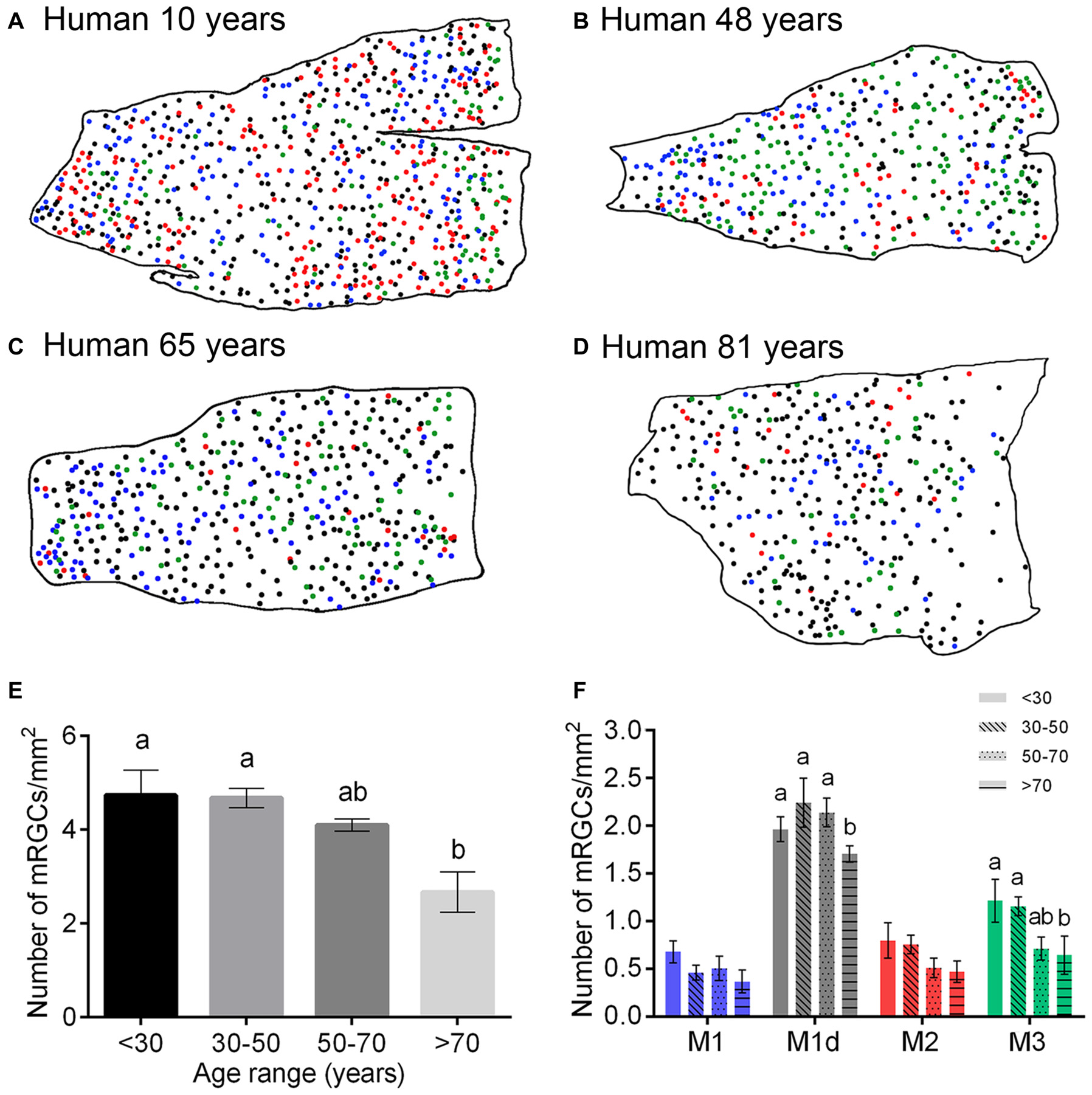
In a study of 24 post-mortem human retinas spanning ages 10 to 81, Esquiva et al. (2017) mapped the structural changes in melanopsin-expressing retinal ganglion cells across the lifespan. Using Sholl analysis — a method that quantifies dendritic branching complexity by counting how many branches cross concentric rings drawn around the cell body — the researchers documented a progressive decline in dendritic area, branch points, and terminal neurite tips starting from age 50.
The distinction between dendritic atrophy and cell death matters. From ages 30 to 50, mRGC density remains relatively stable. After 50, the cells are still present, but their dendritic arbors — the branching structures through which they collect photons — become sparser and cover less retinal area. Fewer branches means a smaller light-catching surface, which translates to weaker input to the SCN even when ambient light conditions are adequate. After age 70, cell death compounds this: total mRGC density drops by 31%, and the spatial distribution of surviving cells becomes more irregular, reducing the uniformity of circadian light integration across the retina (Esquiva et al., 2017).
The aging brain does attempt compensation. Herbst et al. (2012) measured the post-illumination pupil response (PIPR) — a sustained pupil constriction after blue light offset that reflects melanopsin cell function — in 44 healthy adults aged 26 to 68. The PIPR increased with age for blue light stimulation (p = 0.02), suggesting neural upregulation: the remaining melanopsin cells may increase their sensitivity or melanopsin expression to offset reduced optical input from lens yellowing and pupil shrinkage. But this compensatory capacity has a ceiling. Once dendritic atrophy removes enough light-gathering surface, and once cell death reduces the population, upregulation can no longer maintain adequate circadian input.
Chan et al. (2025) demonstrated the functional consequence in living older adults. In 48 healthy participants (mean age 62.6 years), weaker PIPR was associated with reduced rest-activity rhythm amplitude and lower actigraphic mesor — both indicators of flattened circadian rhythms. Attenuated PIPR also correlated with lower overnight urinary 6-sulfatoxymelatonin, the primary melatonin metabolite, linking melanopsin cell function directly to melatonin output (Chan et al., 2025).
Is There a Link Between Circadian Cell Loss and Alzheimer’s Disease?
The retina is not isolated from Alzheimer’s disease pathology. Lee et al. (2020) examined post-mortem retinal and brain tissue from neuropathologically established Alzheimer’s cases and found elevated levels of both intracellular and extracellular amyloid-beta deposits in the retinal ganglion cell region compared to age-matched controls. The mid-peripheral retina showed greater amyloid-beta burden than the central macula, and higher intracellular amyloid-beta in the retinal ganglion cell region correlated inversely with cortical neuritic plaque scores — suggesting partially independent accumulation dynamics between the retina and brain (Lee et al., 2020).
This amyloid accumulation in the retinal ganglion cell region has functional consequences for the melanopsin cells that reside there. Feng et al. (2016) synthesized postmortem evidence showing mRGC loss in Alzheimer’s retinas, with amyloid-beta and tau deposits documented in retinal tissue, including amyloid-beta found inside and around mRGCs. The mRGC population projects directly to the SCN via the retinohypothalamic tract, so when these cells are damaged or destroyed by amyloid deposits, the photic input driving circadian entrainment, melatonin secretion, and rest-activity cycle regulation degrades (Feng et al., 2016).
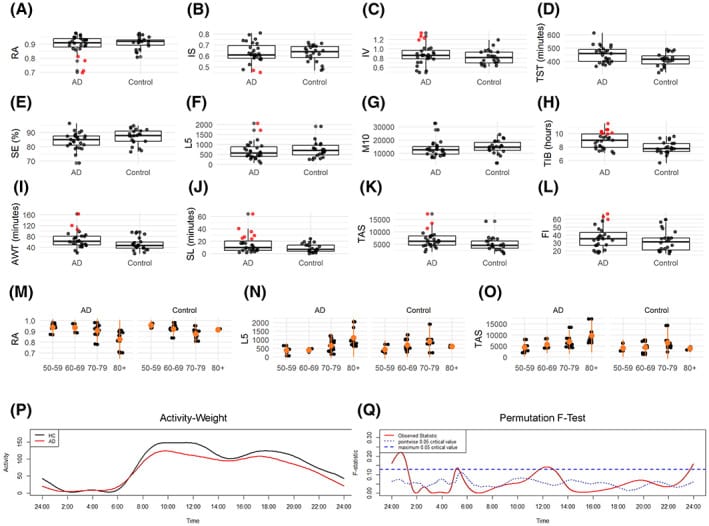
This retinal involvement may be detectable before cognitive decline begins. Oh et al. (2019) compared 10 cognitively healthy individuals with Alzheimer’s pathology before cognitive decline — identified by abnormal cerebrospinal fluid biomarkers — against 10 controls with normal CSF profiles. While average pupillary light responses did not differ between groups, the biomarker-positive group before cognitive decline showed greater intragroup variability in pupillometric measurements and more irregular circadian rest-activity patterns on actigraphy. This variability may reflect heterogeneous mRGC involvement at early disease stages (Oh et al., 2019).
La Morgia et al. (2023) extended these findings using four assessment modalities simultaneously in 29 individuals with early-stage Alzheimer’s and 26 controls. Optical coherence tomography (OCT) documented infero-temporal thinning of the ganglion cell complex. Chromatic pupillometry revealed diminished rod-mediated pupillary responses, interpreted as reflecting mRGC dendritic pathology preceding cell body loss. Functional MRI showed reduced sustained occipital cortex activation during blue light stimulation. And actigraphy identified a circadian-impaired subgroup within the Alzheimer’s cohort (La Morgia et al., 2023).
The pattern across neurodegenerative diseases is not uniform. Steiner and de Zeeuw (2024) pooled chromatic pupillometry data from 42 individuals with Alzheimer’s and 66 with Parkinson’s and found that melanopsin-mediated responses were not impaired at the group level in Alzheimer’s (p = 0.319), while the Parkinson’s group showed marked impairment (p < 0.001). This is consistent with a dendropathy model for Alzheimer's: mRGC dendrites may degrade before the cell bodies die, so the standard PIPR readout — which reflects cell body function — may appear normal until advanced disease stages (Steiner & de Zeeuw, 2024).
The relationship between Alzheimer’s pathology and mRGC damage may be self-amplifying. Fragmented sleep is associated with increased amyloid-beta accumulation in the brain. Amyloid-beta deposits damage mRGCs in the retina. Damaged mRGCs weaken circadian light input to the SCN. Weakened circadian entrainment fragments sleep further. Each node in this loop is supported by independent evidence, though no single longitudinal study has tracked all three variables — sleep fragmentation, amyloid accumulation, and mRGC degradation — together in the same cohort over time.
Emerging retinal imaging approaches are advancing early detection. Ravichandran et al. (2025) combined retinal OCT with plasma phosphorylated tau-217 (p-tau217) in 82 cognitively unimpaired older adults and achieved an area under the curve (AUC) of 0.97 for distinguishing preclinical Alzheimer’s from amyloid-negative controls — exceeding the performance of either modality alone. Abboud et al. (2025) found that photoreceptor inner segment thinning on OCT correlated with plasma neurofilament light chain (NfL) levels in cognitively normal adults classified as preclinical Alzheimer’s based on plasma amyloid-beta ratios, identifying outer retinal changes as a potential early neurodegeneration marker.
Can a Pupil Test Reveal What’s Happening to Your Circadian Cells?
Standard pupil testing measures how much the pupil constricts when light is turned on. Chromatic pupillometry adds a dimension: it measures what happens after the light is turned off. When blue light (~480 nm) is switched off, melanopsin cells drive a sustained pupil constriction that persists for seconds — the post-illumination pupil response. This sustained constriction is distinct from the rapid, transient constriction driven by rods and cones. Because the PIPR depends on melanopsin, it provides a direct, non-invasive readout of mRGC health.
Chan et al. (2025) established the link between PIPR and circadian outcomes in 48 healthy older adults. Attenuated PIPR correlated with reduced rest-activity rhythm amplitude, lower actigraphic mesor, and lower overnight urinary 6-sulfatoxymelatonin. The longer-duration PIPR measurement also correlated negatively with circadian timing offset, connecting pupillary melanopsin function to both melatonin adequacy and circadian phase accuracy (Chan et al., 2025).
Among biomarker-positive individuals before cognitive decline, Oh et al. (2019) found that while group-level PIPR did not differ between biomarker-positive individuals before cognitive decline and controls, the biomarker-positive group before cognitive decline exhibited greater measurement-to-measurement variability — a pattern that may reflect uneven mRGC involvement across the retina at early disease stages.
Romagnoli et al. (2020) provided a mechanistic explanation for why standard PIPR may appear normal in early Alzheimer’s while other pupillometric measures do not. In 26 individuals with Alzheimer’s, the melanopsin-specific PIPR was preserved at the group level, but rod-mediated transient pupillary light reflex amplitude was reduced (p = 0.006). The authors interpret this pattern as evidence of mRGC dendritic pathology — the dendrites that receive rod input are degrading before the melanopsin-containing cell bodies themselves are lost. This dendrite-first model explains why melanopsin-specific readouts remain relatively intact while outer retinal input to mRGCs is already compromised (Romagnoli et al., 2020).
Romagnoli et al. (2024) reviewed chromatic pupillometry methods across Alzheimer’s disease, Parkinson’s disease, hereditary optic neuropathies, and glaucoma, positioning the PIPR as a cross-disease biomarker for mRGC function. Longitudinal cohort studies with standardized methods are needed, and unstandardized stimulus approaches remain a barrier to routine use. But the equipment exists, the test takes minutes, and the measurement is non-invasive — making chromatic pupillometry a candidate for integration into routine ophthalmologic assessment as validation advances (Romagnoli et al., 2024).
Melanopsin cell degradation is one mechanism that weakens circadian entrainment with age. It may compound with lens yellowing, pupil shrinkage, or light exposure patterns — as well as autonomic, metabolic, inflammatory, or hormonal causes. Identifying which causes might be contributing is a useful next step.
Find out which causes might be driving your 3am wakeups →
Frequently Asked Questions
How Many Circadian Clock Cells Do You Have?
The mRGC population is sparse compared to the ~1 million total retinal ganglion cells per eye, but their role is non-redundant. No other retinal cell type can perform circadian photoentrainment. Rod and cone photoreceptors contribute indirectly — they provide synaptic input to mRGC dendrites — but the melanopsin phototransduction within the mRGC cell body and dendrites is what generates the sustained, tonic input that the SCN uses for clock synchronization (Meng et al., 2025). Three distinct mRGC subtypes have been identified in human retinas, each with different dendritic stratification patterns and varying vulnerability to age-related decline (Esquiva et al., 2017).
Can You Protect These Cells From Decline?
The research on mRGC preservation is in early stages. No human trial has demonstrated that a defined approach prevents mRGC dendritic atrophy or cell death. The logic for protective strategies comes from understanding the upstream factors: UV damage to the lens reduces blue-light transmission, so UV-protective eyewear that preserves lens clarity may indirectly support the light reaching mRGCs. Morning light exposure in the ~480 nm range activates melanopsin cells, and regular use of neural pathways is generally associated with maintained function, though this has not been tested in a controlled trial for mRGC preservation. And because amyloid-beta deposits damage mRGCs in Alzheimer’s retinas, strategies that reduce amyloid accumulation — including consolidated sleep — may protect these cells indirectly (Feng et al., 2016).
Does This Explain Why Sleep Gets Worse After 50?
mRGC dendritic atrophy beginning after age 50 reduces the strength of the photic input reaching the SCN, but it is one node in a multi-point degradation. Turner and Mainster (2008) estimated that a 45-year-old retains only about half the circadian photoreception capacity of a 10-year-old due to combined lens yellowing and pupil shrinkage — and that a 95-year-old has approximately one-tenth. The SCN itself loses neurons with age, and pineal melatonin output declines. Each of these changes contributes independently to the flattening of circadian amplitude, advancing of sleep phase, and increasing sleep fragmentation observed in older adults. The article on permanent eye aging covers the broader picture of how multiple eye structures degrade simultaneously.
Is the Alzheimer’s Connection Proven or Theoretical?
The individual links in the proposed loop each have independent evidence. Amyloid-beta in the retinal ganglion cell region has been documented in post-mortem tissue from neuropathologically established Alzheimer’s cases (Lee et al., 2020). mRGC-related changes before cognitive decline have been measured in cognitively normal individuals with abnormal cerebrospinal fluid biomarkers (Oh et al., 2019). Sleep fragmentation as a contributor to amyloid-beta accumulation is well-established in the broader sleep-neurodegeneration literature. The remaining evidence gap is a prospective cohort study that follows the same individuals over years, measuring mRGC function via pupillometry, amyloid burden via PET or plasma biomarkers, and sleep quality via polysomnography — simultaneously — to demonstrate that the loop is self-reinforcing in living humans.
Does Glaucoma Damage These Same Cells?
Because mRGCs are retinal ganglion cells, they are vulnerable to the same intraocular pressure-mediated damage that characterizes glaucoma. Romagnoli et al. (2024) included glaucoma in their review of chromatic pupillometry applications across diseases, noting measurable PIPR reductions in individuals with glaucoma. The circadian and sleep disruption in glaucoma is notable because it extends beyond what visual field loss alone would predict — consistent with damage to the non-image-forming mRGC pathway that the retinal age gap article discusses in the context of retinal aging and longevity biomarkers. Yuan et al. (2026) reviewed ophthalmic conditions including glaucoma that disrupt the melanopsin/ipRGC pathway and impair circadian synchronization.
Related Reading
- Circadian Sleep Disruption: What Breaks Your Body Clock and Keeps You Awake – the full overview of circadian mechanisms that can fragment sleep
- How Does UV Light Age Your Eyes? The Two Types of Lens Damage That Affect Your Vision and Your Sleep – how UV damages the lens and degrades circadian light transmission
- Which Parts of Your Eye Age Permanently — and What Accelerates the Damage? – corneal endothelium, retinal pigment, and limbal stem cell aging
- Can Your Eye Exam Predict How Long You’ll Live? – retinal age gap as a longevity biomarker
- Why Do Your Eyes Get More Vulnerable to UV as You Age — Not Less? – why the same UV dose can do more damage with age
- How Do You Protect Your Eyes From UV Without Blocking Your Body Clock? – practical UV protection without circadian cost
References
Abboud, I., Xu, E., Xu, S., Alhasany, A., Wang, Z., Wu, X., Astraea, N., Jiang, F., Hu, Z. J., & Chan, J. W. (2025). Emerging Oculomic Signatures: Linking Thickness of Entire Retinal Layers with Plasma Biomarkers in Preclinical Alzheimer’s Disease. Journal of Clinical Medicine, 15(1), 275. https://pubmed.ncbi.nlm.nih.gov/41517524/
Chan, J. W. Y., Li, C. T., Chau, S. W. H., Chan, N. Y., Li, T. M., Huang, B., Tsoh, J., Li, S. X., Chong, K. K. L., Roecklein, K. A., & Wing, Y. K. (2025). Attenuated melanopsin-mediated post-illumination pupillary response is associated with reduced actigraphic amplitude and mesor in older adults. Sleep, 48(2). https://pubmed.ncbi.nlm.nih.gov/39383299/
Esquiva, G., Lax, P., Perez-Santonja, J. J., Garcia-Fernandez, J. M., & Cuenca, N. (2017). Loss of Melanopsin-Expressing Ganglion Cell Subtypes and Dendritic Degeneration in the Aging Human Retina. Frontiers in Aging Neuroscience, 9, 79. https://pubmed.ncbi.nlm.nih.gov/28420980/
Feng, R., Li, L., Yu, H., Liu, M., & Zhao, W. (2016). Melanopsin retinal ganglion cell loss and circadian dysfunction in Alzheimer’s disease (Review). Molecular Medicine Reports, 13(4), 3397-3400. https://pubmed.ncbi.nlm.nih.gov/26935586/
Herbst, K., Sander, B., Lund-Andersen, H., Broendsted, A. E., Kessel, L., Hansen, M. S., & Kawasaki, A. (2012). Intrinsically photosensitive retinal ganglion cell function in relation to age: a pupillometric study in humans with special reference to the age-related optic properties of the lens. BMC Ophthalmology, 12, 4. https://pubmed.ncbi.nlm.nih.gov/22471313/
La Morgia, C., Mitolo, M., Romagnoli, M., Stanzani Maserati, M., Evangelisti, S., De Matteis, M., Capellari, S., Bianchini, C., Testa, C., Vandewalle, G., Santoro, A., Carbonelli, M., D’Agati, P., Filardi, M., Avanzini, P., Barboni, P., Zenesini, C., Baccari, F., Liguori, R., Tonon, C., Lodi, R., & Carelli, V. (2023). Multimodal investigation of melanopsin retinal ganglion cells in Alzheimer’s disease. Annals of Clinical and Translational Neurology, 10(6), 918-932. https://pubmed.ncbi.nlm.nih.gov/37088544/
Lee, S., Jiang, K., McIlmoyle, B., To, E., Xu, Q. A., Hirsch-Reinshagen, V., Mackenzie, I. R., Hsiung, G. R., Eadie, B. D., Sarunic, M. V., Beg, M. F., Cui, J. Z., & Matsubara, J. A. (2020). Amyloid Beta Immunoreactivity in the Retinal Ganglion Cell Layer of the Alzheimer’s Eye. Frontiers in Neuroscience, 14, 758. https://pubmed.ncbi.nlm.nih.gov/32848548/
Meng, J., Huang, X., Ren, C., & Xue, T. (2025). Non-Image-Forming Functions of Intrinsically Photosensitive Retinal Ganglion Cells. Annual Review of Neuroscience, 48(1), 211-229. https://pubmed.ncbi.nlm.nih.gov/40053827/
Oh, A. J., Amore, G., Sultan, W., Asanad, S., Park, J. C., Romagnoli, M., La Morgia, C., Karanjia, R., Harrington, M. G., & Sadun, A. A. (2019). Pupillometry evaluation of melanopsin retinal ganglion cell function and sleep-wake activity in Alzheimer’s biomarker positivity before cognitive decline. PLoS ONE, 14(12), e0226197. https://pubmed.ncbi.nlm.nih.gov/31821378/
Ravichandran, S., Snyder, P. J., Alber, J., Murchison, C. F., Chaby, L. E., Jeromin, A., & Arthur, E. (2025). Association and multimodal model of retinal and blood-based biomarkers for detection of preclinical Alzheimer’s disease. Alzheimer’s Research & Therapy, 17(1), 19. https://pubmed.ncbi.nlm.nih.gov/39794837/
Romagnoli, M., Stanzani Maserati, M., De Matteis, M., Capellari, S., Carbonelli, M., Amore, G., Cantalupo, G., Zenesini, C., Liguori, R., Sadun, A. A., Carelli, V., Park, J. C., & La Morgia, C. (2020). Chromatic Pupillometry Findings in Alzheimer’s Disease. Frontiers in Neuroscience, 14, 780. https://pubmed.ncbi.nlm.nih.gov/32848556/
Romagnoli, M., Amore, G., Avanzini, P., Carelli, V., & La Morgia, C. (2024). Chromatic pupillometry for evaluating melanopsin retinal ganglion cell function in Alzheimer’s disease and other neurodegenerative disorders: a review. Frontiers in Psychology, 14, 1295129. https://pubmed.ncbi.nlm.nih.gov/38259552/
Steiner, O. L., & de Zeeuw, J. (2024). Melanopsin retinal ganglion cell function in Alzheimer’s vs. Parkinson’s disease: an exploratory meta-analysis and review of pupillometry protocols. Parkinsonism & Related Disorders, 123, 106063. https://pubmed.ncbi.nlm.nih.gov/38443213/
Turner, P. L., & Mainster, M. A. (2008). Circadian photoreception: ageing and the eye’s important role in systemic health. The British Journal of Ophthalmology, 92(11), 1439-1444. https://pubmed.ncbi.nlm.nih.gov/18757473/
Yuan, M., Liu, H., Zhu, R., Li, Y., Song, S., & Yang, A. (2026). Retinal light perception and biological rhythms: The role of light in sleep and mood from an ophthalmic perspective (Review). Molecular Medicine Reports, 33(1), 16. https://pubmed.ncbi.nlm.nih.gov/41170746/
Written by Kat Fu, M.S., M.S. · Last reviewed: June 19, 2026 · 15 references cited