

Morning sunlight reaching melanopsin-containing retinal ganglion cells is one of the strongest time-setters for the human circadian clock. Each 30 minutes of sunlight before 10 AM is associated with a 23-minute advance in sleep timing (de Menezes-Junior et al., 2025). But the same sun that sets your body clock also delivers cumulative UV damage to the cornea, lens, and retina — damage that accelerates with age as your eye’s own defenses decline.
This article covers the practical side: what each type of UV protection blocks and misses, when unfiltered morning light is lowest-risk, and how to adjust your protection approach as your eyes age. It connects to the broader circadian cause of sleep disruption, one of several causes covered in the Circadian Sleep Disruption. The other four articles in this cluster cover the structures that age permanently, retinal age as a longevity biomarker, why UV vulnerability increases with age, and melanopsin cell loss after 50.
What Does Each Type of Eye Protection Block — and What Does It Let Through?
Hat brims are effective at blocking direct overhead UV but have an inherent geometric limitation. Backes et al. (2018) modeled four hat styles — cap, helmet, medium-brim, and wide-brim — and found that wide-brim hats provided the greatest protection, reducing daily facial UV doses to 1.7 standard erythema dose units (SED). The maximum protection factor across all facial zones reached 76%. But diffuse sky radiation and ground-reflected UV penetrate beneath every brim from lateral and inferior angles. No hat can address UV arriving from below the horizon line.
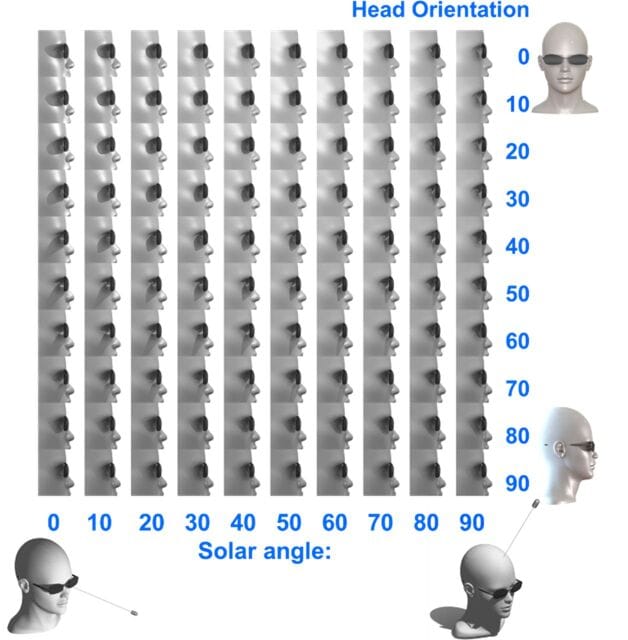
Sunglasses block UV through the lens material itself — many modern lenses, including standard prescription glasses, absorb UV-B and much of UV-A. The limitation is the frame. Backes et al. (2019) used a 3D dose model to quantify corneal UV exposure across sunglass styles and head positions. The unprotected cornea received up to 1,718 J/m^2 over a full outdoor day. Medium-sized sunglasses left the lateral periorbital zone exposed at up to 291 J/m^2 at midday. Large-sized sunglasses performed better, but protection varied with head position and season. Goggles and wrap-around designs achieved near-complete coverage regardless of head orientation. Wang et al. (2025), evaluating UV-blocking eyewear for people receiving photosensitizing therapy, showed that inadequate frame coverage reduces overall eye protection — frame geometry matters as much as lens UV transmittance in determining practical ocular UV dose reduction.
Sunglasses without UV filtration are a documented hazard. Dark-tinted lenses without UV filtering dilate the pupil while allowing UV through — resulting in higher ocular UV exposure than bare eyes. Any sunglass purchase should verify UV400 labeling (blocking wavelengths up to 400 nm) or compliance with ANSI Z80.3 / ISO 12312-1 standards.
Back-surface lens reflection is a lesser-known UV source. Behar-Cohen et al. (2014) documented that UV arriving from behind the wearer at angles of 135-150 degrees reflects off the back surface of spectacle lenses directly onto the cornea. Some antireflective coatings intensify rather than reduce this reflection. Wrap-around frames reduce the problem by limiting the angle of posterior UV incidence.
UV-blocking contact lenses address the geometric blind spot that all frame-based eyewear shares. Wolffsohn et al. (2025) developed the Contact Lens Sun Protection Factor (CL-SPF) and found that Class 1 UV-blocking contact lenses achieved CL-SPF values of 59-66, equivalent to SPF 50+ in sunscreen terms. Because contacts sit directly on the cornea, their protection is invariant to head orientation, solar angle, or frame geometry — covering the oblique approach angles that sunglasses miss. The same study found that conjunctival cells are more susceptible to UV-induced damage and death than skin cells, underscoring why complete ocular surface coverage matters.
The combined-measures finding: Deng et al. (2021) placed manikins outdoors for 8 hours in summer and measured cumulative biologically effective UV (UVBE) under six protective conditions. The unprotected eye received 452 J/m^2 — 15.1 times the ICNIRP 8-hour safety limit of 30 J/m^2. Sunglasses alone reduced this to 69.1 J/m^2 (still 2.3 times the safety limit). A brimmed cap reduced it to 51.4 J/m^2. A bonnet reached 49.0 J/m^2. Across all six conditions tested, cumulative UV remained 1.6 to 15.1 times the ICNIRP threshold. No single measure brought ocular UV below the safety limit on a full summer day.
When Is the Safest Time for Unfiltered Morning Light — and When Does UV Risk Override Circadian Benefit?
A UV index below 2 is classified as low — the WHO states no protective measures are needed at this level, and the EPA labels this range “Low.” In mid-latitude locations, the first 30-60 minutes after sunrise fall within this range. This window aligns with the period when circadian light input has the strongest phase-advancing effect on sleep timing.
De Menezes-Junior et al. (2025) studied 1,762 adults and found that every 30 additional minutes of morning sunlight before 10 AM was associated with a 23-minute earlier sleep midpoint — a measurable circadian phase advance. Morning sunlight also improved overall sleep quality scores. Anderson et al. (2025) showed in a 70-day daily diary study of 103 adults that morning sunlight timing, not total daily sunlight duration, predicted better next-night sleep quality. The main mechanism is morning light reaching intrinsically photosensitive retinal ganglion cells (ipRGCs) containing melanopsin, which transmit timing information to the suprachiasmatic nucleus.
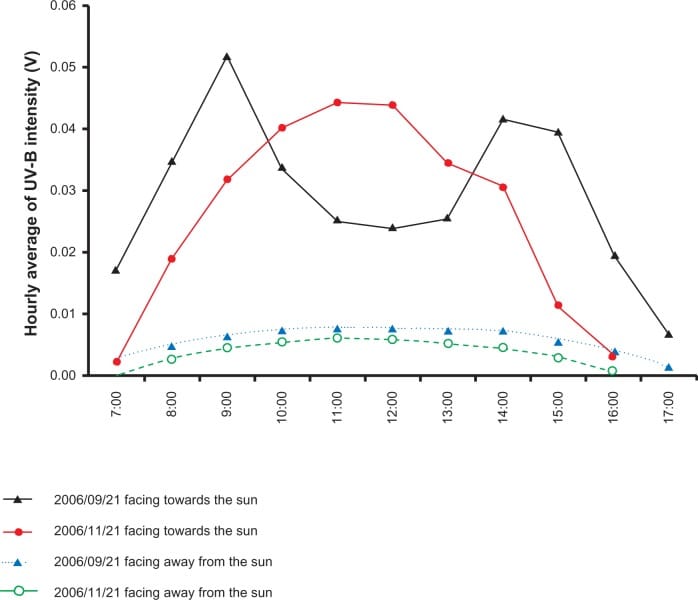
The 40-degree solar elevation finding changes how to think about morning UV risk. Sasaki et al. (2011) measured ocular UV-B using manikins with embedded sensors and found that the standard UV Index — designed for horizontal surfaces — does not reflect actual ocular UV exposure. Ocular UV-B peaked at intermediate solar elevations, not at noon. Hu et al. (2013) reproduced this with manikins at 12 rotational angles: when facing toward or within 30 degrees of the sun, ocular UV peaked at approximately 40 degrees solar elevation — roughly 3-4 hours before and after solar noon. At that angle, the sun shines directly into the orbital aperture. This means that morning walkers facing the rising sun can receive direct ocular UV-B even when the ambient UV index reads low, because the geometry of the eye socket concentrates incoming light at low-to-intermediate solar angles.
Standard automotive glass blocks approximately 99% of UV but transmits roughly 83% of visible light, including the melanopic wavelengths that drive circadian entrainment. For commuters, driving with the sun visible through the windshield may provide circadian light input with built-in UV protection — without requiring bare-eye outdoor exposure.
Standard corrective glasses already block UV-B. The morning light approach does not require removing prescription eyewear. Glass and modern optical plastics absorb UV-B. The circadian-relevant wavelengths (around 460-490 nm, in the blue range) pass through standard untinted lenses with minimal attenuation.
Practical timing thresholds: Put sunglasses on when UV index reaches 3 or above, when the sun exceeds approximately 40 degrees elevation, or after 30-60 minutes of direct morning exposure — whichever comes first. At equatorial latitudes during summer, sunrise may already carry UV index values of 2 or higher; at high latitudes during winter, UV index may not exceed 1 all day. Check local UV index forecasts rather than relying on a fixed clock time.
What Should You Change About UV Protection as Your Eyes Age?
In your 40s and 50s, two opposing trends create a narrowing window. Turner and Mainster (2008) documented that circadian photoreception capacity declines with age due to progressive lens yellowing and pupil constriction. By age 45, circadian photoreception capacity is reduced by approximately 50% relative to a 10-year-old eye. This means the morning light window is more valuable for circadian entrainment — the same outdoor light delivers less melanopic stimulation to aging eyes, so unfiltered exposure during the low-UV sunrise window becomes more important for maintaining circadian alignment. At the same time, the same aging process that reduces circadian input also weakens UV defenses — antioxidant concentrations in the lens decline, melanin in the retinal pigment epithelium degrades, and repair capacity diminishes. The result: morning unfiltered light matters more, while midday and afternoon UV protection also matters more. The low-UV sunrise window serves both needs simultaneously.
In your 60s and beyond, more aggressive UV protection during any UV index above 1 becomes appropriate. Wrap-around sunglasses, wide-brim hats, and UV-blocking contact lenses used in combination provide the most comprehensive coverage for eyes with reduced defense capacity. The melanopsin-containing retinal ganglion cells that drive circadian entrainment begin losing dendritic complexity from the 50s, with 31% cell loss documented after age 70 — so circadian light input is reduced at the retinal receptor level as well as at the optical level. Brighter or longer morning light exposure may be needed to achieve the same circadian benefit that younger eyes get from brief outdoor exposure.
After cataract surgery, the intraocular lens type determines the new equation. Brondsted et al. (2017) compared blue-blocking IOLs to neutral (UV-only) IOLs over one year and found that blue-blocking IOLs attenuated melanopic input. UV-only IOLs transmit the full visible spectrum, including the 460-490 nm wavelengths that melanopsin responds to — restoring circadian photoreception capacity to levels that may exceed what the aging natural lens provided before surgery. Blue-blocking IOLs provide circadian photoreception equivalent to an eye approximately 15-20 years older than UV-only IOLs (Turner & Mainster, 2008), which may require brighter or longer morning light exposure to maintain circadian entrainment. For individuals choosing an IOL, this trade-off between retinal blue-light protection and circadian light transmission is relevant to discuss before surgery.
Yellow-tinted night-driving glasses worn at dawn or dusk add a second blue-wavelength filter on top of an already-yellowed aging lens. For adults over 50, this combination can reduce the circadian-relevant light reaching melanopsin cells during the window when it matters. If you wear tinted lenses for driving, switching to untinted lenses during the morning light window preserves circadian input.
Older adults in dim indoor environments — including many residential care facilities — receive a fraction of the outdoor melanopic light their circadian clocks need. When outdoor morning light exposure is not feasible, bright indoor lighting calibrated to deliver melanopic equivalent daylight illuminance (mEDI) above 250 lux can partially compensate for the reduced optical capacity of aging eyes.
UV protection and circadian light are both longevity inputs — and balancing them becomes more complex as your eyes age. The circadian light deficit from lens yellowing, pupil shrinkage, and melanopsin cell loss may compound with autonomic, metabolic, inflammatory, or hormonal causes of sleep disruption. Identifying which causes might be contributing is a useful next step.
Find out which causes might be driving your 3am wakeups →
Frequently Asked Questions
Are Cheap Sunglasses Worse Than No Sunglasses?
Pupil dilation in response to dark tint is an autonomic reflex — the iris opens to compensate for reduced visible light. If the lens material does not absorb UV, the dilated pupil admits a larger cross-section of UV radiation than the constricted pupil of an unshielded eye. This is a measurable increase in ocular UV dose rather than a theoretical concern. Price is not a reliable indicator — inexpensive polycarbonate lenses can provide full UV400 protection, while expensive fashion frames with non-UV-rated lenses may not. The label, not the price, determines protection.
Do Blue-Violet-Filtering Contact Lenses Affect Circadian Entrainment?
Glickman et al. (2025) introduced the melanopic daylight filtering density (mDFD) metric to standardize how much circadian-relevant light different lenses attenuate. Among 26 commercially tested blue-blocking products, only lenses with mDFD at or above 1.0 provided reductions in melanopic irradiance large enough to alter circadian phototransduction. Daytime wear of high-filtering lenses was associated with attenuated circadian entrainment due to reduction of alerting blue-wavelength light. For contact lens wearers using blue-violet-filtering lenses throughout the day, the circadian impact during morning light exposure has not been studied directly — but the attenuation of melanopsin-relevant wavelengths during the circadian-sensitive morning window may reduce the effectiveness of morning outdoor light as a time-setter.
Is Light Through a Window Enough for Circadian Entrainment?
Low-emissivity (low-e) and triple-pane energy-efficient glass attenuate short-wavelength light more than standard glass. The circadian effectiveness of window light depends on the glass type, the angle of sunlight reaching the window, cloud cover, and the distance from the window. Outdoor light on a sunny morning typically delivers 10,000-100,000 lux; indoor light near a window typically delivers 500-5,000 lux. The melanopsin response has a high activation threshold — dim indoor light may be insufficient, while bright window light from direct sun can be effective. When outdoor morning light exposure is not feasible, positioning near a large, sun-facing window with standard glass is a reasonable alternative.
How Much UV Do Reflective Surfaces Add?
Reflected UV is the primary reason hat brims alone cannot bring ocular UV within safe limits. The ICNIRP safety threshold assumes UV arriving primarily from above — but reflected UV from snow, water, sand, or pavement arrives at angles that pass under hat brims and around sunglass frames. Skiers receive UV from above and a near-equal dose reflected from snow below. Threlfall and English (1999) documented a dose-response relationship between cumulative ocular UV exposure and pterygium risk, with no safe lower threshold detected — even modest reductions in reflected UV from wearing wrap-around sunglasses or UV-blocking contact lenses are associated with reduced disease risk. At high altitude, the combination of increased ambient UV and high surface reflectance creates conditions where ocular UV can exceed safety limits rapidly with unprotected exposure.
After Cataract Surgery, Do You Still Need Morning Light Without Sunglasses?
Turner and Mainster (2008) showed that cataract extraction with a UV-only IOL restores circadian photoreception capacity to levels exceeding what the natural aging lens provided — because the yellowed cataractous lens was filtering out more blue light than an untinted UV-only IOL does. Blue-blocking IOLs were designed to protect the retina from potentially harmful short-wavelength visible light, but this protection comes at the cost of reduced circadian light transmission. For individuals with blue-blocking IOLs, morning outdoor light exposure remains beneficial — it may need to be brighter (standing in direct sun rather than shade) or longer (45-60 minutes rather than 30) to compensate for the attenuation. Discussing IOL type with your ophthalmologist before surgery allows this trade-off to be considered alongside retinal risk factors.
Related Reading
- Circadian Sleep Disruption: What Breaks Your Body Clock and Keeps You Awake – the full overview of circadian mechanisms that can fragment sleep
- How Does UV Light Age Your Eyes? The Two Types of Lens Damage That Affect Your Vision and Your Sleep – how UV damages the lens and degrades circadian light transmission
- Which Parts of Your Eye Age Permanently — and What Accelerates the Damage? – corneal endothelium, retinal pigment, and limbal stem cell aging
- Can Your Eye Exam Predict How Long You’ll Live? – retinal age gap as a longevity biomarker
- Why Do Your Eyes Get More Vulnerable to UV as You Age — Not Less? – why the same UV dose can do more damage with age
- What Happens to Your Circadian Clock Cells After 50? – melanopsin cell loss, Alzheimer’s connection, and pupillometry
References
Backes, C., Religi, A., Moccozet, L., Vuilleumier, L., Vernez, D., & Bulliard, J. L. (2018). Facial exposure to ultraviolet radiation: Predicted sun protection effectiveness of various hat styles. Photodermatology, Photoimmunology & Photomedicine, 34(5), 330-337. https://pubmed.ncbi.nlm.nih.gov/29682802/
Backes, C., Religi, A., Moccozet, L., Behar-Cohen, F., Vuilleumier, L., Bulliard, J. L., & Vernez, D. (2019). Sun exposure to the eyes: predicted UV protection effectiveness of various sunglasses. Journal of Exposure Science & Environmental Epidemiology, 29(6), 753-764. https://pubmed.ncbi.nlm.nih.gov/30382242/
Behar-Cohen, F., Baillet, G., de Ayguavives, T., Garcia, P. O., Krutmann, J., Peña-Garcia, P., Reme, C., & Wolffsohn, J. S. (2014). Ultraviolet damage to the eye revisited: eye-sun protection factor (E-SPF), a new ultraviolet protection label for eyewear. Clinical Ophthalmology, 8, 87-104. https://pubmed.ncbi.nlm.nih.gov/24379652/
Brondsted, A. E., Haargaard, B., Sander, B., Lund-Andersen, H., Jennum, P., & Kessel, L. (2017). The effect of blue-blocking and neutral intraocular lenses on circadian photoentrainment and sleep one year after cataract surgery. Acta Ophthalmologica, 95(4), 344-351. https://pubmed.ncbi.nlm.nih.gov/27966269/
de Menezes-Junior, L. A. A., Sabiao, T. D. S., Carraro, J. C. C., Machado-Coelho, G. L. L., & Meireles, A. L. (2025). The role of sunlight in sleep regulation: analysis of morning, evening and late exposure. BMC Public Health, 25(1), 3362. https://pubmed.ncbi.nlm.nih.gov/41053799/
Anderson, A. R., Ostermiller, L., Lastrapes, M., & Hales, L. (2025). Does sunlight exposure predict next-night sleep? A daily diary study among U.S. adults. Journal of Health Psychology, 30(5), 962-975. https://pubmed.ncbi.nlm.nih.gov/39077837/
Deng, Y., Zhang, C., Zheng, Y., Li, R., Hua, H., Lu, Y., Gurram, N., Chen, R., OuYang, N., Zhang, S., Liu, Y., & Hu, L. (2021). Effect of Protective Measures on Eye Exposure to Solar Ultraviolet Radiation. Photochemistry and Photobiology, 97(1), 205-212. https://pubmed.ncbi.nlm.nih.gov/32875566/
Glickman, G. L., Harrison, E. M., Herf, M., Herf, L., & Brown, T. M. (2025). Optimizing the Potential Utility of Blue-Blocking Glasses for Sleep and Circadian Health. Translational Vision Science & Technology, 14(7), 25. https://pubmed.ncbi.nlm.nih.gov/40728371/
Hu, L., Gao, Q., Gao, N., Liu, G., Wang, Y., Gong, H., & Liu, Y. (2013). Solar UV exposure at eye is different from environmental UV: diurnal monitoring at different rotation angles using a manikin. Journal of Occupational and Environmental Hygiene, 10(1), 17-25. https://pubmed.ncbi.nlm.nih.gov/23145494/
Sasaki, H., Sakamoto, Y., Schnider, C., Fujita, N., Hatsusaka, N., Sliney, D. H., & Sasaki, K. (2011). UV-B exposure to the eye depending on solar altitude. Eye & Contact Lens, 37(4), 191-195. https://pubmed.ncbi.nlm.nih.gov/21670696/
Threlfall, T. J., & English, D. R. (1999). Sun exposure and pterygium of the eye: a dose-response curve. American Journal of Ophthalmology, 128(3), 280-287. https://pubmed.ncbi.nlm.nih.gov/10511020/
Turner, P. L., & Mainster, M. A. (2008). Circadian photoreception: ageing and the eye’s important role in systemic health. British Journal of Ophthalmology, 92(11), 1439-1444. https://pubmed.ncbi.nlm.nih.gov/18757473/
Wang, M., Dawe, R., Ibbotson, S., & Eadie, E. (2025). An investigation into eye protection for patients receiving oral psoralen photochemotherapy (PUVA). Photochemical & Photobiological Sciences, 24(5), 705-713. https://pubmed.ncbi.nlm.nih.gov/40328985/
Wolffsohn, J. S., Drew, T., Devitt, A., & Kieran, S. (2025). Development of a Sun Protection Factor for contact lenses (CL-SPF). BMJ Open Ophthalmology, 10(1), e002005. https://pubmed.ncbi.nlm.nih.gov/40132900/
Written by Kat Fu, M.S., M.S. · Last reviewed: June 24, 2026 · 14 references cited
References
All APA references verified against PubMed API records. Changes from original:
- Wolffsohn et al. (2025) — Added article number “e002005” (was missing from original).
- All other references — Verified correct. Author names, titles, journals, volumes, issues, and pages match PubMed records.
Note on author name formatting: The PubMed record for Brondsted (2017) shows “Brøndsted” with the Danish character. The article uses “Brondsted” which is an acceptable anglicization for publication contexts.