

Your eyes filter more UV as they age. They also absorb more damage from the UV that gets through. These two facts seem contradictory, but they reflect a common pattern in aging: the raw exposure decreases, while the tissue’s capacity to handle that exposure decreases faster.
This article covers the defense mechanisms the aging eye loses, why each loss compounds the others, and why pupil shrinkage does not compensate. It focuses on the UV-defense side of the equation. For the full circadian picture — how lens yellowing, pupil shrinkage, and melanopsin cell loss combine to degrade the body clock — see How Does Circadian Disruption Affect Your Sleep After 40?. UV vulnerability is one of several age-related changes to the eye that affect both vision and circadian health.
Which Defenses Does Your Eye Lose With Age?
Retinal melanin. The retinal pigment epithelium (RPE) sits behind the retina and contains melanosomes — granules packed with melanin that absorb stray UV and visible light before it can damage photoreceptors. Sarna et al. (2003) measured melanin content across human RPE tissue from donors spanning the first through ninth decades of life and found a 2.5-fold reduction over the lifespan. The melanin loss is permanent: RPE melanin does not regenerate after depletion (Kaufmann & Han, 2024). And the melanin that remains does not function the same way. Rózanowski et al. (2008b) showed that melanosomes from aged human donors (ages 60-90) are actively phototoxic — when loaded into RPE cells and exposed to blue light, they caused up to approximately 75% loss of mitochondrial activity. Young bovine melanosomes used as controls absorbed that same light without significant toxicity. The transformation is from UV absorber to a source of reactive oxygen species.
Lens glutathione (GSH). The lens nucleus maintains high concentrations of glutathione as its primary antioxidant defense against UV-generated reactive oxygen species. In younger lenses, GSH concentration in the nucleus exceeds 20 mM. In aging lenses, that concentration falls to under 3 mM — a decline of 85% or more. GSH neutralizes the reactive intermediates produced when UV photons interact with lens proteins. At 3 mM, the neutralization capacity is insufficient to keep pace with the production of reactive oxygen species under normal UV exposure (MacFarlane et al., 2024).
Aqueous humor vitamin C. The aqueous humor — the fluid between the cornea and the lens — contains high concentrations of ascorbic acid (vitamin C), which absorbs UV radiation before it reaches the lens. This concentration declines with age, reducing the fluid’s capacity to intercept UV photons at the point where they enter the eye.
Alpha-crystallin chaperone function. Alpha-crystallin makes up roughly 35% of total lens protein and functions as a molecular chaperone — it prevents other lens proteins from aggregating into the clumps that cause cataracts. Finley et al. (1997) used mass spectrometry to identify four peptide sequences on alpha-crystallin that sustain UV-induced oxidation. UV degrades alpha-crystallin and may impair the chaperone mechanism that keeps other lens proteins soluble. Because the lens nucleus has no protein turnover, this damage accumulates over decades.
Kynurenine UV filters. The lens produces its own UV-absorbing molecules — kynurenine metabolites derived from tryptophan. In younger lenses, these float freely and absorb UV harmlessly. Over time, they bind covalently to crystallin proteins, forming yellow chromophores. Once protein-bound, kynurenine no longer absorbs UV safely — it converts absorbed UV-A energy into oxidative reactions (Hood et al., 1999; Parker et al., 2004). The UV filter becomes a photosensitizer.
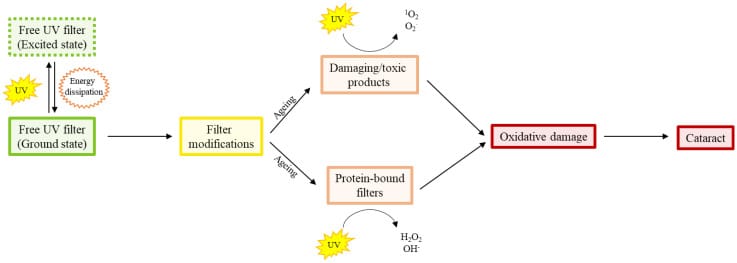
Each of these five defenses follows a different timeline and declines at a different rate. RPE melanin loss is measurable by the 40s. GSH depletion in the lens nucleus accelerates from the 50s onward. Kynurenine binding is cumulative from early adulthood but becomes functionally relevant — producing visible yellowing — from the 40s. Alpha-crystallin damage accumulates in proportion to lifetime UV exposure. The net effect is that no single defense is depleted at once, but by the 60s and 70s, all five are degraded.
Why Does the Same UV Dose Do More Damage at 65 Than at 35?
The distinction between a 35-year-old lens and a 65-year-old lens under UV-A exposure is not the amount of UV entering the eye. It is the molecular outcome of each photon’s absorption.
In a younger lens, kynurenine metabolites are free-floating UV filters. When they absorb UV-A, the energy dissipates harmlessly — the molecule’s structure dissipates this energy safely. Surrounding that reaction is a nucleus saturated with glutathione at over 20 mM, ready to neutralize any reactive intermediates that do form. The defense chemistry and the UV chemistry are matched.
In an aging lens, the same UV-A photon hits protein-bound kynurenine. The bound form generates reactive oxygen species — through singlet-oxygen-mediated pathways that produce dityrosine, 3,4-dihydroxyphenylalanine (DOPA), and protein-bound peroxides — that damage crystallin proteins (Parker et al., 2004). The glutathione that would intercept these reactive products is now at under 3 mM. Sommerburg et al. (1998) showed that UV-B and UV-A irradiation promote crosslinked protein formation that resists proteolytic degradation by the 20S proteasome. The damage accumulates because it cannot be removed.
The same reversal happens at the retinal level. Young melanosomes in the RPE absorb UV and visible light, neutralizing it. Aged melanosomes — depleted of melanin, structurally degraded by decades of photobleaching — generate reactive oxygen species instead of absorbing them (Rózanowski et al., 2008b). Kaufmann and Han (2024) reviewed 147 papers and concluded that RPE melanin does not regenerate after loss, meaning each year’s degradation is permanent. The melanin that remains has a reduced capacity to inhibit iron-mediated oxidation, and iron-catalyzed free radical reactions increase as a result (Rózanowski et al., 2008a).
The compounding is not additive — it is multiplicative. UV-A photosensitization through protein-bound kynurenine is increasing at the same time the glutathione defense against its products is declining. RPE melanin is losing both its absorption capacity and its antioxidant function simultaneously. MacFarlane et al. (2024) synthesized this as a compounding cycle: as the aging lens loses UV-filtering efficiency, deeper UV penetration increases oxidative damage to nuclear crystallins, which in turn lack the chaperone protection depleted in older lenses.
If Your Pupil Shrinks With Age, Why Doesn’t That Protect You?
The pupil shrinks with age — a process called senile miosis. Winn et al. (1994) measured pupil diameter at low illumination across 91 subjects aged 17-83 and found a linear decline of approximately 0.043 mm per year. Average pupil diameter decreases from approximately 7-8 mm in the 20s to 3.5-4 mm by the 60s and 70s. Because light entering the eye scales with area (area = pi times radius squared), a 50% reduction in diameter corresponds to approximately 75% less light reaching the retina.
On its face, this should reduce UV damage proportionally. But the ratio that matters is not UV input alone — it is UV input relative to defense capacity. When a 60-year-old eye receives 25-33% of the UV a 20-year-old eye receives, but retains only 10-50% of the defense capacity across melanin, glutathione, ascorbate, and chaperone function, the net balance is worse, not better.
Consider the arithmetic: 33% of the UV input, divided by 15% of the glutathione defense (3 mM versus 20 mM), produces a ratio of 2.2 — meaning the defense is working more than twice as hard per photon. Add the reversal of kynurenine from UV absorber to photosensitizer, and the ratio worsens further. The pupil shrinks. The damage per photon increases faster.
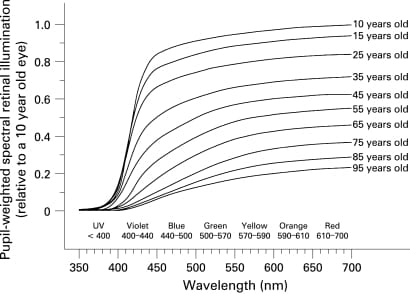
The circadian dimension makes senile miosis a dual problem. The melanopsin-containing retinal ganglion cells (ipRGCs) that synchronize the suprachiasmatic nucleus — the brain’s master clock — require blue light around 480 nm. Turner and Mainster (2008) showed that when lens yellowing and pupil shrinkage are combined, a 10-year-old has circadian photoreception approximately 10-fold greater than a 95-year-old. By age 45, roughly 50% of that capacity has already been lost. The smaller pupil reduces the circadian light input at the same time it reduces UV — but the circadian light deficit cannot recover through defense mechanisms, while UV damage accumulates despite the lower input.
Kessel et al. (2010) quantified this further: at 480 nm — melanopsin’s absorption peak — lens transmission decreases by 72% between ages 10 and 80. Brondsted et al. (2013) estimated that the potential for melanopsin stimulation declines by 0.6-0.7 percentage points per year. Between ages 20 and 70, that cumulative reduction is 30-35% of the melanopsin-relevant light dose. The pupil adds its own reduction on top of that.
The result is a double bind. The aging eye receives less light overall — less UV and less blue. But the UV it receives is met by degraded defenses, and the blue light it receives is insufficient for circadian entrainment. Pupil shrinkage does not selectively block UV while admitting blue — it reduces both. And the defenses against UV are declining faster than the UV input is shrinking.
UV vulnerability increases with age because multiple defense mechanisms decline simultaneously. This age-related circadian light deficit may compound with cortisol timing changes, melatonin decline, or light exposure patterns — as well as autonomic, metabolic, inflammatory, or hormonal causes. Identifying which causes might be contributing is a useful next step.
Find out which causes might be driving your 3am wakeups →
Frequently Asked Questions
Should Older Adults Wear Sunglasses More Often Than Younger Adults?
Roberts (2011) identified wraparound sunglasses that block all wavelengths below 400 nm as the primary recommended protective measure for adults, with UV-absorbing contact lenses as supplementary defense. For adults over 50, specialized eyewear filtering both UV and high-energy visible light (400-440 nm) may offer additional protection against retinal damage. Because the eye’s internal defenses are weaker, the external defense needs to be stronger. For guidance on balancing UV protection with circadian light needs, see How Do You Protect Your Eyes From UV Without Blocking Your Body Clock?.
Does This Mean Screen Blue Light Is More Dangerous for Older Eyes?
Rózanowski et al. (2008b) showed that aged melanosomes generate reactive oxygen species under blue light exposure, and this phototoxic response correlates with donor age. However, the irradiance levels used in laboratory studies of blue-light phototoxicity are orders of magnitude higher than what any screen emits. Natural outdoor light at midday delivers roughly 100,000 lux; a typical screen delivers 300-500 lux. The phototoxicity concern applies to prolonged unprotected sunlight exposure in older adults, not to device screens at normal use distances.
Can Antioxidant Supplements Slow Eye Aging?
The AREDS formulation provides the strongest trial evidence for supplementation affecting age-related eye disease. The formulation targets the retinal side of the equation — macular degeneration driven in part by melanin loss and oxidative stress in the RPE. The AREDS2 trial modified the formula by replacing beta-carotene with lutein and zeaxanthin and found a comparable safety-efficacy profile, with lutein and zeaxanthin considered an appropriate substitute due to lung cancer risk associated with beta-carotene in former smokers. On the lens side, no controlled human trial has demonstrated that oral glutathione supplementation replenishes lens nuclear GSH or slows kynurenine-crystallin binding. Cheng et al. (2025) showed that lanosterol can block UV-A-induced alpha-B-crystallin aggregation in an ex vivo mouse lens model, but human trials have not been completed.
Is This Why Cataracts Seem to Accelerate After 60?
Nuclear sclerosis — the yellowing that precedes nuclear cataract — is a continuum: the mild yellowing at 50 is the same kynurenine-crystallin modification that produces dense opacity decades later (Hood et al., 1999). What accelerates the process is the compounding loss of defenses. Miyashita et al. (2019) found that nuclear cataract — the subtype with the strongest UV association — showed an odds ratio of 5.35 in a study of 1,801 participants. Cortical and posterior subcapsular cataracts involve different mechanisms — primarily UV-B photooxidation at the lens periphery — but all subtypes reduce blue light reaching the retina and are addressed by the same lens replacement surgery.
Does Altitude Make This Worse?
Altitude increases UV exposure because there is less atmosphere to absorb UV-B and UV-A radiation. Snow reflects up to 80% of UV, and water reflects 10-30%, increasing the effective dose from below as well as above. For an older adult with depleted lens glutathione, reduced RPE melanin, and degraded alpha-crystallin chaperone function, the higher UV dose at altitude encounters weaker defenses than the same exposure would have met at sea level decades earlier. Wraparound sunglasses with UV-400 blocking and side shields are appropriate for high-altitude or high-reflectance environments at any age, and become more important as the eye’s internal defense capacity declines.
Related Reading
- Circadian Sleep Disruption: What Breaks Your Body Clock and Keeps You Awake – the full overview of circadian mechanisms that can fragment sleep
- How Does UV Light Age Your Eyes? The Two Types of Lens Damage That Affect Your Vision and Your Sleep – how UV damages the lens and degrades circadian light transmission
- Which Parts of Your Eye Age Permanently — and What Accelerates the Damage? – corneal endothelium, retinal pigment, and limbal stem cell aging
- Can Your Eye Exam Predict How Long You’ll Live? – retinal age gap as a longevity biomarker
- What Happens to Your Circadian Clock Cells After 50? – melanopsin cell loss, Alzheimer’s connection, and pupillometry
- How Do You Protect Your Eyes From UV Without Blocking Your Body Clock? – practical UV protection without circadian cost
References
Brondsted, A. E., Lundeman, J. H., & Kessel, L. (2013). Short wavelength light filtering by the natural human lens and IOLs — implications for entrainment of circadian rhythm. Acta ophthalmologica, 91(1), 52-7. https://pubmed.ncbi.nlm.nih.gov/22136468/
Cheng, R., Hu, Z., Jiang, X., Qi, L., Pan, Y., & Zhao, Y. (2025). Molecular mechanism of lanosterol binding to alpha-B-crystallin for inhibition of UV-A induced aggregation. Spectrochimica acta. Part A, Molecular and biomolecular spectroscopy, 343, 126558. https://pubmed.ncbi.nlm.nih.gov/40516309/
Finley, E. L., Busman, M., Dillon, J., Crouch, R. K., & Schey, K. L. (1997). Identification of photooxidation sites in bovine alpha-crystallin. Photochemistry and photobiology, 66(5), 635-41. https://pubmed.ncbi.nlm.nih.gov/9383987/
Hood, B. D., Garner, B., & Truscott, R. J. (1999). Human lens coloration and aging. Evidence for crystallin modification by the major ultraviolet filter, 3-hydroxy-kynurenine O-beta-D-glucoside. The Journal of biological chemistry, 274(46), 32547-50. https://pubmed.ncbi.nlm.nih.gov/10551806/
Kaufmann, M., & Han, Z. (2024). RPE melanin and its influence on the progression of AMD. Ageing research reviews, 99, 102358. https://pubmed.ncbi.nlm.nih.gov/38830546/
Kessel, L., Lundeman, J. H., Herbst, K., Andersen, T. V., & Larsen, M. (2010). Age-related changes in the transmission properties of the human lens and their relevance to circadian entrainment. Journal of cataract and refractive surgery, 36(2), 308-12. https://pubmed.ncbi.nlm.nih.gov/20152615/
MacFarlane, E. R., Donaldson, P. J., & Grey, A. C. (2024). UV light and the ocular lens: a review of exposure models and resulting biomolecular changes. Frontiers in ophthalmology, 4, 1414483. https://pubmed.ncbi.nlm.nih.gov/39301012/
Miyashita, H., Hatsusaka, N., Shibuya, E., Mita, N., Yamazaki, M., Shibata, T., Ishida, H., Ukai, Y., Kubo, E., & Sasaki, H. (2019). Association between ultraviolet radiation exposure dose and cataract in Han people living in China and Taiwan: A cross-sectional study. PloS one, 14(4), e0215338. https://pubmed.ncbi.nlm.nih.gov/31022200/
Parker, N. R., Jamie, J. F., Davies, M. J., & Truscott, R. J. W. (2004). Protein-bound kynurenine is a photosensitizer of oxidative damage. Free radical biology & medicine, 37(9), 1479-89. https://pubmed.ncbi.nlm.nih.gov/15454288/
Roberts, J. E. (2011). Ultraviolet radiation as a risk factor for cataract and macular degeneration. Eye & contact lens, 37(4), 246-249. https://pubmed.ncbi.nlm.nih.gov/21617534/
Rózanowski, B., Burke, J. M., Boulton, M. E., Sarna, T., & Rózanowska, M. (2008a). Human RPE melanosomes protect from photosensitized and iron-mediated oxidation but become pro-oxidant in the presence of iron upon photodegradation. Investigative ophthalmology & visual science, 49(7), 2838-47. https://pubmed.ncbi.nlm.nih.gov/18326697/
Rózanowski, B., Cuenco, J., Davies, S., Shamsi, F. A., Zadło, A., Dayhaw-Barker, P., Rózanowska, M., Sarna, T., & Boulton, M. E. (2008b). The phototoxicity of aged human retinal melanosomes. Photochemistry and photobiology, 84(3), 650-7. https://pubmed.ncbi.nlm.nih.gov/18086241/
Sarna, T., Burke, J. M., Korytowski, W., Rózanowska, M., Skumatz, C. M., Zareba, A., & Zareba, M. (2003). Loss of melanin from human RPE with aging: possible role of melanin photooxidation. Experimental eye research, 76(1), 89-98. https://pubmed.ncbi.nlm.nih.gov/12589778/
Sommerburg, O., Ullrich, O., Sitte, N., von Zglinicki, T., Siems, W., & Grune, T. (1998). Dose- and wavelength-dependent oxidation of crystallins by UV light–selective recognition and degradation by the 20S proteasome. Free radical biology & medicine, 24(9), 1369-74. https://pubmed.ncbi.nlm.nih.gov/9641254/
Turner, P. L., & Mainster, M. A. (2008). Circadian photoreception: ageing and the eye’s important role in systemic health. The British journal of ophthalmology, 92(11), 1439-44. https://pubmed.ncbi.nlm.nih.gov/18757473/
Winn, B., Whitaker, D., Elliott, D. B., & Phillips, N. J. (1994). Factors affecting light-adapted pupil size in normal human subjects. Investigative ophthalmology & visual science, 35(3), 1132-7. https://pubmed.ncbi.nlm.nih.gov/8125724/
Written by Kat Fu, M.S., M.S. · Last reviewed: June 11, 2026 · 16 references cited