

The eye contains structures that age on a one-way trajectory — once cells are lost or molecules are degraded, no biological repair mechanism restores them. This matters for more than vision. These same structures form the light pathway your circadian clock depends on, and their degradation changes what light reaches the retinal cells that set melatonin timing, sleep-wake rhythm, and overnight recovery.
This article covers three irreversible aging processes in the eye: corneal endothelial cell loss, retinal melanin degradation, and limbal stem cell damage. For the full overview of how UV and aging affect circadian light transmission, see How Does Circadian Disruption Affect Your Sleep After 40?. Each of these mechanisms is one component of a broader set of causes that can disrupt sleep after 40.
Why Can’t Your Cornea’s Inner Lining Regenerate — and What Happens When It Runs Out?
The corneal endothelium is the innermost surface of the cornea — a single sheet of hexagonal cells responsible for maintaining the hydration level that keeps the cornea transparent. Unlike other human tissues, these cells do not divide in the adult eye. The cell population you are born with is the entire supply you will ever have.
A 2025 prospective study of 75 healthy participants measured endothelial cell density across multiple corneal zones (central, 3 mm, 4 mm, and 4.5 mm eccentricity) and found a uniform decline of 83-92 cells per mm² per decade across all zones (Su et al., 2025). Central endothelial cell density declined at 83 cells per mm² per decade. Peripheral zones declined at comparable rates — 86, 92, and 83 cells per mm² per decade at 3, 4, and 4.5 mm respectively. The uniformity of decline across all corneal zones rules out a zonally selective process and supports a whole-endothelium aging mechanism.
UV radiation accelerates this baseline loss. UV-B damages corneal endothelial cells through two converging pathways. A 2022 in vitro study exposed human corneal endothelial cells to repeated UV-B doses and documented activation of the ATM-p53-p21 DNA damage response pathway alongside elevated reactive oxygen species — both converging on permanent G1-phase cell cycle arrest (Jiang et al., 2022). The cells enlarge, stop dividing, and begin releasing inflammatory factors including IL-6, IL-8, and TNF-alpha, but they do not die right away. They occupy space without contributing to the pump function that maintains corneal transparency.
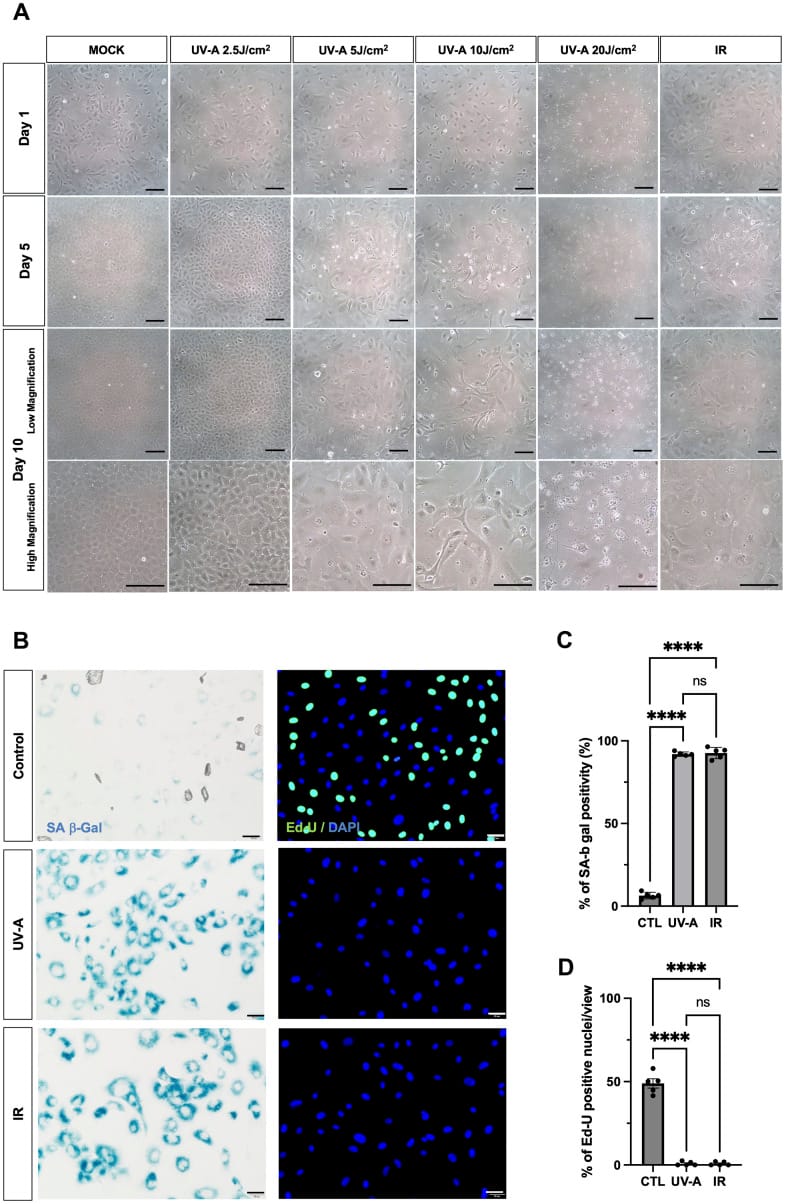
UV-A causes the same endpoint through a different entry point. A 2024 in vitro study found that 5 J/cm² of UV-A — a dose roughly equivalent to one hour of summer midday sun exposure — drives human corneal endothelial cells into a senescent state with 93.8% molecular overlap with ionizing radiation damage at the protein level (Numa et al., 2024). At the transcriptomic level, 83.9% of upregulated genes matched the radiation-induced senescence profile. UV-A produces a senescence response in cultured corneal endothelial cells that is molecularly comparable to radiation-induced senescence.
When endothelial cell density falls below approximately 500 cells per mm², the remaining cells can no longer maintain corneal dehydration. The cornea swells, becomes opaque, and vision is lost — a condition called corneal decompensation. No drug reverses this. The current remedy is corneal transplant. ROCK inhibitor eye drops represent an emerging approach that may stimulate surviving cells to migrate and partially cover gaps, but this remains under investigation and does not restore the lost cells themselves (Domagala et al., 2025).
How Does Your Retina’s Own UV Shield Turn Against You After 50?
The retinal pigment epithelium (RPE) sits directly behind the photoreceptors and performs three functions relevant to light-mediated aging: it absorbs stray photons that would otherwise scatter and degrade image quality, it neutralizes free radicals generated by photoreceptor activity, and it sequesters redox-active iron that would otherwise catalyze oxidative damage. Melanin is the molecule responsible for all three functions.
A human tissue study using electron spin resonance spectroscopy measured melanin across RPE cells from donors spanning the first through ninth decade of life and found a 2.5-fold reduction in melanin content over the human lifespan (Sarna et al., 2003). The decline is not uniform — it accelerates with cumulative light exposure. When RPE eyecup preparations were exposed to visible light, melanosomes showed time-dependent photobleaching accompanied by measurable hydrogen peroxide production. The photobleaching observed on isolated melanosomes resembled the changes seen in older donor tissue, supporting photooxidation as a contributor to melanin loss alongside intrinsic aging.
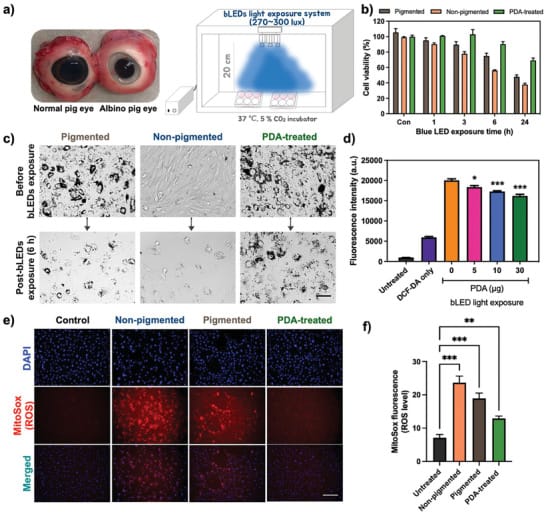
What makes this process consequential is that the remaining melanin does not merely become less effective. It reverses function. In bovine RPE cell suspensions, intact melanosomes reduced iron-mediated oxidation rates approximately four-fold in pigmented versus non-pigmented cells (Rozanowski et al., 2008). Human melanosomes from the same study exerted a concentration-dependent inhibitory effect on both photosensitized and iron-mediated oxidation in intact cells. After blue-light-induced photodegradation, these human melanosomes lost their ability to inhibit iron-mediated oxidation. Photodegraded melanosomes showed lower melanin content, reduced iron-binding capacity, and increased photogeneration of superoxide anion. The melanin that remains in an aged RPE no longer sequesters iron — it promotes iron-catalyzed free radical damage.
The functional consequence was quantified in a separate study: RPE cells loaded with melanosomes from aged donors (ages 60-90) and exposed to blue light showed up to approximately 75% decrease in mitochondrial activity compared to cells loaded with young melanosomes (Rozanowski et al., 2008b). Aged melanosomes also caused loss of lysosomal pH regulation and direct cell death. Dark incubation or blue light alone without aged melanosomes produced minimal damage — both the aged melanosome and light exposure were required for the phototoxic effect.
A 2013 study established the PTeCA/PTCA ratio as a validated biomarker for tracking the oxidative modification of RPE eumelanin over time (Ito et al., 2013). Both eumelanin and pheomelanin in human RPE undergo progressive oxidative cross-linking and polymer cleavage from lifetime blue light exposure — structural changes that reduce antioxidant capacity and may explain the transition from photoprotectant to photosensitizer.
A 2024 review of 147 papers synthesized the connection between RPE melanin degradation and age-related macular degeneration (Kaufmann & Han, 2024). RPE melanin does not regenerate after loss or degradation — any depletion from chronic light exposure is permanent and cumulative. In aging eyes, melanin loss correlates with increased lipid peroxidation, heightened inflammatory response, and accumulation of oxidized cellular byproducts that characterize early AMD. Polydopamine nanoparticles — which share photoprotective and antioxidant properties with natural eumelanin — have shown potential in animal models (Nrf2-deficient mice) to functionally substitute for depleted melanin and reduce blue-light-induced retinal damage, but this approach has not been tested in humans (Kwon et al., 2024).
What Does the Limbal Stem Cell Concentration Problem Mean for Your Cornea’s Surface?
The geometry of the eye creates a UV concentration problem at a location that cannot afford it. The curved surface of the cornea refracts peripheral light inward, focusing it on the nasal limbus at intensities up to 20 times higher than the incident UV dose. This is a physical optics effect — the cornea acts as a converging lens for light entering from the temporal side.
The nasal limbus is where limbal epithelial stem cells reside. These stem cells are the sole source of corneal epithelial renewal. Every surface cell on the cornea originates from this population. When UV damages these stem cells — through DNA mutation, oxidative stress, or chronic inflammatory response — the cornea loses its ability to maintain a healthy surface over time.
Pterygium is the visible consequence of this UV-stem cell interaction. A dose-response study in Western Australia found that individuals in the highest UV exposure quartile had an odds ratio of 6.8 for pterygium compared to the lowest quartile (Threlfall & English, 1999). Rarely wearing sunglasses or hats was associated with 3.6-4.6 times greater risk. Pterygium tissue shows p53 mutations consistent with a direct UV mutagenesis mechanism rather than a nonspecific inflammatory process.
Pterygium prevalence varies with latitude and UV exposure: from 1.3% in Tehran to 31% in Lima. An estimated 15 million Americans may have pterygium, with many cases undiagnosed because early-stage growth is asymptomatic (Abraham et al., 2023). Pinguecula — a precursor lesion in the same anatomical location — reaches prevalence up to 97% in populations with sustained high UV exposure.
The cornea’s optics concentrate UV at the location of the irreplaceable cells responsible for corneal surface renewal, and each exposure adds cumulative damage to a population that cannot expand to compensate for losses.
The structures described in this article are part of the light pathway your circadian clock depends on. When any of them degrades — from UV, from aging, or both — the downstream effect on sleep timing, melatonin, and recovery may compound with autonomic, metabolic, inflammatory, or hormonal causes. Identifying which causes might be contributing is a useful next step.
Find out which causes might be driving your 3am wakeups →
Frequently Asked Questions
Does UV Damage the Fluid Inside Your Eye?
The aqueous humor — the fluid between the cornea and the lens — functions as a UV filter because of its high ascorbate concentration. Ascorbate absorbs UV photons before they reach the lens and deeper structures. As this pool declines with age, more UV reaches the lens (accelerating yellowing and cataract formation) and the anterior chamber tissues. Oxidative DNA damage from reduced ascorbate buffering has been linked to trabecular meshwork impairment, which can elevate intraocular pressure. This is one of several pathways through which cumulative UV exposure is associated with increased glaucoma risk.
Do Floaters Mean Your Eye Is Aging?
The vitreous body is composed primarily of collagen fibrils suspended in hyaluronic acid. With age, collagen fibrils aggregate and the gel structure breaks down into liquid pockets — a process called vitreous liquefaction. The collapsed collagen casts shadows on the retina, producing floaters. By the 40s and 50s, this process is well underway in many people. While not directly UV-driven, the oxidative environment of the aging eye — including reduced antioxidant capacity from melanin loss and ascorbate depletion — may contribute to collagen degradation over time.
Can UV Cause Glaucoma?
The link between glaucoma and pseudoexfoliation syndrome involves a condition in which abnormal fibrillar protein accumulates on the lens capsule and trabecular meshwork. This material physically obstructs the drainage channels for aqueous humor, raising intraocular pressure and increasing the risk of optic nerve damage. The geographic distribution of pseudoexfoliation — more common at higher latitudes farther from the equator — presents a complex epidemiological pattern. The 11% increase in prevalence per degree of latitude from the equator is an epidemiological association, not a proven causal relationship, and the mechanism may involve reflected UV, ambient light patterns, or gene-environment interactions rather than direct UV dose.
Does UV Damage the Retina Directly?
The distinction between UV wavelengths matters for understanding retinal risk. UV-B (280-315 nm) is largely absorbed by the cornea and lens, making it the primary driver of corneal and lens damage but less of a direct retinal concern. UV-A (315-400 nm) penetrates deeper and can reach the retina, where it triggers RIPK3-mediated necroptosis in photoreceptors — a programmed cell death pathway involving inflammation (Yu et al., 2022). The 400-450 nm range (violet light, at the boundary of UV-A and visible light) is damaging to the retina through photochemical mechanisms. This is distinct from the 480 nm blue-cyan light that drives melanopsin-based circadian entrainment in intrinsically photosensitive retinal ganglion cells. The wavelengths that damage the retina and the wavelengths that set the circadian clock are neighbors but not identical, which has implications for how UV protection and circadian light exposure can be balanced.
Is There a Blood Test for Eye Aging?
Retinal imaging offers a window into biological aging that no blood test currently provides. AI algorithms trained on fundus photographs can predict chronological age from retinal vessel patterns, nerve fiber thickness, and other structural features. When the predicted “retinal age” exceeds actual chronological age, the difference — called the retinal age gap — correlates with increased mortality risk and higher rates of cardiovascular and neurodegenerative disease. A separate article on retinal age gap as a longevity biomarker covers this topic in depth. Retinal imaging is non-invasive and can be performed during a routine eye exam, making it one of the more accessible biological age estimation methods available.
Related Reading
- Circadian Sleep Disruption: What Breaks Your Body Clock and Keeps You Awake – the full overview of circadian mechanisms that can fragment sleep
- How Does UV Light Age Your Eyes? The Two Types of Lens Damage That Affect Your Vision and Your Sleep – how UV damages the lens and degrades circadian light transmission
- Can Your Eye Exam Predict How Long You’ll Live? – retinal age gap as a longevity biomarker
- Why Do Your Eyes Get More Vulnerable to UV as You Age — Not Less? – why the same UV dose can do more damage with age
- What Happens to Your Circadian Clock Cells After 50? – melanopsin cell loss, Alzheimer’s connection, and pupillometry
- How Do You Protect Your Eyes From UV Without Blocking Your Body Clock? – practical UV protection without circadian cost
References
Abraham, A. P., Brooks, G., Dadas, C., Hovanesian, J., Lee, J., Ni, J., & Whitcup, S. (2023). Prevalence of Pterygium in the United States: A Claims-Based Analysis. Investigative Ophthalmology & Visual Science, 64(8), 2471. https://iovs.arvojournals.org/article.aspx?articleid=2789789
Domagala, D., Muzyka-Wozniak, M., Penciak, N., Niebora, J., & Wozniak, S. (2025). Corneal endothelial cells decline – A review of recent findings from molecular and clinical research. Biomedicine & Pharmacotherapy, 192, 118564. https://pubmed.ncbi.nlm.nih.gov/40972396/
Ito, S., Pilat, A., Gerwat, W., Skumatz, C. M., Ito, M., Kiyono, A., Zadlo, A., Nakanishi, Y., Kolbe, L., Burke, J. M., Sarna, T., & Wakamatsu, K. (2013). Photoaging of human retinal pigment epithelium is accompanied by oxidative modifications of its eumelanin. Pigment Cell & Melanoma Research, 26(3), 357-366. https://pubmed.ncbi.nlm.nih.gov/23421783/
Jiang, G. J., You, X. G., & Fan, T. J. (2022). Ultraviolet B irradiation induces senescence of human corneal endothelial cells in vitro by DNA damage response and oxidative stress. Journal of Photochemistry and Photobiology B: Biology, 235, 112568. https://pubmed.ncbi.nlm.nih.gov/36137302/
Kaufmann, M., & Han, Z. (2024). RPE melanin and its influence on the progression of AMD. Ageing Research Reviews, 99, 102358. https://pubmed.ncbi.nlm.nih.gov/38830546/
Kwon, Y. S., Munsoor, J., Kaufmann, M., Zheng, M., Smirnov, A. I., & Han, Z. (2024). Polydopamine Nanoparticles as Mimicking RPE Melanin for the Protection of Retinal Cells Against Blue Light-Induced Phototoxicity. Advanced Science, 11(29), e2400230. https://pubmed.ncbi.nlm.nih.gov/38816934/
Numa, K., Patel, S. K., Zhang, Z. A., Burton, J. B., Matsumoto, A., Hughes, J. B., Sotozono, C., Schilling, B., Desprez, P. Y., Campisi, J., & Kitazawa, K. (2024). Senescent characteristics of human corneal endothelial cells upon ultraviolet-A exposure. Aging, 16(8), 6673-6693. https://pubmed.ncbi.nlm.nih.gov/38683123/
Rozanowski, B., Burke, J. M., Boulton, M. E., Sarna, T., & Rozanowska, M. (2008). Human RPE melanosomes protect from photosensitized and iron-mediated oxidation but become pro-oxidant in the presence of iron upon photodegradation. Investigative Ophthalmology & Visual Science, 49(7), 2838-2847. https://pubmed.ncbi.nlm.nih.gov/18326697/
Rozanowski, B., Cuenco, J., Davies, S., Shamsi, F. A., Zadlo, A., Dayhaw-Barker, P., Rozanowska, M., Sarna, T., & Boulton, M. E. (2008). The phototoxicity of aged human retinal melanosomes. Photochemistry and Photobiology, 84(3), 650-657. https://pubmed.ncbi.nlm.nih.gov/18086241/
Sarna, T., Burke, J. M., Korytowski, W., Rozanowska, M., Skumatz, C. M., Zareba, A., & Zareba, M. (2003). Loss of melanin from human RPE with aging: possible role of melanin photooxidation. Experimental Eye Research, 76(1), 89-98. https://pubmed.ncbi.nlm.nih.gov/12589778/
Su, R. C., Young, L. H., Benetz, B. A., O’Brien, R. C., Chiang, T. K., Das, P., Li, W. L., Omar, A. F., & Lass, J. H. (2025). Age-Related Changes in Endothelial Cell Density of the Central and Peripheral Corneal Endothelium. Cornea. https://pubmed.ncbi.nlm.nih.gov/41371205/
Threlfall, T. J., & English, D. R. (1999). Sun exposure and pterygium of the eye: a dose-response curve. American Journal of Ophthalmology, 128(3), 280-287. https://pubmed.ncbi.nlm.nih.gov/10511020/
Yu, Z., Correa, V. S. M. C., Efstathiou, N. E., Albertos-Arranz, H., Chen, X., Ishihara, K., Iesato, Y., Narimatsu, T., Ntentakis, D., & Vavvas, D. G. (2022). UVA induces retinal photoreceptor cell death via receptor interacting protein 3 kinase mediated necroptosis. Cell Death Discovery, 8(1), 489. https://pubmed.ncbi.nlm.nih.gov/36509771/
Written by Kat Fu, M.S., M.S. · Last reviewed: May 20, 2026 · 13 references cited