

Brain fog and poor sleep often arrive together – and they can share an upstream driver. Neuroinflammation, the activation of the brain’s own immune response, can connect the two through a self-reinforcing loop: sleep loss activates brain immune cells in animal models, those cells release inflammatory molecules that are associated with cognitive impairment, and the same inflammation may fragment the deep sleep stages that would otherwise help resolve it. This article covers how sleep restriction triggers inflammatory signaling, how that inflammation can contribute to the cognitive impairment commonly described as brain fog, and what happens when the loop runs unchecked. For the broader picture of how inflammation disrupts sleep through multiple pathways, see Inflammatory Sleep Disruption.
How Does Sleep Loss Trigger Brain Inflammation?
The first evidence came from a controlled human experiment. Irwin et al. (2008) kept 14 healthy adults awake from 11pm to 3am for a single night – a four-hour sleep window, the kind of partial night many people experience routinely. By the next morning, NF-kB activation in their peripheral blood mononuclear cells was significantly greater than after baseline or recovery sleep. NF-kB is the transcription factor that switches on inflammatory gene expression: when it activates, the downstream result is production of pro-inflammatory cytokines including IL-6 and TNF-alpha.
One night produces the activation. But whether that activation becomes sustained depends on how many nights follow.
Haack et al. (2007) tested what happens across 10 consecutive nights of four-hour sleep in a randomized controlled trial with 18 healthy volunteers. By the end of the restriction period, IL-6 levels were elevated compared to the eight-hour sleep condition (p < 0.05). The IL-6 elevation correlated with increased pain sensitivity (r = 0.67, p < 0.01) - demonstrating that the inflammatory response was not just measurable in blood work but was producing measurable downstream effects.
The 2026 meta-analysis by Ballesio et al. sharpened the threshold. Across 35 human experimental studies (n = 887), multiple nights of partial sleep deprivation – averaging 4.3 hours for three or more consecutive nights – produced an IL-6 effect size of 0.42 (p < 0.01) and a CRP effect size of 0.76 (p = 0.03). A single night of total or partial sleep deprivation did not. This converges with Irwin et al.'s (2016) earlier meta-analysis of 72 studies (n > 50,000), which found the same distinction: chronic sleep disturbance – not isolated total deprivation – was associated with sustained elevations in CRP and IL-6 across cohort and experimental designs. The pattern is consistent: it is chronic partial restriction, not an isolated bad night, that drives the sustained peripheral inflammation.
The question is how peripheral inflammation may connect to the brain. Hu et al. (2024) identified a molecular upstream trigger in sleep-deprived rats. In sleep-deprived rats, mitochondria inside microglial cells became damaged, leaking oxidized mitochondrial DNA (mtDNA) into the cell’s cytoplasm. This mtDNA leakage activated NF-kB within the microglia themselves – triggering the same inflammatory cascade, but now inside the brain. When the researchers suppressed mtDNA oxidation, both the mtDNA release and the downstream inflammatory markers decreased. This places mitochondrial stress as a bridge between sleep loss and microglial NF-kB activation.
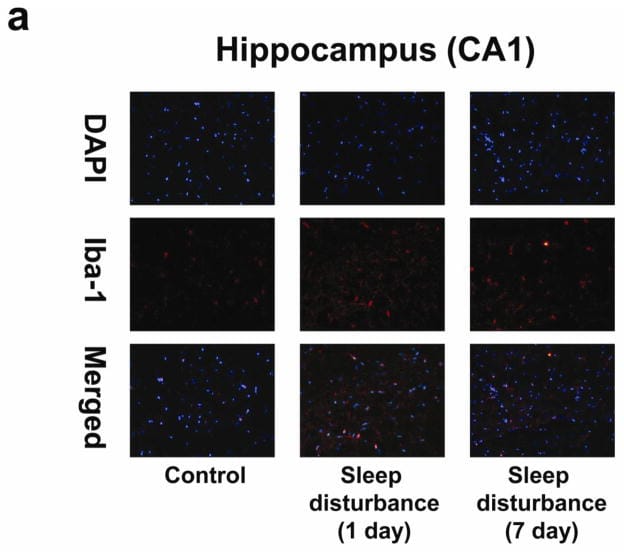
Once microglia activate, the regional pattern matters. Zhu et al. (2012) found that 24 hours of sleep disturbance in mice elevated IL-6 and activated microglia (measured by Iba-1 staining) in the hippocampal CA1 and CA3 regions – the areas responsible for memory encoding. The cortex showed no comparable activation. The hippocampus bore the inflammatory burden, and hippocampus-dependent contextual memory was impaired while other memory types were not.
What Is Brain Fog and Is It Caused by Inflammation?
The experience is familiar to anyone who has slept poorly for several consecutive nights: words are harder to retrieve, reading comprehension drops, and routine decisions require disproportionate effort. This can feel different from ordinary tiredness, which often improves with a nap or a full night of rest. Inflammation-driven cognitive impairment may persist when inflammatory signaling remains elevated, because neuroimmune activity can continue affecting neural circuits involved in attention and memory.
You et al. (2024) examined this relationship at population scale using NHANES data from 2011-2014 (n = 2,641; mean age 69.58 years). Participants with severe short sleep – under six hours per night – showed lower cognitive function scores across multiple domains. Independently, a higher immune-inflammation index (SII) was associated with worse cognitive performance. The inflammatory burden and the sleep restriction each were associated with cognitive decline, and both were present simultaneously in short sleepers.
The same study included single-cell transcriptomics in mice. Sleep deprivation activated inflammatory and oxidative stress pathways predominantly in GABAergic neurons – the neurons responsible for inhibitory control and cognitive regulation. The enriched pathways overlapped with those seen in Alzheimer’s disease and Huntington’s disease models.
Ballesio et al. (2026) provided the quantitative human evidence for the inflammation itself. Across controlled experimental studies, chronic partial sleep deprivation produced a measurable IL-6 increase (effect size 0.42). IL-6 can participate in brain-immune communication, and Zhu et al. (2012) showed that sleep disturbance can produce hippocampal IL-6 elevation and microglial activation in mice. The convergence supports a plausible pathway: repeated sleep restriction raises inflammatory signaling, and inflammatory signaling can affect the neural systems that support memory, attention, and processing speed.
Ordinary sleepiness often improves with recovery sleep. Brain fog driven by ongoing inflammatory signaling may not fully resolve until the inflammatory load itself decreases, which can depend on whether upstream causes such as ongoing sleep restriction, gut inflammation, chronic stress, or metabolic imbalance are addressed.
Can Sleep Deprivation Cause Long-Term Brain Damage?
Under normal conditions, microglia serve a maintenance role. They monitor synapses, remove metabolic waste, and support the neural architecture that produces healthy sleep. But when microglial activation becomes chronic – sustained by weeks or months of poor sleep, ongoing inflammation, or chronic stress – microglia change their functional state.
Rabago-Monzon et al. (2025) reviewed how chronic stress promotes this transition. Sustained stress exposure pushes microglia into a pro-inflammatory phenotype – releasing cytokines that both fragment sleep and impair glymphatic clearance (the brain’s waste-drainage process that runs during deep sleep). The result is a compounding loop: pro-inflammatory microglia can fragment sleep, fragmented sleep can reduce glymphatic waste removal, accumulated waste may perpetuate microglial activation, and the cycle continues.
Bellesi et al. (2017) demonstrated in mice that sleep loss increases astrocytic phagocytosis of synaptic components – astrocytes (the other major glial cell type in the brain) begin consuming parts of synapses at higher rates after sleep deprivation. In parallel, microglial activation increased after chronic sleep restriction. When this process continues over extended periods, it targets presynaptic components, especially at large synapses, and may interfere with synaptic maintenance in networks that support restorative sleep.
This glial stress response can create a forward-feed sequence. Neuroinflammation fragments deep sleep. Fragmented deep sleep reduces glymphatic clearance. Reduced clearance allows inflammatory proteins, amyloid-beta, and metabolic waste to accumulate. Accumulation sustains microglial activation. Activated glial responses can alter synaptic maintenance, which may further destabilize the neural conditions that support consolidated deep sleep.
The Zhu et al. (2012) data showed that microglial activation in the hippocampus persisted at 7 days post-disturbance, even after normal sleep was restored – the brain’s immune response outlasts the sleep disruption that triggered it. But microglial activation may be responsive to sustained improvements in sleep continuity and inflammatory load. Reducing ongoing inflammatory inputs and allowing consolidated sleep to resume may help shift glial activity back toward a more homeostatic state.
Does Deep Sleep Repair Brain Inflammation?
During consolidated NREM sleep, interstitial space in the brain expands by approximately 60%, allowing cerebrospinal fluid to flow through brain tissue and carry waste products toward the lymphatic drainage routes. This glymphatic process is the brain’s primary clearance mechanism for metabolic byproducts, including amyloid-beta, that accumulate during waking hours.
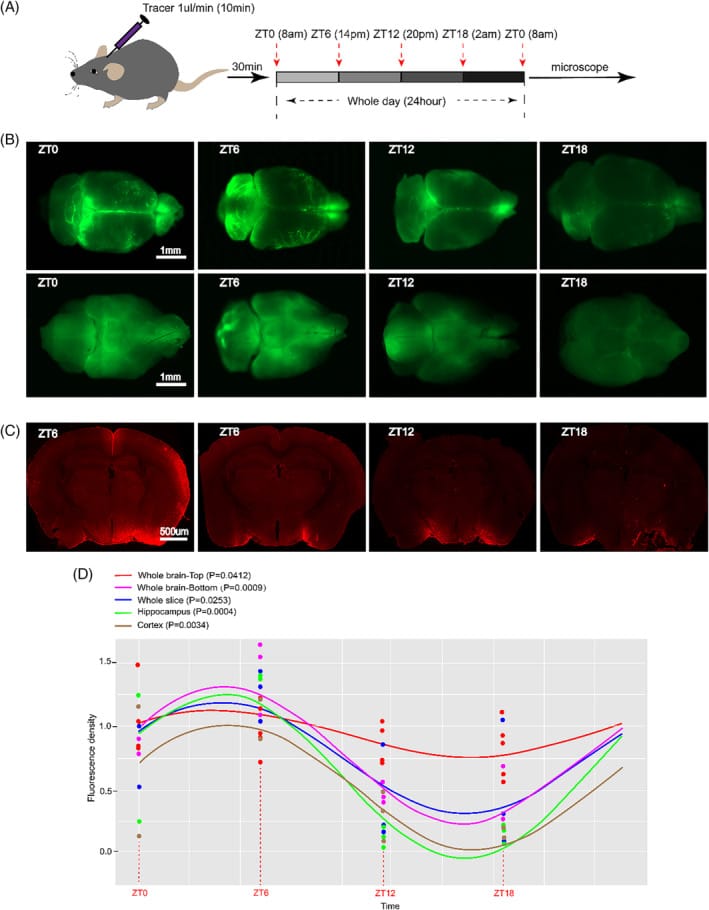
Yang et al. (2024) demonstrated that microglial function follows a circadian pattern that synchronizes with glymphatic activity. During the sleep-dominant phase, microglia show changes in morphology and function that synchronize with glymphatic activity. This relationship appears tied to circadian and sleep-wake timing rather than a simple passive state shift. When sleep is fragmented and normal sleep-linked rhythms are disrupted, glymphatic and glial regulation may run less efficiently.
The bidirectional relationship between neuroinflammation and deep sleep becomes visible here. Neuroinflammation can fragment deep sleep. Fragmented deep sleep can interfere with normal sleep-linked glial and glymphatic rhythms. Microglia may remain more inflammatory or less homeostatic. The glymphatic process, which depends on consolidated sleep and glial cooperation, runs at reduced capacity. Inflammatory proteins that would normally be cleared may accumulate. The accumulation can sustain the neuroinflammation that fragmented deep sleep in the first place.
The same relationship also runs in the recovery direction. Improving deep sleep quality – through reducing inflammatory load and stabilizing sleep continuity – may support recovery. As sleep becomes more consolidated, glymphatic clearance can improve, glial activity may shift toward more homeostatic patterns, and the inflammatory load may decrease. With less inflammatory pressure, sleep may fragment less the following night.
Neuroinflammation might be one piece of what is fragmenting your sleep – but it rarely acts alone. It might be compounding with autonomic dysregulation, metabolic factors like blood sugar instability, hormonal changes, or circadian disruption. Identifying which causes might be active in your specific pattern is a useful next step before addressing any one of them.
Find out which causes might be driving your 3am wakeups ->
Frequently Asked Questions
Can Neuroinflammation Cause Sleep Problems?
The relationship is bidirectional. Sleep loss activates microglia in animal studies, and activated microglia can disrupt sleep. Zhu et al. (2012) showed that microglial activation concentrated in the hippocampus – a region involved in memory encoding. Rabago-Monzon et al. (2025) reviewed how pro-inflammatory microglial states impair glymphatic function, which depends on consolidated deep sleep to function. When microglia are chronically activated, the cytokines they release act on neural signaling systems that generate slow-wave oscillations, reducing both the depth and continuity of NREM sleep.
Is Brain Fog a Sign of Neuroinflammation?
Brain fog has multiple potential contributors: metabolic imbalance, hormonal changes, gut inflammation, and sleep deprivation itself. When neuroinflammation is involved, the pattern may persist even after a full night of sleep, because inflammatory signaling can continue affecting the neural systems involved in attention and memory. The You et al. (2024) NHANES data showed that inflammatory indices were associated with cognitive decline after adjustment for major covariates, supporting this distinction.
How Do You Reduce Neuroinflammation?
Consolidated slow-wave sleep supports sleep-linked glial rhythms and enables the glymphatic waste clearance that removes metabolic waste from brain tissue (Yang et al., 2024; Xie et al., 2013). Improving sleep continuity – reducing awakenings, increasing time in sustained deep sleep – gives the brain the conditions it needs to begin resolving the inflammation.
The other direction is addressing upstream inflammatory sources: gut permeability can contribute to systemic inflammatory signaling that may affect neuroimmune pathways, chronic stress maintains elevated cortisol and NF-kB activation, and metabolic imbalance (insulin resistance, elevated blood glucose) contributes its own inflammatory load. Each of these feeds the neuroinflammatory cycle from outside the brain.
What Is Microglial Activation and How Does It Affect Sleep?
In their surveillance (homeostatic) state, microglia monitor neural activity, support synaptic maintenance, and cooperate with glymphatic drainage during deep sleep. In their activated (pro-inflammatory) state – triggered by sleep deprivation, peripheral inflammation, or accumulated metabolic waste – they release IL-6, TNF-alpha, and IL-1beta into neural environments that influence sleep regulation, reducing the brain’s ability to generate and sustain slow-wave oscillations. Hu et al. (2024) showed that the activation trigger in rats involves mitochondrial damage within microglia: oxidized mtDNA leaks into the cytoplasm and activates NF-kB. The activation is not an on-off switch – it appears related to accumulated cellular stress rather than a simple on-off event.
Related Reading
- Inflammatory Sleep Disruption — the cause overview for cytokines, histamine, gut inflammation, neuroinflammation, and circadian immune timing
- How Does Leaky Gut Affect Sleep? — how gut permeability and LPS signaling can contribute to sleep fragmentation
- Gut Bacteria and Insomnia — which microbial pathways and metabolites are linked with sleep
- How Does the Glymphatic System Work During Sleep? — how brain waste clearance depends on sleep depth and continuity
- What Is the Connection Between Chronic Inflammation and Insomnia? — how cytokines, sleep loss, and arousal can form a repeating loop
References
1. Ballesio, A., Fiori, V., & Lombardo, C. (2026). Effects of experimental sleep deprivation on peripheral inflammation: An updated meta-analysis of human studies. Journal of Sleep Research, 35(1), e70099. https://pubmed.ncbi.nlm.nih.gov/40474574/
2. Bellesi, M., de Vivo, L., Chini, M., Gilli, F., Tononi, G., & Cirelli, C. (2017). Sleep loss promotes astrocytic phagocytosis and microglial activation in mouse cerebral cortex. Journal of Neuroscience, 37(21), 5263-5273. https://pubmed.ncbi.nlm.nih.gov/28539349/
3. Haack, M., Sanchez, E., & Mullington, J. M. (2007). Elevated inflammatory markers in response to prolonged sleep restriction are associated with increased pain experience in healthy volunteers. Sleep, 30(9), 1145-1152. https://pubmed.ncbi.nlm.nih.gov/17910386/
4. Hu, Y., Wang, Y., Wang, Y., Zhang, Y., Wang, Z., Xu, X., Zhang, T., Zhang, T., Zhang, S., Hu, R., Shi, L., Wang, X., Li, J., Shen, H., Liu, J., Noda, M., Peng, Y., & Long, J. (2024). Sleep deprivation triggers mitochondrial DNA release in microglia to induce neural inflammation: Preventative effect of hydroxytyrosol butyrate. Antioxidants, 13(7), 833. https://pubmed.ncbi.nlm.nih.gov/39061901/
5. Irwin, M. R., Olmstead, R., & Carroll, J. E. (2016). Sleep disturbance, sleep duration, and inflammation: A systematic review and meta-analysis of cohort studies and experimental sleep deprivation. Biological Psychiatry, 80(1), 40-52. https://pubmed.ncbi.nlm.nih.gov/26140821/
6. Irwin, M. R., Wang, M., Ribeiro, D., Cho, H. J., Olmstead, R., Breen, E. C., Martinez-Maza, O., & Cole, S. (2008). Sleep loss activates cellular inflammatory signaling. Biological Psychiatry, 64(6), 538-540. https://pubmed.ncbi.nlm.nih.gov/18561896/
7. Rabago-Monzon, A. R., Osuna-Ramos, J. F., Armienta-Rojas, D. A., Camberos-Barraza, J., Camacho-Zamora, A., Magana-Gomez, J. A., & De la Herran-Arita, A. K. (2025). Stress-induced sleep dysregulation: The roles of astrocytes and microglia in neurodegenerative and psychiatric disorders. Biomedicines, 13(5), 1121. https://pubmed.ncbi.nlm.nih.gov/40426947/
8. Yang, T., Tang, Y., Liu, X., Gong, S., & Yao, E. (2024). Microglia synchronizes with the circadian rhythm of the glymphatic system and modulates glymphatic system function. IUBMB Life, 76(12), 1209-1222. https://pubmed.ncbi.nlm.nih.gov/39223969/
9. You, Y., Li, J., Zhang, Y., Li, X., Li, X., & Ma, X. (2024). Exploring the potential relationship between short sleep risks and cognitive function from the perspective of inflammatory biomarkers and cellular pathways: Insights from population-based and mice studies. CNS Neuroscience & Therapeutics, 30(5), e14783. https://pubmed.ncbi.nlm.nih.gov/38797980/
10. Zhu, B., Dong, Y., Xu, Z., Gompf, H. S., Ward, S. A. P., Xue, Z., Miao, C., Zhang, Y., Chamberlin, N. L., & Xie, Z. (2012). Sleep disturbance induces neuroinflammation and impairment of learning and memory. Neurobiology of Disease, 48(3), 348-355. https://pubmed.ncbi.nlm.nih.gov/22776332/
11. Xie, L., Kang, H., Xu, Q., Chen, M. J., Liao, Y., Thiyagarajan, M., O’Donnell, J., Christensen, D. J., Nicholson, C., Iliff, J. J., Takano, T., Deane, R., & Nedergaard, M. (2013). Sleep drives metabolite clearance from the adult brain. Science, 342(6156), 373-377. https://pubmed.ncbi.nlm.nih.gov/24136970/
Written by Kat Fu, M.S., M.S. ? Last reviewed: January 23, 2026 ? 11 references cited