
Poor Sleep Is a Symptom: Why one solution doesn’t fit all sleep issues
A few days ago, I invited you to consider a different perspective on sleep.
The idea is this is: Poor sleep is not the problem you need to solve. Poor sleep is a symptom.
Today, I want to expand on that idea and show you why reframing the problem of sleep is the first step in the Vault 5-Part Sleep Clarity Series—and the foundation for lasting sleep improvement.
Let’s get started.
A Different Mental Model That Makes Sleep Easier to Understand (& Easier to Fix)
Sleep is notoriously difficult to conceptualize.
Unlike a strained muscle or injured joint—structures you can visualize and often feel—sleep is a brain state created by chemical & neural signals transmitted between brain regions and affected by signals happening in the rest of the body.
You can’t feel melatonin being synthesized in your pineal gland. You can’t sense GABA receptor activation. You can’t detect the shift in your suprachiasmatic nucleus signaling in response to light. You can’t see this happening on an ultrasound the same way you can see a joint issue.
Yet, these processes build and sustain sleep in ways similar to how structural support maintains spinal stability. But because they’re “invisible” in our day-to-day experience, we tend to default to addressing what we can observe: the symptom of disrupted sleep itself.
This is where a mental comparison with back pain becomes valuable.
It provides a visual model for an otherwise invisible system.
The Back Pain Parallel: Why One Solution Doesn’t Fit All Back Pain (or Sleep Issues)
Lower back pain is a symptom. It can arise from multiple different causes:
- Herniated disc compressing nerve roots
- Muscle strain from repetitive loading
- SI joint dysfunction creating instability
- Hip misalignment transferring stress to the lumbar spine
The cause is important to know because:
Stretching protocols that resolve muscle strain can worsen a herniated disc. Physical therapy for disc compression looks different from stabilization work for SI joint issues. And, gait retraining for hip misalignment will not do anything for a muscle strain.
Applying the wrong approach, at best, does nothing. At worst, it can exacerbate the problem or create new problems.
The same principle applies to sleep.
The 2-PHASE Solution (& Why This Also Matters for Sleep)
Resolving back pain typically involves 2 phases:
- Addressing the pain itself (managing acute symptoms)
- Identifying and correcting the underlying source (restoring stability)
Here’s where the back pain analogy becomes even more helpful:
When you’re working on back pain, a physical therapist can tell you which phase you’re in. They can show you whether a specific exercise is managing symptoms or correcting the structural source.
With sleep, this clarity almost never exists. We’re left to figure it out ourselves.
So we keep trying what we can—new supplements, better mattresses, meditation apps, cooler rooms.
But here’s the question we haven’t been given the tools to answer:
Which phase are these approaches actually addressing?
In Part 2 of The Vault 5-Part Sleep Clarity Series, I’ll show you the framework that answers this question.
You’ll be able to see which category your strategies fall into—and understand why this difference often determines whether a strategy produces “somewhat better” or “sometimes helpful” outcomes VS. consistent restoration.
P.S. The Vault 5-Part Sleep Clarity Series is built from the sleep questions I get most often. I’m putting the final touches on Part 5 today. If there’s something you’d like me to consider while I’m wrapping it up, you can tell me here.
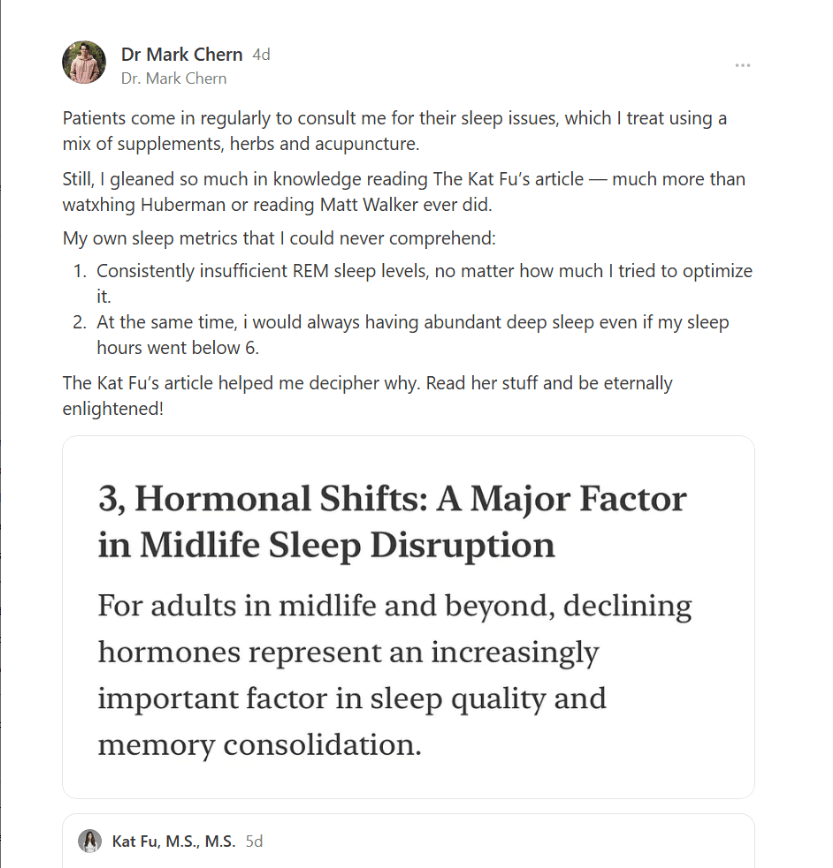
P.P.S. A physician who treats sleep recently shared this reflection—I wanted to pass it along because it shows how universal these sleep challenges can be—even for those who work with them every day.
Upgrade for personalized roadmaps—systematic implementation frameworks you can personalize to your specific biomarkers and risk factors.