
High cholesterol despite healthy diet: how to lower ApoB naturally so you can protect arteries, brain, and colon health before or alongside a statin decision.
The Cholesterol-Handling Strategy Many Healthy Individuals Haven’t Utilized
Conventional heart health optimization centers around lipid management and saturated fat restriction.
While foundational, this approach overlooks how gut bacteria function as a metabolic control center—directly regulating cholesterol synthesis, inflammatory responses, and cardiovascular disease risk.
The emerging research reveals a more sophisticated relationship: our microbiome regulates heart and brain health, not merely a digestive assistant.
But, this approach misses a central factor: diversity.
Different fiber sources feed distinct bacterial populations that regulate different aspects of health.
The Challenge We Face: high ApoB despite healthy lifestyle
For many health-conscious adults with LDL-C or ApoB higher than they want, one central challenge is is an underused gut-based route: microbiome-driven cholesterol handling—the way gut microbes and bile acids influence how much cholesterol is cleared vs. recycled over time:
- When gut communities are dominated by longevity-supporting microbes, more cholesterol tends to be pulled out of circulation and less is recycled, partly through how these microbes modify bile acids, the body’s main cholesterol exit route.
- When inflammatory-leaning microbes dominate, LDL-C and ApoB can stay higher than expected despite strong habits.
This is where fiber still matters—but in a more specific way than “just get more.”
Average fiber intake hovers around 15 grams daily, and the bigger issue is not only quantity; it is the narrow range of fiber types that determines which microbial groups are able to flourish.
Many adults add a supplement such as psyllium or lean on one or two familiar plant foods, without realizing that different fiber structures feed different microbes and therefore different cholesterol-handling patterns.
When this substrate pattern stays narrow, we are effectively asking the microbiome to improve cholesterol handling with a limited toolkit.
The result is a microbial pattern that cannot provide the full spectrum of cardiometabolic and brain-protective outputs that support healthy aging, even when exercise, body composition, and basic nutrition are already in good shape.
Related article: “My LDL-C is 186—I eat whole foods & exercise: what else is left to do?”
Related article: The LDL-C Risk Healthy Eaters Overlook: Longevity-Supporting Microbes vs. Inflammatory Microbes for Cardiovascular & Brain Health Protection
What The 5-Phase Gut-LDL-C Blueprint for Lower Cholesterol + Reduced Cardiovascular Risk Delivers: how to lower ApoB naturally
A framework that helps you with phased changes in your daily fiber pattern to improve microbiome-driven cholesterol handling and cultivate diverse bacterial populations with longevity benefits—making the changes automatic rather than complex.
- Progression Plan: Step-by-step implementation guide that builds bacterial diversity progressively while ensuring digestive adaptation.
- Bacterial Population Engineering: Evidence based Framework for cultivating specific bacterial strains linked with longevity benefits.
- Effortless Approach: Strategic approach that helps you move beyond the common ~15-gram baseline into a higher, more protective fiber pattern—without supplements, tracking, or calculating grams.
Who This Blueprint Is For: Those With high cholesterol despite healthy diet
- Adults 50+ who understand that microbiome composition is modifiable and want to deliberately leverage it for cardiovascular and cognitive protection.
- Those looking to cultivate bacterial populations that actively support optimal cholesterol levels, reduce inflammation, and provide long-term disease prevention—especially when they have already addressed diet and exercise and are considering what remains before or alongside a statin discussion.
- Health-conscious individuals who want evidence-based approaches that make meaningful improvements effortless rather than relying on supplementation or broad, unspecific plant-based recommendations.
You shouldn’t have to feel like your only option is extreme restriction to get cardiovascular risk down; with The 5-Phase Gut-LDL-C Blueprint, you won’t.
You can access The 5-Phase Gut-LDL-C Blueprint for Lower Cholesterol + Reduced Cardiovascular here:
It gives you the same structured gut–bile–LDL approach I would normally work through across multiple sessions, but in a format you can implement at your own pace.
You shouldn’t have to treat statins as the only “serious” next step when lifestyle hasn’t moved your numbers; with The 5-Phase Gut-LDL-C Blueprint, you won’t.
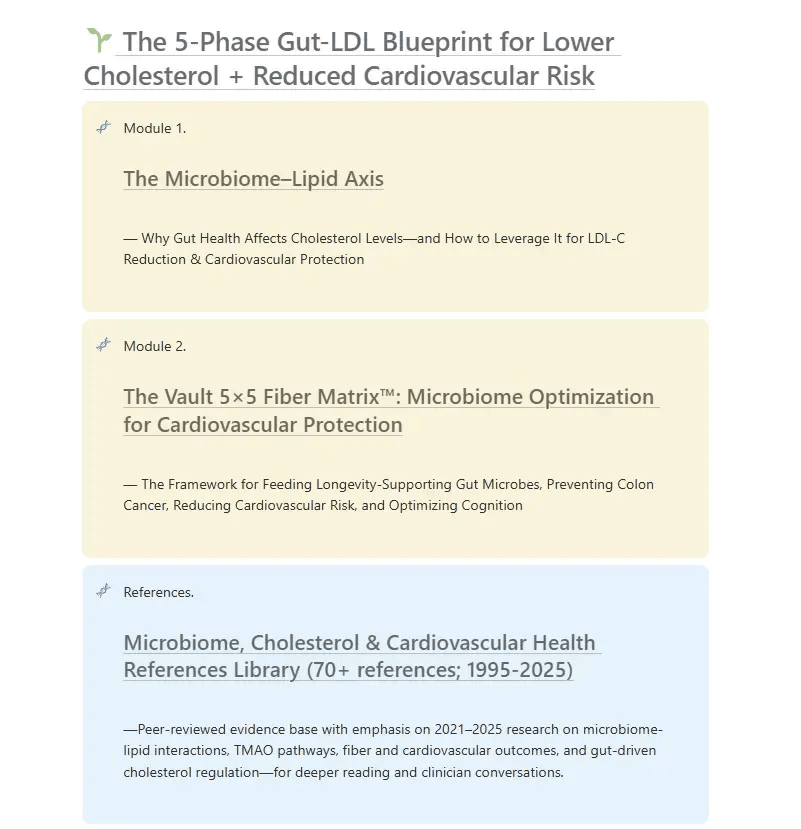
This is accessed through a private link to the Dashboard (shown below) you receive, so you’re getting a structured & live digital resource—not a static PDF file:
All my digital solutions are updated regularly: The 5-Phase Gut-LDL-C Blueprint (based on 70+ peer reviewed articles) was just updated to incorporate the latest data on longevity-promoting microbes and how to support them. All existing owners and Vault Insiders automatically have access to the new edition, and that access remains active even as new editions are released at higher investment levels.

References
- Strong JP et al. Prevalence and extent of atherosclerosis in adolescents and young adults: implications for prevention from the Pathobiological Determinants of Atherosclerosis in Youth Study. JAMA. 1999 Feb 24;281(8):727-35.
- Díaz Perdigones CM et al. Taxonomic and functional characteristics of the gut microbiota in obesity: a systematic review. Endocrinol Diabetes Nutr (Engl Ed). 2025 Nov;72(9):501624.
- Singh P et al. Implications of the gut microbiome in cardiovascular diseases: association of gut microbiome with cardiovascular diseases, therapeutic interventions and multi-omics approach for precision medicine. Medical Microbiology. 2023.
- Wu L et al. Gut microbiota as an antioxidant system in centenarians associated with high antioxidant activities of gut-resident Lactobacillus. npj Biofilms Microbiomes. 2022;8:102.
- Benjamin EJ et al. Heart disease and stroke statistics—2018 update: a report from the American Heart Association. Circulation. 2018;137(12):e67-e492.
- Cui X et al. Metagenomic and metabolomic analyses unveil dysbiosis of gut microbiota in chronic heart failure patients. Sci Rep. 2018 Jan 12;8(1):635.
- Wang Z et al. Non-lethal inhibition of gut microbial trimethylamine production for the treatment of atherosclerosis. Cell. 2015 Dec 17;163(7):1585-95.
- Poland JC et al. Bile acids, their receptors, and the gut microbiota. Physiology (Bethesda). 2021 Jul 1;36(4):235-245.
- Razavi AC et al. High-density lipoprotein cholesterol in atherosclerotic cardiovascular disease risk assessment: exploring and explaining the U-shaped curve. Curr Cardiol Rep. 2023 Dec;25(12):1725-1733.
- Zhou Z et al. Low-density-lipoprotein cholesterol and mortality outcomes among healthy older adults: a post hoc analysis of ASPREE trial. J Gerontol A Biol Sci Med Sci. 2024 Apr 1;79(4):glad268.
- De Oliveira-Gomes D et al. Apolipoprotein B: bridging the gap between evidence and clinical practice. Circulation. 2024 Jul 2;150(1):62-79.
- Ghavami A et al. Soluble fiber supplementation and serum lipid profile: a systematic review and dose-response meta-analysis of randomized controlled trials. Adv Nutr. 2023 May;14(3):465-474.
- Dahl WJ et al. Position of the Academy of Nutrition and Dietetics: health implications of dietary fiber. J Acad Nutr Diet. 2015 Nov;115(11):1861-70.
- Svilaas T et al. High levels of lipoprotein(a) – assessment and treatment. Tidsskr Nor Laegeforen. 2022 Dec 16;142(1).
- Gaba P et al. Association between achieved low-density lipoprotein cholesterol levels and long-term cardiovascular and safety outcomes: an analysis of FOURIER-OLE. Circulation. 2023 Apr 18;147(16):1192-1203.
- Grundy SM et al. 2018 AHA/ACC/AACVPR/AAPA/ABC/ACPM/ADA/AGS/APhA/ASPC/NLA/PCNA guideline on the management of blood cholesterol: executive summary. J Am Coll Cardiol. 2019 Jun 25;73(24):3168-3209.
- Cholesterol Treatment Trialists’ (CTT) Collaboration et al. Efficacy and safety of more intensive lowering of LDL cholesterol: a meta-analysis of data from 170,000 participants in 26 randomised trials. Lancet. 2010 Nov 13;376(9753):1670-81.
- Ference BA et al. Effect of long-term exposure to lower low-density lipoprotein cholesterol beginning early in life on the risk of coronary heart disease: a Mendelian randomization analysis. J Am Coll Cardiol. 2012 Dec 25;60(25):2631-9.
- Sabatine MS et al. Evolocumab and clinical outcomes in patients with cardiovascular disease. N Engl J Med. 2017 May 4;376(18):1713-1722.
- Schwartz GG et al. Alirocumab and cardiovascular outcomes after acute coronary syndrome. N Engl J Med. 2018 Nov 29;379(22):2097-2107.
- Zhou Z et al. Low-density-lipoprotein cholesterol and mortality outcomes among healthy older adults: a post hoc analysis of ASPREE trial. J Gerontol A Biol Sci Med Sci. 2024 Apr 1;79(4):glad268.
- Chwal BC et al. On-target low-density lipoprotein cholesterol in adults with diabetes not at high cardiovascular disease risk predicts greater mortality, independent of early deaths or frailty. J Clin Med. 2024 Dec 16;13(24):7667.
- Madsen CM et al. Extreme high high-density lipoprotein cholesterol is paradoxically associated with high mortality in men and women: two prospective cohort studies. Eur Heart J. 2017 Aug 21;38(32):2478-2486.
- Jacobson TA et al. National Lipid Association recommendations for patient-centered management of dyslipidemia: Part 2. J Clin Lipidol. 2015 Nov–Dec;9(6 Suppl):S1-122.e1.
- Gidding SS et al. Pathobiological Determinants of Atherosclerosis in Youth (PDAY) Risk Score in young adults predicts coronary artery and abdominal aorta calcium in middle age: the CARDIA Study. Circulation. 2016 Jan 12;133(2):139-46.
- Sniderman AD et al. Apolipoprotein B particles and cardiovascular disease: a narrative review. JAMA Cardiol. 2019 Dec 1;4(12):1287-1295.
- Giugliano RP, et ak; FOURIER Investigators. Clinical efficacy and safety of achieving very low LDL-cholesterol concentrations with the PCSK9 inhibitor evolocumab: a prespecified secondary analysis of the FOURIER trial. Lancet. 2017 Oct 28;390(10106):1962-1971.