
Most kidney stone prevention advice stops at two things: drink more water and avoid high-oxalate foods. That addresses only part of the problem. Of all urinary oxalate in typical diets, 60-80% is produced endogenously by the liver—not absorbed from food—which means dietary changes alone leave the dominant source untouched.
- 70-80% of kidney stones are calcium oxalate, making oxalate management central to prevention
- Only 20-40% of urinary oxalate comes from food; the remaining 60-80% is produced inside the body by the liver, regardless of diet
- A 2024 study of 426,000 healthy adults found higher urinary oxalate linked with higher long-term risk of chronic kidney disease—even in individuals who never formed a stone, after adjusting for diet and urine volume
- Small calcium oxalate crystals can irritate kidney structures and trigger low-grade inflammation that contributes to kidney function decline without ever becoming a painful stone
- Genetic predisposition shapes baseline risk but doesn’t determine outcome; managing oxalate load and kidney stress over time still affects what happens
A lot of Longevity Vault members have asked me over the years:
“If I just drink more water and avoid spinach, am I safe from kidney stones?”
Or: “Kidney stones run in my family—does that mean I’m stuck with them?”
Short answer: those things matter. Longer answer: they only touch a small part of the problem.
Most kidney stones—70-80%—are calcium oxalate.
So if you’re thinking about prevention, oxalate is the main variable.
That sets up the more useful question: Is “water + avoiding high-oxalate foods” enough to manage oxalate?
It isn’t—and the main reason is that a large share of oxalate doesn’t come from food.
In typical diets, only 20-40% of urinary oxalate is dietary. The remaining 60-80% is produced within the body (’endogenously’) by your liver from precursors unrelated to oxalate-containing foods.
That’s why some people who rarely eat high-oxalate foods still develop kidney stones, while some with higher-oxalate diets don’t.
It’s simply not the dominant factor.

Genetics are only part of the story.
Some families do have higher baseline risk. There are individuals who are more prone to form stones and individuals who are less prone.
But genetic predisposition doesn’t mean inevitability, and not having a family history doesn’t mean your kidneys are immune to the effects of subclinical oxalate impacts.
How you manage oxalate load and kidney stress over time still shapes the outcome.
Kidney Stones: What else is happening inside your kidneys?
A 2024 study of 426,000 healthy adults found higher urinary oxalate is linked with higher long-term risk of chronic kidney disease (CKD)—in individuals who never formed stones—even after adjusting for diet, urine volume, and comorbidities. In addition, even small calcium oxalate crystals can irritate the structures inside the kidney and trigger low-grade inflammation that contributes to kidney function decline without becoming a painful kidney stone.
So it’s not just about preventing another stone. It’s about the reducing subclinical kidney micro-injury accumulating in the background.
Earlier this week, I walked through how—even without kidney stones—oxalates injure kidney tissue and accelerate kidney aging, and what that means for a smarter prevention approach.
If you missed it, you can read it here: Do Oxalates Matter If You’ve Never Had Kidney Stones?
’Warmly.
—Kat
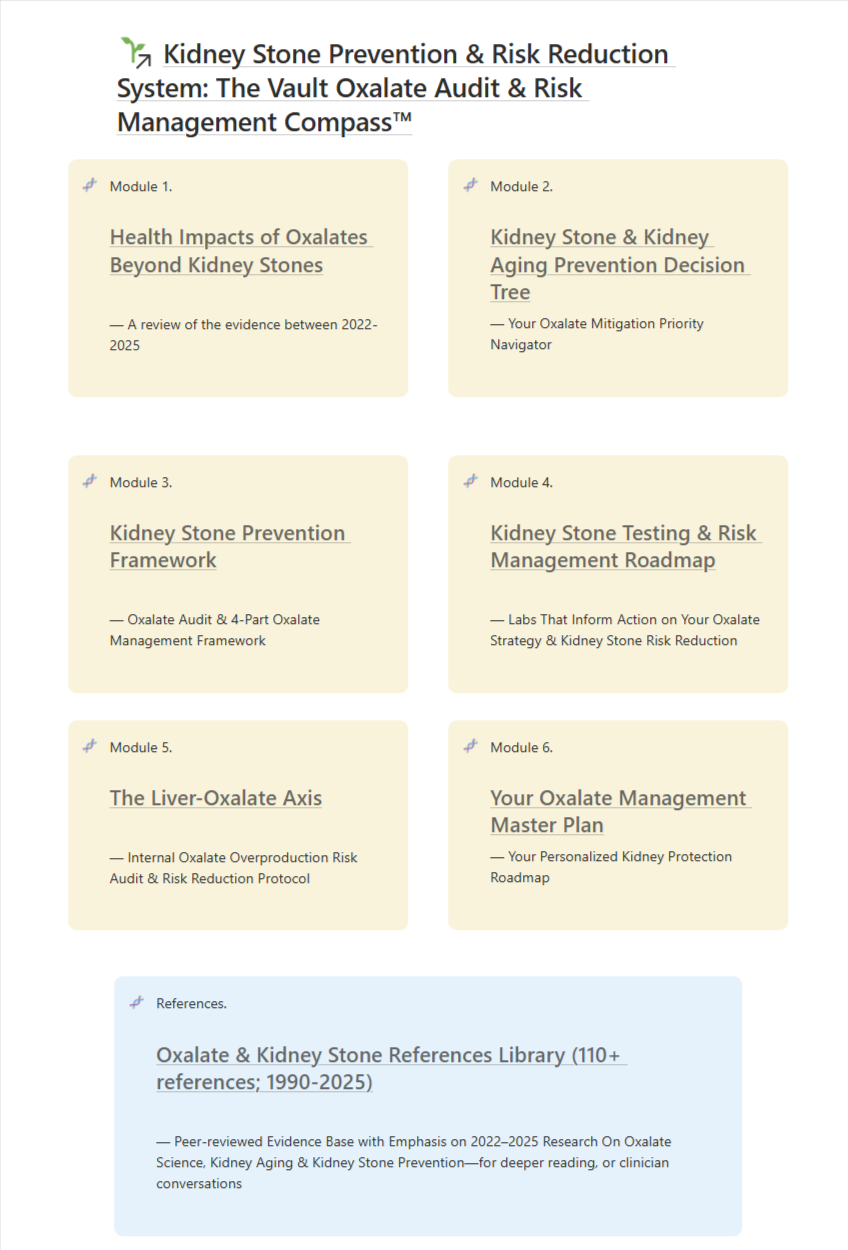
P.S. If you’ve read it and want help mapping which risk factors apply to you—and turning that into your personalized strategy—my Kidney Stone Prevention & Risk Reduction System: The Vault Oxalate Audit & Risk Management Compass was built to help you:
- map your external load, internal production, absorption and urine chemistry (beyond drinking water)
- turn that pattern into a step-by-step strategy so you can reduce both risk of stone recurrence & long-term kidney stress
Reduce your kidney stone risk & protect kidney function longevity here:
(Subscriber-only early access: $137 $77 through 11:59PM ET tonight (12/6); after that, it will be $137. Many of you mentioned missing the Sleep OS early access window—this is the equivalent for the Kidney Stone System.)
Frequently Asked Questions
Why do I keep getting kidney stones even though I drink a lot of water and avoid high-oxalate foods?
In typical diets, only 20-40% of urinary oxalate comes from food. The remaining 60-80% is produced endogenously by the liver from precursors unrelated to oxalate-containing foods. Drinking more water and lowering dietary oxalate leave that internal production route unaddressed, which is part of why those two steps can reduce but often don’t eliminate risk.
Does a family history of kidney stones mean I’ll develop them too?
Genetic predisposition shapes baseline risk but doesn’t determine outcome. Some families do carry higher baseline risk, and managing oxalate load and kidney stress over time still shapes what happens — even for people who carry that predisposition. Not having a family history also doesn’t mean kidneys are protected from subclinical oxalate effects.
Can calcium oxalate crystals injure the kidneys even if they never cause a painful stone?
A 2024 study of 426,000 healthy adults found higher urinary oxalate linked with higher long-term risk of chronic kidney disease — in individuals who never formed a stone — even after adjusting for diet, urine volume, and comorbidities. Small calcium oxalate crystals can irritate kidney structures and trigger low-grade inflammation that contributes to kidney function decline without producing the pain of a full stone.
If the liver produces 60-80% of urinary oxalate regardless of diet, does food choice still factor into stone prevention?
Dietary oxalate accounts for 20-40% of urinary oxalate in typical diets, so food choice contributes to the overall load. But it leaves endogenous liver production — the larger contributor — unaddressed. That’s part of why some people with lower-oxalate diets still form stones, while others with higher dietary oxalate intake don’t.