
Lab reference ranges are designed to catch established disease—not to flag the early biological shifts that matter most for longevity. When results fall within the “normal” range, no follow-up is triggered, even when values have drifted meaningfully from a person’s own baseline.
- Population thresholds vs. individual trajectories: Current lab ranges prioritize identifying pathology like diabetes or anemia. If those ranges were tightened to reflect where research shows risk begins, the resulting follow-up workload would overwhelm available resources.
- No structured guidance for borderline values: Even when a physician recognizes a concerning pattern—such as fasting insulin doubling from 6 to 12 μIU/mL while remaining “in range”—standard guidelines and reimbursement structures offer no defined next step.
- hsCRP as a practical example: An hsCRP of 2.0 mg/L may pass standard review, but from a longevity lens it reflects elevated inflammatory load. Sleep quality, dietary patterns, body composition, and environmental exposures all influence this marker.
- Personal baselines reveal what population ranges hide: A fourfold increase from your own historical value carries different meaning than a single snapshot compared to a broad reference range.
- Multi-marker drift matters: hsCRP paired with rising fasting glucose or triglycerides points to broader metabolic strain rather than a transient fluctuation.
Reading your existing bloodwork as a trajectory—not a pass/fail verdict—is where personal agency begins.
why doctors miss early aging: If We Rely on “Normal” Lab Ranges, We’ll Miss the First Signs of Decline.
I still go to my GP.
She’s diligent, kind, and always booked solid—20‑minute appointments stacked one after another, often with patients waiting because she never rushes anyone.
Watching her juggle those demands shows that the challenge isn’t a lack of care from doctors, but the structure they’re working inside.
The healthcare system was built to protect populations from disease, not to guide individuals toward longevity.
In that role, it does what it’s designed to do.
But if your goal is to stay ahead of aging, the very design that keeps the system functional also creates limitations.
This is the lens we need to adopt.
Respect the system for what it does well, but recognize that longevity requires a different way of reading the same information—for example, the bloodwork you already get in routine care.
Section 2: Population Logic — Why Normal Ranges Weren’t Built for You and Me
If every subtle shift in lab results were flagged, the healthcare system would seize up.
Current thresholds are set primarily to identify clear pathology—conditions like diabetes, kidney dysfunction, advanced liver damage, anemia, or active infection—rather than to detect early risk.
The priority is ensuring that disease is recognized and managed efficiently within available resources.
Right now, a sub-fraction of routine laboratory results are indicated for follow‑up.
If ranges were tightened to reflect where research shows risk begins, the proportion of abnormal results would rise dramatically. That could mean a majority of patients requiring some form of follow‑up.
Each flagged result triggers a cascade of work:
- physician review,
- patient communication & appointment scheduling,
- consideration of further testing,
- documentation & insurance authorization.
Multiply this across millions of test results per day, and the burden quickly surpasses available time and resources.
This does not reflect indifference by physicians.
Rather, it highlights a structural reality: if high‑normal results were indicated as risks, the resulting workload would overwhelm the system.
For individuals pursuing longevity, however, this reality means that early declines often remain outside the scope of what the conventional healthcare system will detect or can act upon.
Section 3: The Protocol Gap — Why Borderline Normal Has No Playbook
Even when physicians recognize concerning patterns in borderline-normal values, the conventional healthcare system provides no structured guidance for interpretation or response.
Guidelines and reimbursement structures are built on binary logic: abnormal values trigger defined diagnostic pathways, while results within the reference range requires no action.
This framework leaves little to no space for the nuanced middle ground where the most actionable health decline occurs.
Consider a physician reviewing results where fasting insulin measures 12 μIU/mL—elevated from the patient’s historical baseline of 6 μIU/mL, but still within the laboratory’s reference range of 2–25 μIU/mL.
The physician probably recognizes this pattern as possible early insulin resistance. Yet clinical guidelines provide no standardized protocol for this scenario.
- Insurance systems don’t cover follow-up testing for “normal” results.
- There is no established timeframe for reassessment, no clear intervention threshold, and no reimbursement pathway for preventive management.
The likely outcome is clinical limbo: documentation and deferral until values cross the abnormal threshold.

When high-normal values consistently receive no clinical attention, they become psychologically invisible in practice. The cognitive pattern of “normal = no action” becomes ingrained. Over time, this absence of pathways creates a form of institutional “blindness,” where gradual biological shifts remain unaddressed.
The reinforcement runs deeper than individual practice:
- Medical education emphasizes pathology recognition over trajectory monitoring.
- Board examinations test knowledge of disease states, not prevention protocols.
- Continuing medical education mainly focuses on managing established conditions rather than intercepting early decline into possible disease.
The result is inertia.
From the individual’s perspective, this trade-off functions like implicit rationing.
For those like you and me, pursuing longevity, this is the practical reality we must work with.
Section 4: Where System Constraints End and Personal Agency Begins
The limits described above exist because the healthcare system must serve entire populations.
But we as individuals are not bound by those same constraints.
We don’t need to wait for values to cross diagnostic thresholds before paying attention.
By looking at personal baselines, research-informed ranges, and changes that persist over time, it’s possible for us to see meaningful signals long before the system is designed to act.
This perspective doesn’t replace medical care.
It simply emphasizes that longevity requires a different lens: one that interprets “normal” results as part of a trajectory, not a verdict.
So what does this look like in practice?
Section 5: Beyond Standard Labwork Interpretation — Why We Can’t Outsource Early Detection & What We Can Do Instead
As emphasized throughout, conventional medicine excels at diagnosing pathology, but it wasn’t built to guide optimal longevity trajectories.
Take high-sensitivity C-reactive protein (hsCRP) as an example.
On a standard lab report, results may only be flagged when levels are markedly elevated. Yet research shows meaningful cardiovascular and longevity risk emerge below those cutoffs.
Looking at hsCRP through a longevity lens reveals a different picture:
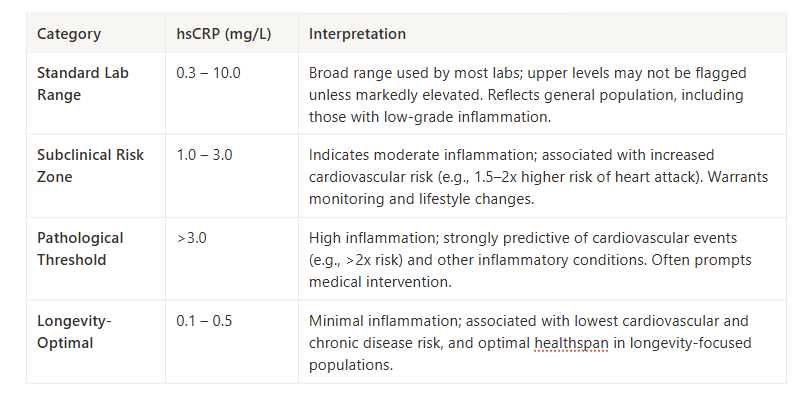
If your hsCRP comes back at 2.0 mg/L, your physician may tell you it’s fine—and within the system’s logic, it is.
But from a longevity perspective, it signals that your inflammatory load is already elevated compared to truly low-risk individuals.
Here’s the empowering shift: you don’t need to wait for values to cross into clinical abnormal ranges.
By considering research-based ranges, you can use hsCRP as an early cue to adjust the levers within your control:
- Sleep quality: Even modest reductions in sleep quality or duration can elevate hsCRP.
- Dietary patterns (carbohydrates & fiber): Excess refined carbs raise hsCRP, while fiber and gut-supportive foods help lower it.
- Dietary patterns (nutrients & phytonutrients): Adequate omega-3 intake and polyphenol-rich foods (berries, olive oil, green tea) are associated with lower inflammation.
- Body composition: Abdominal fat is metabolically active and raises baseline inflammation.
- Environmental exposures: Air pollutants, poor indoor air quality, and certain toxins can chronically elevate hsCRP.How sleep restriction may increase risk of cardiovascular diseases
Small adjustments in these areas can nudge hsCRP down over time, moving you closer to the longevity-optimal range.
But looking at a single marker is only the first layer. Once you start reading hsCRP differently, complexity emerges:
- Personal baselines: A result of 0.8 mg/L may appear fine, but if your historical baseline is 0.2, that’s a fourfold increase—context matters.
- Persistence vs. spikes: Was the elevation a one-off after a recent cold, or has it stayed high for months? The answer changes its significance.
- Multi-marker drift: hsCRP gains more meaning when paired with related markers. For example, rising hsCRP alongside fasting glucose or triglycerides suggests systemic strain rather than a transient blip.
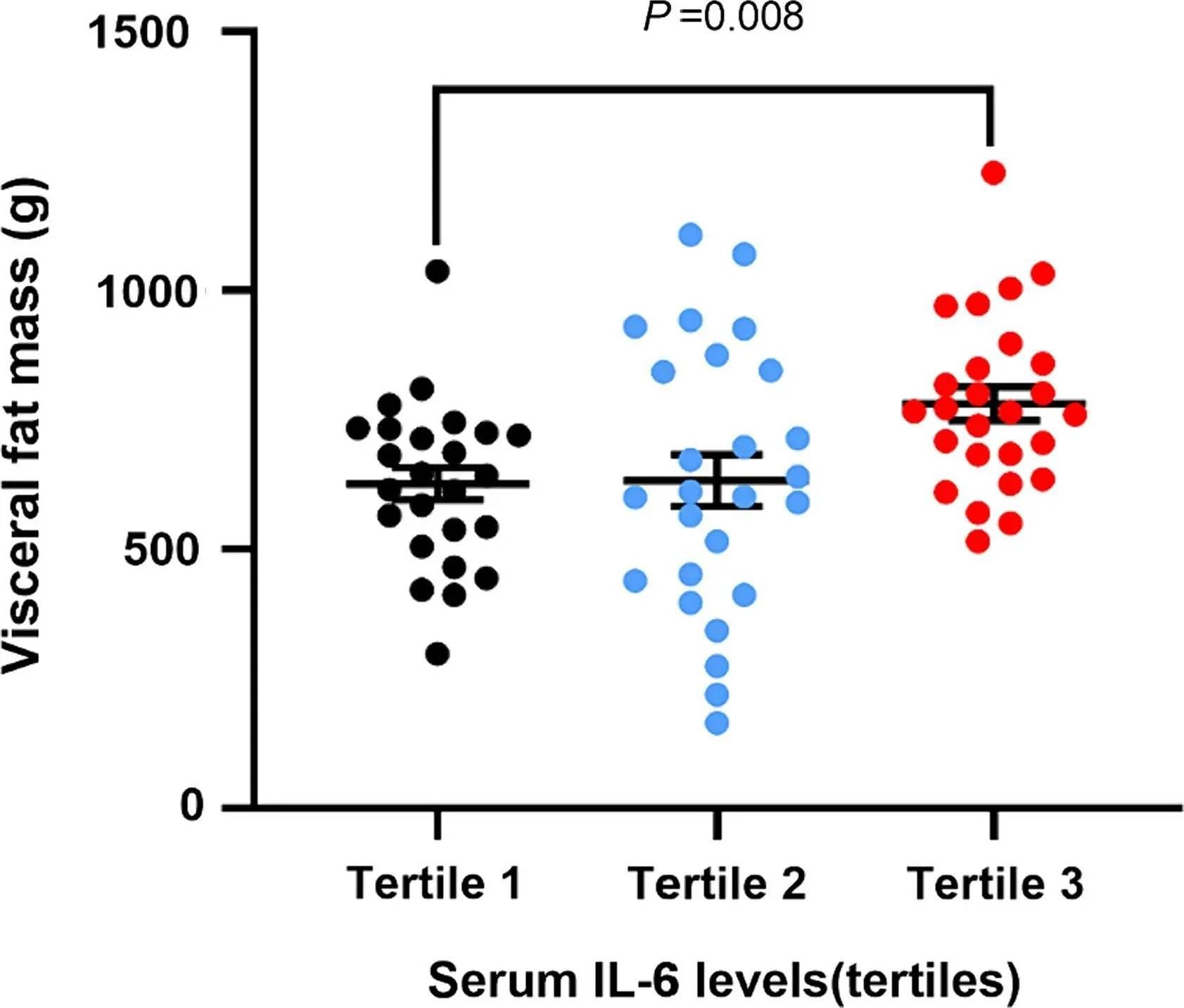
- Marker selection: hsCRP is only one of several inflammation-linked measures. Ferritin, white blood cell count, IL-6, or uric acid can provide complementary signals of immune tone and metabolic stress.
Takeaway: Even a standard marker like hsCRP can become a practical tool when you view it as part of a trajectory instead of a static number.
Acting on small deviations today—through sleep, diet, body composition, and environment—can change your aging trajectory years before the healthcare system could intervene.
The challenge is scaling this perspective across many markers.
How do you weigh shifts in insulin, glucose, and inflammation together? How do you separate lab variation from true decline? And what other markers should you be looking at and acting on before they reach clinical thresholds?
That’s where the Vault SPIRAL System comes in: my framework designed to capture not just one number, but the patterns across time, across markers, relative to your own baseline, and how to take action.
VAULT SPIRAL—The 6-Step System To Detect Early Aging from Routine Labs & Reverse Course
Most decline starts inside the normal range. SPIRAL shows you where to act early.
The Prevention Gap Most Adults Face
Everyone understands that prevention is better than treatment.
Yet most people inevitably wait for “abnormal” lab results before taking action on their health.
The challenge isn’t knowing that normal ranges aren’t optimal—it’s knowing how to systematically move from your current normal toward your personal optimal.
SPIRAL bridges that gap.
It transforms routine bloodwork from a static health snapshot into a dynamic tool for early detection and course correction, years before conventional medicine would intervene.
The complete SPIRAL system includes the step-by-step framework plus implementation worksheets, tracking templates, and optimization reference guides for 12 key markers where longevity-optimal ranges differ from standard “normal” ranges.

What You Get With SPIRAL
The Complete Framework: My systematic 6-step methodology for reading early decline lab patterns that conventional medicine overlooks.
Includes a 14-day money-back period — full refund on request at support@thelongevityvault.com.
12 Critical Markers Analysis: Longevity-optimal ranges for hsCRP, fasting insulin, triglycerides, WBC, and 8 other markers where normal isn’t optimal.
Complete Implementation Workbook:
- Quick Command System for rapid lab reviews
- Intelligence Center with optimization priority frameworks
- Step-by-step analysis worksheets for systematic evaluation
- Context Assessment Scanner to distinguish temporary fluctuations from genuine changes
- Integration Pattern Analyzer for reading marker relationships
- Action Logic Planner with two-phase response protocols
- Long-term Progress Tracking with quarterly optimization dashboards
- Professional Consultation Decision Tree for complex patterns
Personal Biology Manual: Framework for documenting what affects your unique physiology and what reliably restores your baseline.
Upgrade to Vault Insider Exclusive to unlock the full (& growing)catalog of Exclusive Resources including the SPIRAL Framework so you can detect early aging from your routine labs & reverse course. Vault Insiders also receive all future digital tools for the year.
Alternatively, if you’d like to access the complete SPIRAL System & Implementation Workbook as a one-time option, you can do so here:
How To Get Lab Tests:
All SPIRAL markers are standard blood tests that clinicians and national labs can run (relatively inexpensively).
Inside the SPIRAL system, you’ll get a marker list plus access to the Vault SPIRAL Companion Lab Shop, which bundles the recommended markers into ready-to-order panels you can use in most U.S. states.
You can also take the same marker list to your own physician or a national lab service (such as Quest or Labcorp) and run the tests through your usual channels.
Just a reminder that direct self-ordering has state-specific limitations (for example, the Vault Lab Shop is not available for self ordering in NY, NJ, or RI), and different services have different rules, but the portals will automatically show what’s available for your location.
Frequently Asked Questions
Why do normal lab results miss early signs of aging?
Lab reference ranges are designed to catch established disease—conditions like diabetes, kidney impairment, and anemia—not the earlier biological changes that matter for longevity. The thresholds are set where the healthcare infrastructure can act efficiently, and a result within range triggers no follow-up, even when a value has moved meaningfully from your own historical baseline.
Does an hsCRP of 2.0 mg/L matter for longevity even when a doctor says it’s fine?
From a longevity perspective, an hsCRP of 2.0 mg/L reflects elevated inflammatory load compared to truly low-risk individuals, even if standard review finds nothing actionable. Sleep quality, dietary patterns, body composition, and environmental exposures all influence this marker—making it a practical starting point before values reach a practical threshold.
My fasting insulin doubled but is still in the normal range—does that matter?
When fasting insulin moves from 6 to 12 μIU/mL, it stays within the laboratory reference range of 2–25 μIU/mL, so practical guidelines provide no defined response—insurance doesn’t cover follow-up testing for “normal” results, and there’s no established timeframe for reassessment. The likely outcome is documentation and deferral until values cross the abnormal boundary, which is why this type of pattern tends to be invisible to standard care.
How do I use blood work trends over time to catch early aging?
A fourfold increase from your own historical baseline carries different meaning than a single snapshot compared to a broad population range—personal trajectory is information that standard lab review isn’t designed to use. hsCRP paired with rising fasting glucose or triglycerides, for example, points to broader metabolic strain rather than a transient fluctuation, and persistence over time matters more than any single reading.