

The assumption that worsening sleep after midlife is inevitable because hormone levels decline misses a large part of the picture. Decline and impairment operate differently—and the distinction matters because the vast majority of what impairs hormone function is modifiable. This is why some adults at 70+ sleep well while others at 40 struggle.
- Age is one variable among 10–15 disruption categories per hormone—and often not the dominant one
- The HPG axis (the brain’s instruction loop that triggers testosterone production via GnRH → LH) can be compromised independently of age, causing production to drop even when the body is capable of producing it
- SHBG dysregulation—both high and low levels—destabilizes how much testosterone is available to support sleep, and can occur at any age
- Progesterone’s calming effect on sleep depends on its conversion into allopregnanolone via the 5-alpha-reductase enzyme; when this conversion is disrupted, the sleep-stabilizing effect is lost regardless of circulating progesterone levels
- Estrogen clearance can be impaired by genetic variants (COMT, MTHFR), liver processing bottlenecks, or gut microbiome disruptions—affecting both men and women, at any age
Is Sleep Decline just age—or something you can still change?
The belief that worsening sleep after midlife is “just age” is one of the most common—and most incomplete—explanations for fragmented, shallow sleep. While hormone levels do decline with age, decline does not equal dysfunction. Some adults at 70+ sleep well while others at 40 struggle, because age is just one variable among 10–15 categories of disruption factors that affect each hormone’s ability to support sleep. For testosterone alone, the Sleep OS program examines 15 disruption categories in men and 15 in women—age is one of them, and often not the most influential. Examples of age-independent disruptors include HPG signaling disruptions (where the brain’s instruction loop for testosterone production is compromised), SHBG dysregulation (where both high and low binding protein levels destabilize hormone availability), excess aromatization (where testosterone converts too aggressively into estrogen), progesterone conversion failure (where the enzyme needed to produce the sleep-stabilizing compound allopregnanolone is impaired), and estrogen clearance bottlenecks (where genetic variants or liver processing issues allow estrogen to recirculate).
Key Takeaways:
- Hormone decline with age is real, but decline does not equal impairment—most disruption factors are modifiable and age-independent
- For testosterone, there are 15 categories of disruption factors per gender; age is just one
- HPG axis signaling, SHBG dysregulation, excess aromatization, progesterone conversion failure, and estrogen clearance issues all affect sleep independently of age
- The question isn’t “Can I get 30-year-old hormones back?” but “Which forces shaping my hormone function over the last 10–20 years can still be changed?”
- Waking between 2–4 AM, hitting a 5–6 hour ceiling, and feeling more exhausted than your tracker suggests is almost always more than just age
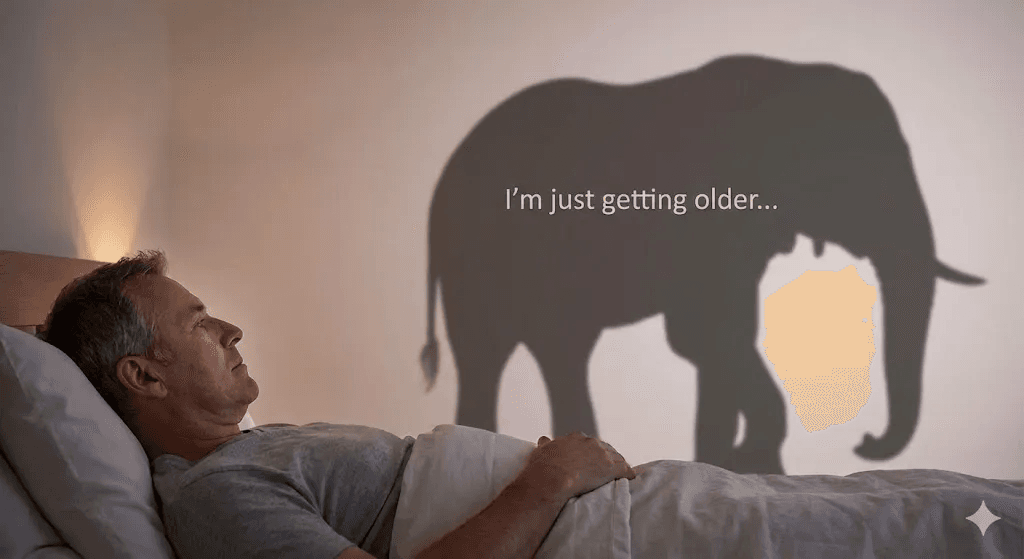
There is a thought that stops many of us from fixing our sleep. The “Elephant in the Room” of midlife health:
“I’m just getting older. My hormones are naturally declining. This is just how it is now.”
I want to challenge that today.
Hormone levels may decline with age, but decline does not have to mean impairment or dysfunction.
This is why some adults at 70+ still sleep well while others at 40 struggle.
Inside SleepOS Hormones, we examine and help you address ‘hormone disruptors’—the factors that impair hormone function and fragment sleep.
And, when we look at any single hormone through this lens, age is indeed a contributor.
It is, however, just one variable among many, and rarely the largest.
Take testosterone: We examine 15 categories of disruption factors in men and 15 in women—age is merely one of them. Across Estrogen, Progesterone, we also examine and address 10-15 disruption categories per hormone.
(And yes, every hormone has disruption factors for both men and women because normal physiology involves all hormones at different baselines.)
The vast majority of the other factors are modifiable—independent of age.
Here are a few examples of disruption factors that significantly impact hormone function but aren’t age-dependent (meaning they can occur at any age and be addressed at any age):
What Testosterone Disruptions Affect Sleep in Midlife?
How Do Hypothalamic-Pituitary-Gonadal Disruptions Affect Testosterone and Sleep?
Testosterone production begins in the brain, not the testes.
The HPG axis is the instruction loop (GnRH → LH) that tells the body to produce testosterone.
Even when the testes are capable of producing testosterone, the instruction itself can be compromised — meaning production was never triggered.
Although aging is one factor that can influence HPG signaling, it is often disrupted for several addressable factors unrelated to age.
(The HPG axis also influences estrogen)
How Does Low Free Testosterone Affect Sleep?
SHBG (sex hormone–binding globulin) is the transport protein that carries testosterone through the bloodstream.
You may have heard the phrase “high SHBG lowers free Testosterone” — that is true, but lower SHBG is not better.
Low SHBG often reflects an internal environment where hormone signaling becomes less stable or more erratic.
Both high and low SHBG levels represent dysregulation: Low T weakens sleep stability, while high T can disrupt it.
This disruption can occur at any age — and can be addressed at any age.
(SHBG dynamics also impact estrogen.)
How Does Excess Aromatization of Testosterone Affect Sleep?
Aromatase is a normal enzyme that converts testosterone into estrogen. This is part of natural and healthy physiology in men and women.
However, when the process of aromatization becomes dysregulated, this can create a “double pattern”: low testosterone support at night and rising estrogen-like activity at the same time.
Several modifiable, age-independent factors can cause excess aromatization (and it is not taking aromatase inhibitors).
Sleep OS Hormones is now available as a 60-day self-guided program with dedicated systems for estrogen, progesterone, and testosterone, or bundled together for a more complete approach.
How Does Disrupted Progesterone Conversion Affect Sleep?
For progesterone to exert its calming effect, it must convert into allopregnanolone— a compound that stabilizes the brain’s GABA system.
This conversion depends on the 5-alpha-reductase enzyme.
When this conversion process is disrupted — progesterone cannot generate its sleep-stabilizing effect.
This affects both men and women, and can be disrupted for several addressable factors reasons unrelated to age
How Does Impaired Estrogen Detoxification Affect Sleep?
Once estrogen has performed its job, it must be packaged and cleared by the liver.
Some adults have genetic variants (COMT, MTHFR) and liver-processing bottlenecks that impair estrogen clearance. Others have gut microbiome disruptions that prevent elimination, allowing estrogen to recirculate.
This creates excess estrogen activity disruptive to normal sleep physiology.
Estrogen clearance issues can occur in both men and women at any age, and they can be addressed at any age.
So now you see, when we examine hormone disruption in midlife and beyond, age is not the most influential factor—it is just the one that gets talked about the most.
That has two implications.
- First, if your sleep looks like this— waking between 2–4 a.m., hitting a hard 5–6-hour ceiling, and feeling more exhausted than your tracker suggests—then “it’s just age” is almost always an incomplete explanation.
- Second, it means there is still room to move the system.
SleepOS Hormones doesn’t divide people into ‘high T vs low T’ or ‘on HRT vs not’ or ‘in (peri) menopause’ or ‘not in (peri) menopause’ and stop there.
It builds disruption profiles for testosterone, estrogen, and progesterone in midlife and beyond, then walks you through resolving the modifiable disruptors so your hormones can support sleep.
So the question is not, “Can I get thirty-year-old hormones back?”

A better question is:
“What has been shaping my hormone function over the last 10–20 years—and which of those forces can still be changed over the next 60–120 days and set the stage for the next 10-20 years of optimal hormonal health & restorative sleep?”
That is what Sleep OS: Hormones is build to help you do.
Inside the program, you’ll identify:
- Where age sits on your specific susceptibility map
- Which additional factors are most amplifying hormone-related sleep disruption in your case—and the specific steps to resolve them
- How testosterone, estrogen, and progesterone each contribute differently to 3 a.m. wakeups and 5–6-hour ceilings
From there, the implementation sequences take those insights and turn them into a , stepwise plan: how to support hormone production, handling, and clearance under real-world constraints, in an order that makes sense for someone who is not 25 and does not live a laboratory lifestyle.
If you have been assuming that your sleep is “just age,” and you suspect there is more going on under the surface, this is the step I invite you to take.
Age is part of the story.
But for the kind of person who reads this far—someone who takes ownership and wants to understand the system—it is a surprisingly small part.
P.S. Many of you wrote to say you missed the early Charter Access window. While that founding period has ended, I am opening an exclusive seasonal access window (until 12/1) for this list today to help you get started.
This gives you access to the Trio Hormone Sleep Solution & Duo Hormone Sleep Solution at a preferred investment level, using your private codes below, so you can see the full categories of hormone disruptors and start addressing them one by one.
Access the Trio (Testosterone, Progesterone, Estrogen) system here (code: TRIO15)
Access the Duo (Progesterone, Estrogen) system here (code: DUO15)
FAQ
Q: If my hormones are naturally declining, isn’t poor sleep just inevitable? A: No. Decline is one variable among many. The vast majority of factors that impair hormone function—are modifiable at any age. Some adults maintain excellent sleep architecture into their 70s and 80s because their hormone function, not just their hormone levels, remains intact.
Q: What’s the difference between hormone decline and hormone dysfunction? A: Decline refers to lower circulating levels—a natural part of aging. Dysfunction refers to impaired hormone production, conversion, transport, receptor sensitivity, or clearance. You can have declined levels that still function well (adequate sleep), or “normal” levels with dysfunction at multiple points in the cascade (poor sleep).
Q: What is HPG axis disruption and why does it matter for sleep? A: The HPG (Hypothalamic-Pituitary-Gonadal) axis is the brain’s instruction loop that triggers hormone production. GnRH signals LH, which tells the testes or ovaries to produce hormones. If this signaling is compromised—by chronic stress, sleep debt, metabolic issues—production drops even when the organs are capable. This is often mistaken for age-related decline when it’s actually a signaling problem with addressable causes.
Q: Can I improve hormone-related sleep disruption without hormone replacement therapy? A: In many cases, yes. Because most disruption factors are modifiable—conversion enzyme support, clearance pathway optimization, stress reduction, metabolic health improvements—addressing these can restore hormone function without supplementation. If you’re already on HRT, addressing these same factors often improves how well your supplemented hormones work.
Q: How long does it take to see sleep improvements from addressing hormone disruptors? A: Many people notice changes within 2–4 weeks of addressing the most impactful disruptors. The Sleep OS program is structured as a 60–120 day process because some changes (particularly metabolic and gut-related factors) require longer to stabilize.