

The challenge in addressing poor sleep is not finding more things to try—it’s finding the right thing for your specific situation. Sleep trackers show the signatures of poor sleep but estimate stages at only 60-70% accuracy and cannot explain why. Your lived disruption pattern—morning vitality, cognitive function, how rested you feel—reflects what these tools miss: the underlying recovery and brain waste-clearance processes that determine next-day function.
- Consumer sleep trackers estimate sleep stages at approximately 60-70% accuracy and miss subtleties such as the quality of REM sleep and its role in brain protection; lab tests show only static snapshots of a dynamic, nightly process.
- Three disruption patterns appear frequently in midlife adults: the Fragmentation Architecture (2-4 AM wake-ups with a racing mind, or truncated 5-6 hours regardless of bedtime), the Stress-Response Mismatch (wired and tired at night or at 3 AM), and the Hormonal Timing Signature (sleep troubles beginning or worsening around midlife hormonal transitions).
- Testosterone, progesterone, and estrogen influence the circadian rhythm, metabolic balance, and the stress axis; when these are unsupported, addressing secondary factors like sleep hygiene has limited effect on the outcome.
- The 90% sleep solution involves identifying the one factor that, when addressed, resolves 90% of sleep disruption—rather than pursuing multiple approaches without addressing the primary issue.
- SleepOS Hormones addresses hormonal pathways through non-pharmaceutical, self-paced strategies synthesized from 170+ peer-reviewed references for testosterone, 220+ for estrogen, and 150+ for progesterone.
What Is the “90% Sleep Solution” Approach?
Your 90% sleep solution comes from identifying the one factor that, when addressed, accounts for the majority of your sleep disruption. Rather than optimizing every variable simultaneously, this approach narrows the investigation to the primary driver — the input that, once resolved, often improves the secondary ones.
Welcome to the 5th and Final part of the Vault Sleep Clarity Series.
In part 4, the question we ended with was: “How do I figure out what to do instead of just finding the next things to try?”
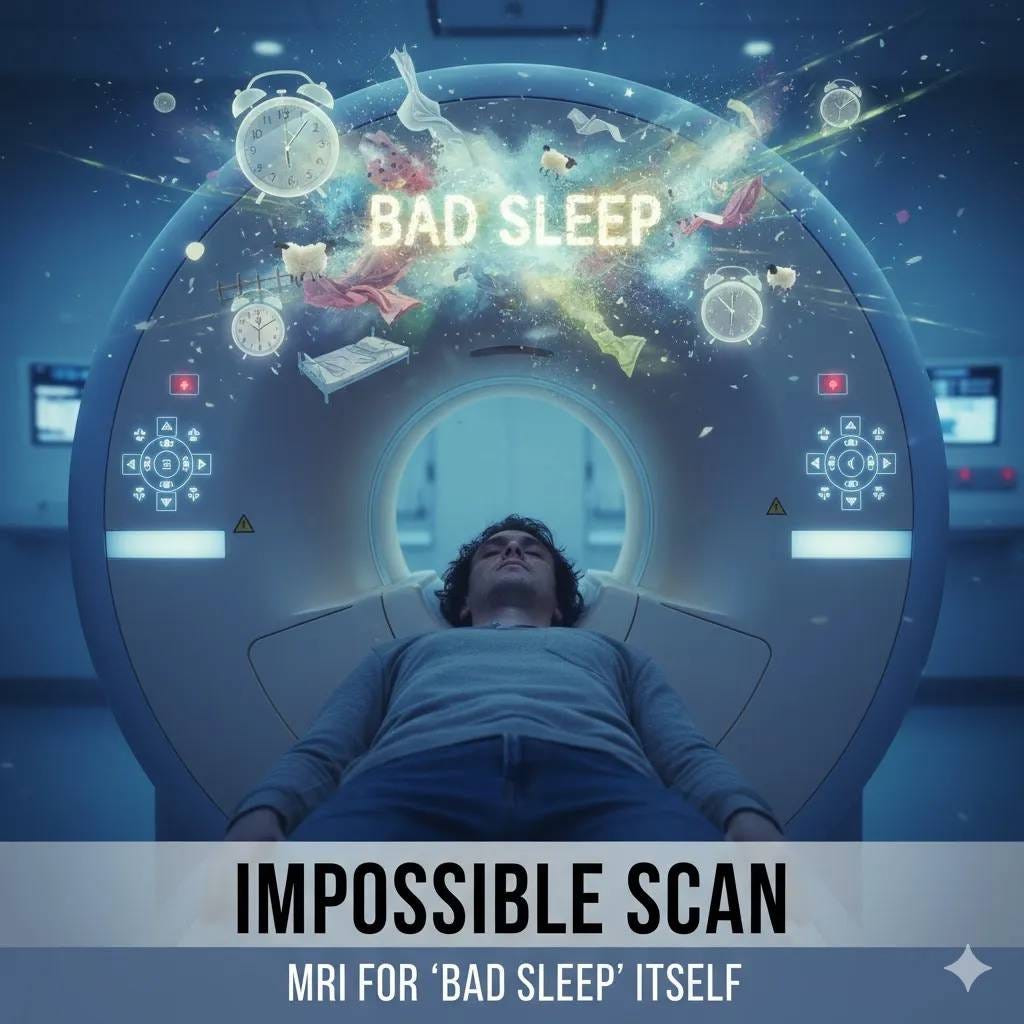
Why Can’t You Get an Imaging Scan for Bad Sleep?
If your back hurts, you can get an image and see the structural cause. Sleep disruption has no equivalent — no single test reveals the primary driver. This is why many people cycle through solutions without improvement: each approach targets one variable without knowing whether that variable is the central one.
If your back hurts, you can get an image. You can see the slipped disc, the compressed nerve. The type of back issue informs the solution.
Sleep has almost none of this.
(This is, of course, distinct from medical sleep disorders like sleep apnea which can and should be diagnosed clinically.)
So, if we don’t have an MRI, what tool do we use?
Your sleep disruption pattern.
This may sound counter-intuitive in an age of increasingly sophisticated lab tests and sleep trackers, but your lived experience—morning vitality, cognitive clarity, gym performance, mood stability, and how rested you feel—remains the essential indicator of sleep quality.
- Consumer sleep trackers can show you the signatures of poor sleep—low HRV, reduced REM, fragmented stages—but they can’t tell you why. They’re not the “MRI” for sleep.
- They also estimate stages with reported ~60-70% accuracy and miss the subtleties, such as the quality of REM sleep and its critical role in brain protection.
- Labs show static snapshots and are unable to capture the dynamic, nightly process of sleep.
Sleep pattern recognition reflects what these tools miss: It reveals the underlying recovery and brain waste-clearance processes that determine next-day function.
The sleep disruption pattern points to the problem(s)—and the problem(s) informs the solution(s).
A 2-4 AM wake-up with a racing mind is a different pattern—and points to different problems —than an inability to fall asleep.
Not being able to sleep more than 5-6 hours (regardless of when you go to bed) points to yet another problem. Waking up hungry at 3 AM is a different pattern still.
How Do You Find Your 90% Sleep Problem?
The 90% sleep solution comes from identifying the one factor that, when addressed, resolves the majority of your disruption. In midlife, this primary driver tends to fall into one of several categories: hormonal changes affecting sleep architecture, circadian misalignment, metabolic instability during the overnight fast, or autonomic dysregulation from accumulated stress.
Your 90% sleep solution comes from identifying the one factor that, when addressed, resolves 90% of your sleep disruption.
I cannot tell you your specific 90% problem in a single email (or in a series of 1-many emails such as this).
But I can show you the patterns I see most often in health-literate adults like yourself in midlife and beyond.
Let’s see if these sound familiar:
The Fragmentation Architecture
- Do you wake between 2-4 AM with a racing mind?
- Do you get a truncated 5-6 hours of sleep, regardless of when you go to bed?
- Do you have more problems staying asleep than falling asleep?
- Do you wake up un-refreshed?
The Stress-Response Mismatch
- Do you get “wired and tired” at night or at 3 AM—even though your actual life stressors haven’t changed much?
- Do you feel the same stress more intensely—more anxious, worried than before?
- Does your body react more to stress—racing heart, difficulty calming down, or longer recovery time?
The Hormonal Timing Signature
- Did your sleep troubles start or get noticeably worse around a mid-life hormonal transition (testosterone changes, perimenopause, menopause)?
- Men: Are you experiencing more early-morning awakenings and lower morning motivation?
- Women: Are you experiencing fragmented sleep around cycle changes or feeling warmer at night?
If some of these feel familiar, you may be seeing the same pattern I see in many of the individuals I work with—in many of those who already eat well, exercise and mind sleep hygiene—a big part of their 90% problem relates to hormonal shifts that now benefit from more targeted support.
Many mistake this for a “stress” problem, but stress response to similar stressors doesn’t get worse in midlife on its own.
What has often changed is that the physiological systems buffered by testosterone, estrogen and progesterone become more susceptible to disruption and benefit from deliberate support.
You are now feeling that same stress more acutely, and it is fragmenting your sleep.
What Is the “Hormonal Ceiling” in Midlife Sleep?
For many adults in midlife, a hormonal change is the ceiling that no amount of sleep hygiene can address. Testosterone, estrogen, and progesterone each influence sleep depth, continuity, and autonomic recovery — and when these change in midlife, the tools that worked before (melatonin, cooling, routines) stop producing the same result because they target the wrong variable.
Testosterone, progesterone, and estrogen are foundational. They broadly influence systems critical to sleep: your circadian rhythm, your metabolic balance, and your nervous system’s stress axis.
When these systems are unsupported, it doesn’t matter how well you manage sleep hygiene. You are trying to fix secondary factors while the 90% problem is still acting as a ceiling on your results.
What Does “Precise Comprehensiveness” Mean for Sleep?
Precise comprehensiveness means examining the full picture of what affects your sleep while narrowing to the specific driver that matters for you. It combines breadth (understanding all the categories that can disrupt sleep) with precision (identifying which one is primary in your case) — and it is the reason a framework-based approach produces different results than trying individual fixes.
This is the clarity we’ve been working toward.
Finding your 90% problem informs your “Precise Comprehensiveness.” It tells you which Builders and Disruptors matter most.
This was my goal for this 5-part series: to give you the lens to move from trying everything to the clarity of what to do.
What Are 3 Paths Forward Once You Identify Your Primary Sleep Driver?
Three paths match different needs: mapping the driver yourself using the framework and doing your own research, following a structured program that provides the implementation tools for a hormonal pattern, or working with a guided process that handles the investigation and implementation together. Each path has trade-offs in time, cost, and depth.
What Does the Self-Directed Path to Sleep Recovery Look Like?
You now have the framework. This path is for those who want to do the research, identify their primary driver, and build their own implementation plan. It requires the greatest time and effort, but produces the deepest individual understanding of what is driving your sleep disruption and what to do about it.
You now have the framework. This path is for those who want to do the deep research and self-investigation. Your process might look something like this:
- Identify Your 90% Problem: Use the pattern recognition questions from this series. Go deeper: journal your sleep, energy, and cognitive clarity for 2-3 weeks. If your patterns differ significantly from the one described, remember: different patterns point to different ‘sources’ of poor sleep.
- Consider Lab Testing: Based on your pattern, you may choose to run relevant blood or functional tests (e.g., inflammation markers, advanced cortisol profiling, metabolic markers, continuous glucose monitor) to help identify additional clues.
- Map Your System: Learn the mechanism of your 90% problem. Then use that understanding to identify which factors are Builders and which are Disruptors for your 90% problem (this can involve synthesizing primary research, typically 75-100+ peer-reviewed studies).
- Execute “Precise Comprehensiveness”: Address your specific Disruptors and implement the right Builders—applied in a biologically appropriate sequence. This isn’t just doing the things; it’s doing them in the right order so each step builds the physiological conditions for the next. This also includes ongoing protocol management: analyzing inputs, iterating based on response, and making these changes sustainable as your default over time.
What Is the Structured Path for Hormonal Sleep Disruption?
If the hormonal pattern resonated — midlife changes, wired-and-tired at 3 a.m., or anxious waking — this path provides the implementation framework for testosterone, estrogen, and progesterone-related sleep disruption. It includes the decision tools, lab guidance, and step-by-step sequences for addressing each hormonal input.
If that pattern—midlife changes, wired and tired, or anxious at 3 AM—resonated, your path can be focused.
Your 90% solution involves supporting the hormonal systems that govern sleep & stress architecture
This is SleepOS Hormones. It is the step-by-step “doing” plan to address this specific 90% problem with precise comprehensiveness.
- You can view my most comprehensive and popular Trio Hormone Sleep Solution
- Or, start with the essential Sleep & Stress Single Hormone Solution
All programs are self-paced, self-contained, and do not require lab work.
What Is the Fully Guided Path for Sleep Recovery?
For those who prefer a guided process rather than self-directed research, this path provides a structured program that handles the investigation and implementation together. It trades time investment for direction — less personal research, more structured execution within a proven framework.
What if you’re time-constrained and prefer a fully guided process instead of years of self-investigation?
Or perhaps you need help identifying your 90% problem in the first place?
I work with a small number of clients each quarter on specifically this:
- Identifying your specific 90% problem (or multiple contributing factors)
- Mapping your Builders and Disruptors based on your unique physiology
- Building your fully personalized “doing” plan from the ground up.
If you’d like me as your mentor on this journey, you can learn more about my Sleep Clarity Mentorship Program & the application-only Sleep Recovery Concierge program here.
I sincerely hope this 5-part series has provided clarity for you.
This approach—finding your 90% problem instead of following universal protocols—is the core ethos of The Longevity Vault. I built it because I saw too many intelligent health-conscious individuals invest years—even decades—of energy on advice that isn’t relevant to their situation.
Having had poor sleep most of my adult life—and having solved it to experience the complete opposite—my passion is helping people make this transition to robust sleep.
Sleep that isn’t fragile. Sleep that can handle real life: an occasional late dinner, a stressful day, an occasional glass of wine.
Because it’s not just about the sleep itself.
It’s about the foundation for energy, intellectual curiosity, and longevity—the capacity to cook, garden, read, and play with your grandkids. It’s the confidence of knowing you’ll sleep well enough to show up as your best self tomorrow.
And it’s the mental freedom—the time and brainpower you’re no longer spending hunting for the next tip that gives you a “little, sometimes” result.
That energy goes back into the hobbies and people you love.
Until next time,
Kat
P.S. Optimal hormone function isn’t just about hormone levels—it’s also about hormone transport, the ability of hormones to be used at target tissues and cells, metabolism/clearance, and HPG/HPA signaling.
SleepOS Hormones addresses these pathways through non-pharmaceutical, self-paced strategies that require no prescriptions or appointments, as well as the disruptors of optimal hormone function.
(This system is synthesized using a biologically logical sequence—each step building the conditions for the next—from 170+ peer-reviewed references for testosterone, 220+ for estrogen, and 150+ for progesterone).
Sleep OS Hormones is now available as a 60-day self-guided program with dedicated systems for estrogen, progesterone, and testosterone, or bundled together for a more complete approach.
Frequently Asked Questions
Why can’t sleep trackers tell me why my sleep is disrupted?
Consumer sleep trackers estimate sleep stages with reported accuracy of around 60-70% and miss subtleties like the quality of REM sleep and its role in brain protection. They show the signatures of poor sleep—low HRV, reduced REM, fragmented stages—but cannot identify the underlying cause. Lab tests show static snapshots and are unable to capture the dynamic, nightly process of sleep. Your disruption pattern reflects what these tools miss: the recovery and brain waste-clearance processes that determine next-day function.
What does it mean when you wake up between 2 and 4 AM?
A 2-4 AM wake-up with a racing mind is a specific disruption pattern that points to different problems than an inability to fall asleep or a truncated 5-6 hours of sleep regardless of when you go to bed. Waking up hungry at 3 AM is yet another distinct pattern, pointing to a different set of issues. Each pattern reflects a different underlying problem, and identifying which pattern fits your experience is the foundation for finding your 90% sleep solution.
How do midlife hormonal changes affect sleep?
Testosterone, progesterone, and estrogen influence the circadian rhythm, metabolic balance, and the stress axis—all foundational to sleep. When these hormones are unsupported in midlife, the physiological buffers they once provided are reduced, and the same stressors can feel more intense and disrupt sleep. Men may notice early-morning awakenings and lower morning motivation; women may experience fragmented sleep around cycle changes or feeling warmer at night.
What is the 90% sleep solution?
The 90% sleep solution is the process of identifying the one factor that, when addressed, resolves the bulk of your sleep disruption—rather than addressing secondary factors while the primary problem remains unaddressed. Your sleep disruption pattern points to that primary problem: a 2-4 AM wake-up with a racing mind indicates different issues than an inability to sleep beyond 5-6 hours. Once identified, the 90% problem informs which specific actions—Builders and Disruptors—matter most for your physiology.